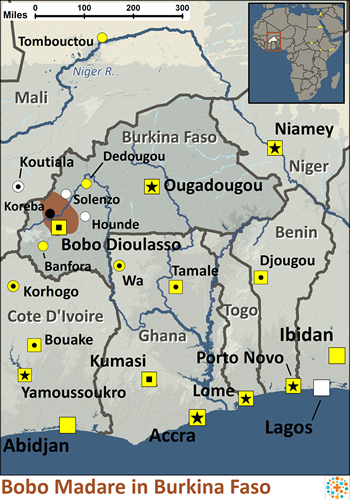
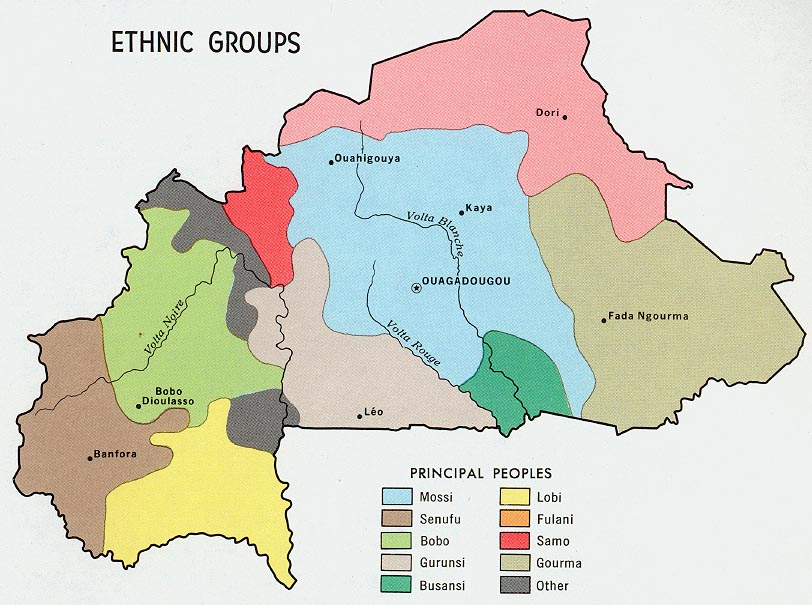
The Bobo Madare of Burkina Faso are part of the larger Bobo cultural cluster, a group with deep historical roots in the western regions of the country. Historically, the Bobo peoples are believed to have been among the early inhabitants of this area, settling long before the arrival of later dominant groups such as the Mossi. Over time, the Bobo Madare developed a distinct identity within the broader Bobo population, maintaining their own social structures, customs, and traditions.
The history of the Bobo Madare is closely tied to their agricultural way of life and their strong connection to the land. Traditionally, they have lived in small, organized villages led by local elders and lineage heads who provided social and spiritual guidance. Their society has been shaped by a decentralized structure, with authority resting more in family and clan relationships than in centralized political systems.
Like many groups in Burkina Faso, the Bobo Madare experienced external influences during the colonial period under French rule. Colonial administration introduced new political boundaries, economic systems, and limited infrastructure, but the Bobo Madare largely retained their traditional lifestyle in rural areas.
The language of the Bobo Madare is part of the Mande (or Mandé) language family, which is widespread across West Africa. Their specific language, often referred to as a variety of Bobo or closely related to Bobo Madare speech forms, serves as a primary means of communication within the community. It is used in everyday life, in the home, and in community gatherings, helping to preserve oral traditions, cultural knowledge, and social cohesion.
However, like many minority languages, the Bobo Madare language exists alongside more widely used regional and national languages. Dioula (Jula), a major trade language in Burkina Faso, is commonly used in markets and interethnic communication, while French serves as the official language of government, education, and formal settings. As a result, many Bobo Madare people may be multilingual, especially those who have greater interaction with urban centers or national institutions.
The primary occupation of the Bobo Madare is farming. They raise millet, sorghum, peanuts, tomatoes, a small number of chickens, goats and other livestock. Women and men join in the daily agricultural chores. Women are also responsible for all cooking, washing, childcare and obtaining water. Children are expected to help with chores at a very early age.
Recreational life among the Bobo Madare is closely intertwined with their social and cultural traditions. Leisure time is often limited due to the demands of agricultural work, but moments of relaxation are found in community gatherings and shared activities. Evenings may be spent in conversation, storytelling, or communal interaction within the village. Oral traditions remain important, helping to pass down history, values, and cultural identity from one generation to the next.
Festivals and ceremonies provide the most significant opportunities for recreation and celebration. These events are often linked to agricultural cycles, life events such as marriages, or traditional religious observances. During such times, the community gathers for music, dancing, and feasting. Traditional drums, masks, and performances may be featured, reflecting the rich cultural heritage of the Bobo people. These celebrations strengthen community bonds and provide a sense of continuity and identity.
Children and young people often engage in simple games and outdoor activities, while adults find enjoyment in socializing and participating in communal events. Shared work itself can also carry a social dimension, as groups of villagers may come together to assist one another in farming tasks, combining labor with fellowship.
The Bobo Madare people are primarily Sunni Muslims who believe that the supreme God, Allah, spoke through his prophet, Mohammed, and taught mankind how to live a righteous life through the Koran and the Hadith. To live a righteous life, you must utter the Shahada (a statement of faith), pray five times a day facing Mecca, fast from sunup to sundown during the month of Ramadan, give alms to the poor, and make a pilgrimage to Mecca if you have the means. Muslims are prohibited from drinking alcohol, eating pork, gambling, stealing, slandering and making idols. They gather for corporate prayer on Friday afternoons at a mosque, their place of worship.
The two main holidays for Sunni Muslims are Eid al Fitr, the breaking of the monthly fast and Eid al Adha, the celebration of Abraham's willingness to sacrifice his son to Allah.
Sunni religious practices are staid and simple. They believe that Allah has pre-determined our fates; they minimize free will.
In most of the Muslim world, especially in Africa, people depend on the spirit world for their daily needs since they regard Allah as too distant. Allah may determine their eternal salvation, but the spirits determine how well we live in our daily lives. For that reason, they must appease the spirits. They often use charms and amulets to help them with spiritual forces. Throughout their history, the Bobo Madare have preserved many traditional beliefs and practices, particularly those related to the spiritual world, ancestors, and the natural environment.
Education remains a privilege for only a few children and school enrollment creates a financial strain on families. Life remains challenging for the Bobo Madare. Malaria, measles, meningitis and malnutrition take many lives. Healthcare is often inaccessible and unaffordable.
Many churches have been established in the southern area of the Bobo Madare. Many people in the area have professed conversion to Christianity, but most of the population remains rooted in Islam and traditional animistic beliefs. They need open hearts.
Pray for the Lord to thrust out workers among these people and for persons of peace to welcome them.
Pray that the Lord would raise up church planters and disciplers among this people group and bring glory to Christ and his word.
References
Scripture Prayers for the Bobo Madare in Burkina Faso.
| Profile Source: Joshua Project |