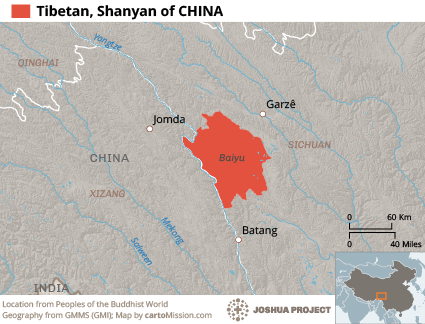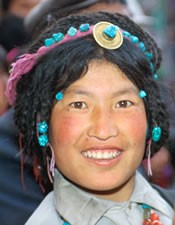

People living in the extraordinarily remote Shanyan District of Baiyu County in China's Sichuan Province belong to the little-known Shanyan Tibetan ethnic group. The Chinese government does not differentiate between the Shanyan Tibetans and the main Tibetan nationality. The Tibetan name for Shanyan means 'rough terrain '.
The Shanyan Tibetans are culturally, ethnically and linguistically different from the Khampa Tibetans who also live in this remote region. When talking about his ancestors, a Shanyan Tibetan named Dorji Wengxiong said, 'We came from areas on the upper reaches of the Yarlung Zangbo River in present-day Nghari Prefecture in Tibet. We are Tibetans and not local Khampa people. Our ancestors kept moving east until they came to the Jinsha River. So far, we have lived here for 40 to 50 generations.' Although historically the Shanyan Tibetans came from far western Tibet, their present home is a vast distance of more than 1,000 kilometers (620 mi.) from their original homeland. The hundreds of years of separation have resulted in the Shanyan Tibetans evolving into a distinct people group with a language no longer intelligible with Nghari Tibetan varieties. It was not until October 1910 that the Shanyan Tibetans finally came under Chinese rule.
Among the Shanyan Tibetans of China, recreational activities are closely linked to their cultural traditions, highland environment, and strong sense of community. Leisure is not highly separated from daily life but is woven into seasonal rhythms, social gatherings, and religious observances.
Men often spend their free time in communal settings, where conversation, storytelling, and the sharing of local news play an important role in maintaining social bonds. Traditional games and contests, including tests of strength or skill, may be enjoyed during periods of rest or during community gatherings. Horse-related activities, such as riding or informal racing, can also serve as a form of recreation in areas where livestock plays a central role in daily life.
Women primarily engage in recreational activities that overlap with their social and domestic responsibilities. Visiting neighboring households, singing traditional Tibetan songs, and participating in cooperative work provide opportunities for relaxation and companionship. Music and song are especially valued, often reflecting themes of faith, nature, and community life.
Children typically create their own games using the natural environment, playing in groups and imitating adult roles in pastoral or agricultural life. These activities foster both creativity and a sense of belonging within the community.
Festivals and religious celebrations provide the most significant expressions of recreation among the Shanyan Tibetans. During these times, the community participates in traditional dancing, chanting, and ceremonial events connected to Tibetan Buddhist practices. Colorful gatherings, shared meals, and collective participation reinforce both cultural identity and spiritual values.
Most Shanyan Tibetans are Buddhists of the Nyima sect. They "seldom invite lamas to chant sutras for them, as is required for religious events in other areas. Instead, they do it themselves while drinking. In old times, before setting off for a battle, all adult males would gather to slaughter an ox, drink and chant sutras. After drinking, they took an oath. Then, with a string of prayer beads or a pebble, they practiced divination to predicate their luck in the battle."
The Shanyan Tibetans are completely unreached by the gospel. Like people everywhere, the Shanyan Tibetans people need to allow the loving savior to direct their lives. They need his forgiveness for sin.
Pray for the Lord to intervene in their families, calling people to his side.
Pray for bold workers who are driven by the love of the Holy Spirit to go to them.
Pray for their hearts to be drawn to the Lord of lords.
Pray for a church planting movement to thrive in their communities.
Scripture Prayers for the Tibetan, Shanyan in China.
Peoples of the Buddhist World, Asia Harvest, Copyrighted © Used with permission
| Profile Source: Joshua Project |