


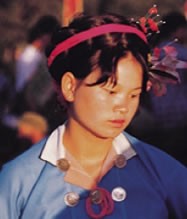

The Northwestern Guiyang Miao are one of the many distinct branches of the larger Miao ethnic family living in Guizhou Province in southwestern China. They are found mainly in counties west of Guiyang City, including Qianxi, Pingba, Qingzhen, and surrounding mountain regions. Their language belongs to the Guiyang branch of the Hmong-Mien language family and is recognized as a separate Northwestern variety within the broader Guiyang Miao cluster.
The Miao peoples have a long and difficult history in China. Historical records and oral traditions describe centuries of migration, conflict, and displacement as Han Chinese expansion pushed many Miao communities into remote mountain regions. During the eighteenth and nineteenth centuries, violent military campaigns were launched against various Miao groups in Guizhou, resulting in devastating loss of life and forced relocation into less fertile highland areas.
Because of their relative isolation in mountainous regions, the Northwestern Guiyang Miao preserved distinct language patterns, customs, oral traditions, and spiritual beliefs that differ from neighboring populations. Their identity remains closely tied to family lineage, village relationships, and traditional Miao culture.
Most Northwestern Guiyang Miao traditionally live in mountain villages surrounded by steep hills, forests, and terraced farmland in Guizhou Province. Agriculture remains central to daily life, with families growing crops such as rice, corn, sweet potatoes, and vegetables adapted to the mountain environment. Some families also raise livestock including pigs, chickens, and cattle.
Village life is strongly community-oriented. Extended families often remain closely connected, and cooperation between relatives and neighbors is important for farming, building homes, and organizing festivals. Traditional Miao villages are known for wooden houses built along mountain slopes and for preserving colorful cultural customs, music, embroidery, silver ornamentation, and dance traditions.
Food commonly includes rice, corn, vegetables, preserved meats, and spicy dishes typical of Guizhou cuisine. Festivals and ceremonies are major parts of community life and often involve singing, dancing, traditional clothing, and ritual observances connected to ancestors and local spiritual beliefs.
Traditional beliefs about spirits and supernatural protection still influence many aspects of family life. Some Miao customs surrounding childbirth and illness reflect fear of evil spirits and the need for ritual protection.
Economic opportunities can be limited in isolated mountain areas. Some younger people migrate to cities for work, but rural communities may still face challenges related to healthcare access, transportation, education, and poverty.
The Northwestern Guiyang Miao traditionally practice a mixture of animism, ancestor reverence, and folk religion. Their worldview includes belief in numerous spirits and supernatural forces that influence health, crops, fertility, and daily life. Rituals, offerings, and ceremonies are often performed to seek blessing, avoid misfortune, or protect families from harmful spiritual powers.
Traditional Miao cosmology teaches that heaven is a real place inhabited by ancestors and spiritual beings. Some oral traditions describe a past connection between heaven and earth that was later broken, separating humanity from the spiritual world.
Fear of demons and unseen spirits continues to shape many customs and superstitions. Ritual specialists and traditional healers may be consulted during sickness, childbirth, family crises, or agricultural difficulties.
Very few Northwestern Guiyang Miao have heard a clear biblical presentation of the gospel. Earlier Protestant missionary efforts in the broader Guiyang region had very limited response among some Miao communities, and many villages remained isolated from meaningful Christian witness.
The Northwestern Guiyang Miao need faithful access to the gospel through Scripture, discipleship, audio resources, and compassionate Christian witness presented in their own language and cultural setting. Many have never heard biblical teaching clearly explained in a way they can fully understand.
Practical needs include healthcare access, educational opportunities, transportation infrastructure, and economic support for remote mountain communities. Geographic isolation and poverty continue to affect many villages in Guizhou's highland regions.
There is also a strong need for spiritually mature believers who can disciple local Christians and establish biblically grounded churches free from syncretism with animistic traditions. Oral Bible teaching, translated Scripture resources, and long-term relational ministry are especially important among communities with strong oral traditions and limited literacy.
Pray that the Northwestern Guiyang Miao will hear a clear and understandable presentation of the gospel in their own language.
Pray that God will raise up compassionate Christian workers who are willing to serve faithfully among the mountain villages of the Northwestern Guiyang Miao.
Pray that the Northwestern Guiyang Miao will be adopted through the People Group Adoption program so that ongoing prayer and future gospel engagement will continue among them.
Pray that believers among the Miao peoples of China will grow strong in biblical faith and faithfully share the truth of Jesus Christ with neighboring Miao communities.
Scripture Prayers for the Miao, Guiyang Northwestern in China.
https://people-groups.asiaharvest.org/China/chinaPeoples/M/MiaoGuiyangNorthwestern.pdf
https://en.wikipedia.org/wiki/Guiyang_Miao_language
https://english.scio.gov.cn/m/chinafacts/2017-04/17/content_40636437.htm
https://globalrecordings.net/en/language/huj
https://en.people.cn/n3/2024/0527/c90000-20174482.html
| Profile Source: Joshua Project |



