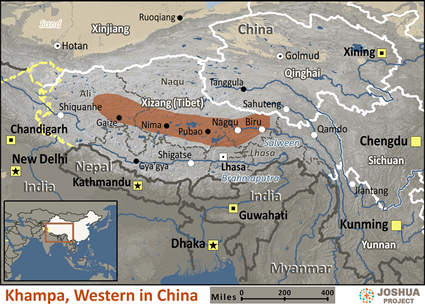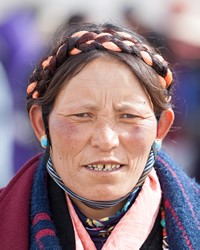

Approximately 205,000 Tibetans living in the massive Nghari Prefecture in central and northern Tibet speak the Western Khampa language. They have "a very sparse population in a band to the northeast and extending to the north of almost the entire central Tibetan area." The region is mostly a high, desolate plateau. "At 17,000 feet [5,180 meters], the rarefied atmosphere has only half as many oxygen particles as at sea level. As early as AD 100 a Chinese official described the Tibetan Plateau as 'Headache Mountains'."
The suffix pa means "people" in Tibetan. Kham-pa, therefore means "people of Kham." Kham was a province of Tibet until it was annexed by the Chinese and incorporated into Qinghai and Sichuan provinces. The Western Khampa, however, live wholly within Tibet itself, which the Chinese call Xizang (Hidden West).
Western Khampa is unintelligible with the Central Tibetan languages or Amdo Tibetan. Despite living in a huge area approximately the size of England, only two dialects are reported within the Western Khampa language.
For centuries the Khampa terrorized other Tibetans. During the 1950s they formed guerrilla groups and took over considerable territory. "In 1958 they attacked a Chinese market town, killing several thousand of them."
Living in some of the harshest conditions in the world, the traditional long-sleeved coats of the Khampa are tied up with a belt, which conceals a large knife or sword. Many wear lucky charms, magical strings, or amulet boxes around their neck. Khampa men, who often get around on horseback, are never without a weapon. Polyandry (the practice of brothers sharing the same wife) still occurs in some places. Life expectancy for Khampa living on the bitter plateau averages only about 45 years.
The Khampa rely on demons, ghosts, and the spirits of disembodied deities to guide their decisions. Many monks are able to call up fearsome demons, who sometimes visualize in front of them. The most devout monks are reported to be able to transport themselves spiritually from one place to another and have been reputed to appear in different widespread locations on the same day. The Khampa also worship Yama, the god of death. They believe he is the king of the underworld and that he controls all the events of their lives.
The Western Khampa Tibetans are the epitome of an unreached people group. Missionaries in the past, frustrated at not being allowed into Tibet, loaded up dozens of yaks with Tibetan tracts and sent them randomly into the vast Tibetan frontiers. In the 1920s one writer lamented, "This region is not only without a resident missionary, but even the scouts of Christianity have barely touched it except at one or two points. All these are realms to conquer in West China. Large areas are unknown absolutely, and still larger ones remain relatively unknown."
Without the guidance of Christ, these people will be lost in this life and the life to come. They need someone to go to them as Christ-bearers.
Pray for the Lord to intervene in their families, calling people to his side.
Pray for loving, anointed workers.
Pray for their hearts to be drawn to the Lord of lords.
Pray for a church planting movement to thrive in their communities.
Scripture Prayers for the Khampa, Western in China.
Operation China, Asia Harvest, Copyrighted © Used with permission
| Profile Source: Joshua Project |