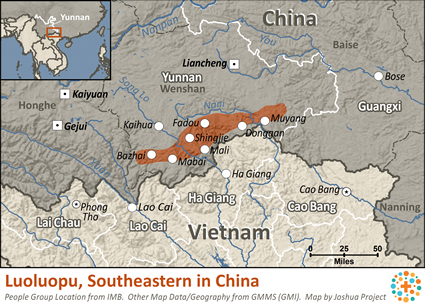

Although they have received status as a separate ethnic group in Vietnam, the Southeastern Luoluopo have not been so fortunate in China where they are considered to be just one subgroup of the massive Yi nationality. The self-name of this group is Luoluopo. Southeastern has been added to distinguish this group from the other Luoluopo groups in China who speak completely different languages, even though they share the same autonym.
According to Vietnamese sources, the Luoluopo migrated to Vietnam in two different waves: one in the fifteenth century and the other in the eighteenth century. This suggests that the Luoluopo have been living in southern China for more than 500 years. In recent years, many of the Southeastern Luoluopo in China who live near the townships or in the valleys have started mixed communities with the Han Chinese and are rapidly losing their language and culture.
When a Luoluopo dies, his or her relatives organize a "dance of the spirits." They believe this dance will help the soul find its way back to the resting place of its ancestors. At the dance the son-in-law of the deceased carries a bag on his shoulder. Inside the bag is a cloth ball which represents the head of the deceased person.
The Luoluopo are a very religious people. Even their homes are arranged to reflect this. The altar to the "spirit of the house" stands against the back wall. A room on the right side contains a bedroom with a fireplace and the room on the left side contains the kitchen and the ancestral altar. The oldest surviving member of each family is expected to maintain the altar and to faithfully execute all the ancestral ceremonies and rituals. In addition to their intricate system of ancestor worship, the Lolo believe in two gods who created the world, Mit Do and Ket Do. Ket Do created the entire universe and mankind, while Mit Do governs the earth and watches over the Luoluopo.
The Southeastern Luoluopo are one of the most neglected and gospel-starved peoples in the region.
Without the guidance of Christ, these people are like sheep without a shepherd. They need the good shepherd in their families and communities.
Pray for the authority of Christ to bind hindering spiritual forces to lead them from darkness to light.
Pray for signs and wonders to happen among them and for great breakthroughs with a rapid multiplication of disciples and house churches.
Pray for bold workers who are driven by the love of the Holy Spirit to go to them.
Pray for an unstoppable movement to Christ among them.
Scripture Prayers for the Luoluopo, Southeastern in China.
Operation China, Asia Harvest, Copyrighted © Used with permission
| Profile Source: Joshua Project |