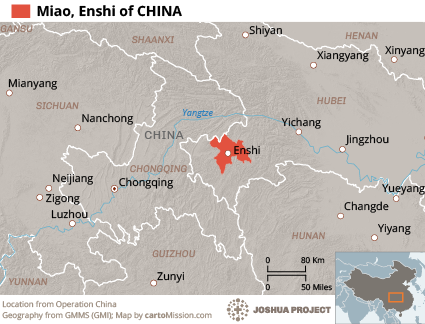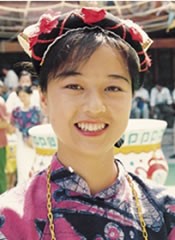

The Enshi Miao are a vivid example of what happens to a people group when assimilation takes place. Because they lived at the perimeter of Miao habitation, the Enshi Miao came into contact with the Han Chinese at a much earlier stage than other Miao groups. After centuries of contact, the Enshi Miao lost the use of their mother tongue and absorbed the Chinese language. Today there are no more than a few loanwords remaining from Miao. The Enshi Miao have also absorbed Chinese culture and customs. Few still wear a traditional style of dress, and few of their ways are different from the Chinese around them. The main distinguishing feature of the Enshi Miao is their official classification as part of the Miao nationality, which was based on their historical origins.
In Operation China this group is labeled Miao, Enshi even though far more of these people live in southeast Sichuan than in the Enshi County of Hubei. This is to avoid relating their name with Sichuan Province because of confusion with the Chuan Miao group who live farther to the west in Sichuan. The Enshi Miao and the Chuan Miao are two very different ethnolinguistic people groups.
The Enshi Miao have lost all or most of their culture. They no longer celebrate Miao festivals, although in recent years they have started a movement to rediscover their roots as Miao people. The Enshi Miao observe the major festivals of the Han Chinese, including the Spring Festival and the Chinese New Year.
Elderly Enshi Miao continue to worship their ancestors, especially during the annual ancestral rites when graves are cleaned and prayers are offered to the spirits of the dead. Most Enshi Miao under the age of 40 have no interest in religion.
Very little mission work was ever undertaken in eastern Sichuan and western Hubei prior to 1949, except for work in the city of Chongqing. Today, there are thought to be only a few hundred Christians among the Enshi Miao, mostly Catholic believers living in the townships. Most Enshi Miao have never heard the gospel.
The Enshi Miao, who have lost much of their traditional culture, need a sense of identity.
Pray for the people to find their identity in Christ.
Pray for signs and wonders to happen among them and for great breakthroughs with a rapid multiplication of disciples and house churches.
Pray for bold workers who are driven by the love of the Holy Spirit to go to them.
Pray for an unstoppable movement to Christ among them.
Scripture Prayers for the Miao, Enshi in China.
Operation China. Used by permission.
| Profile Source: Joshua Project |