
The Banten Kingdom broke off from the Padjajaran Kingdom of West Java in the 16th century, becoming a major trading center until the late 17th century. The kingdom was annexed into the Dutch East Indies in the early 19th century.
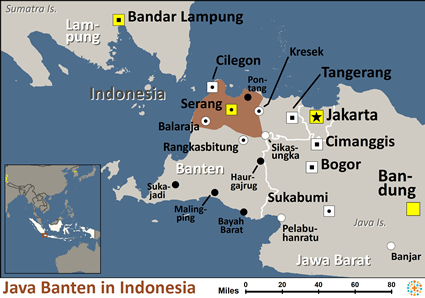
The Banten live in Banten Province in the southwest of the island of Java. Currently, most Banten live in the regencies of Pandeglang, Serang, Lebak and western Tangerang, as well as the cities of Cilegon and Serang. The Banten speak a dialect of the Sunda language regarded as less polite and less sophisticated than the dialect spoken by Sunda living in West Java.
The Banten grow rice and other crops such as coffee, cloves, beans, bananas and durian (a stinky fruit with a thick, spiky shell). Cooperative groups work the land under various arrangements; one type of cooperative funds repairs of mosques and Muslim prayer houses, another funds public infrastructure, and another is simply shared labor. Everyone participates in cooperative work or faces penalties for non-compliance.
The Banten leadership is composed of three elements: formal leaders, Muslim religious leaders, and leaders of the traditions and culture. These three groups play an important role in forming the local political system. Village leaders cultivate and develop the village's kinship relationships and handle matters of administration, irrigation, logistics and religion.
The Banten area features many tourist attractions, beginning with a nature preserve and including the great Mosque of Banten, where the tombs of Banten's sultans are placed at the south and north of the mosque. A nine-story rock (15 meters tall) is believed to be a relic from the Megalithic Era. Banten is open to the outside world for tourism, but the Banten protect their traditions and culture.
From the 15th century establishment of the Sultanate of Banten until today, the majority of the Banten have been Muslims. They practice Islam faithfully, but still also rely on black magic and occult power. As an example, a practitioner of debus can repeat a certain mantra to become invulnerable to physical blows, fire and sharp objects.
The Banten have a reputation for great occult knowledge; as a result, many people from different regions of Indonesia come to Banten to learn spells or to ask for help.
Most Banten make their living as farmers or merchants. They need help with modernization, including better educational facilities, as well as joint business ventures with outside companies in order to become more competitive. Additionally, the Banten living in remote areas such as Panjang Island in Banten Bay need development to overcome poverty.
Ask the Holy Spirit to free the Banten from their reliance on the occult.
Pray for a spiritual hunger that will drive the Banten people to the foot of the cross.
Ask God to raise up loving, dedicated workers to take the Gospel to the Banten.
Pray that God will lead them to persons of peace among the Banten.
Thank God for the availability of the Bible in Javanese (the main language of the Banten); pray that God will lead them to encounter the scriptures.
Pray for a Disciple Making Movement among the Banten that will result in disciples and churches multiplying through generations.
Scripture Prayers for the Java Banten in Indonesia.
https://www.britannica.com/place/Banten-province-Indonesia
| Profile Source: Joshua Project |