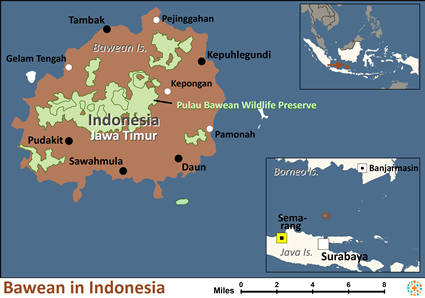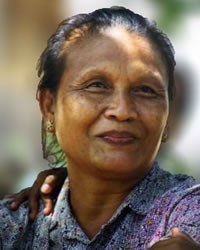

The Bawean homeland is 200 square kilometer island 120 kilometers north of Surabaya (East Java) in the middle of the Java Sea. Bawean has been known as the "island of women" because most of its inhabitants are women. This is because the men tend to look for employment in other lands. A man from Tanjung Ori village who worked for 20 years in Malaysia said, "A Bawean male is not considered an adult until he has stepped on foreign soil." Merantau (going to distant lands to seek success) is a major aspect of Bawean culture and it influences almost every other facet of their society. A significant number of the Baweanese reside in Malaysia. In fact, the Baweanese population there far exceeds that found on the island itself. Other areas of Baweanese migration include Perth, Australia and Singapore, where they are known as the Boyanese people. Linguistically speaking, the Bawean dialect is part of Madura language which also includes the dialects of Bangkalan, Pamekasan, Sampang, Sapudi and Sumenep.
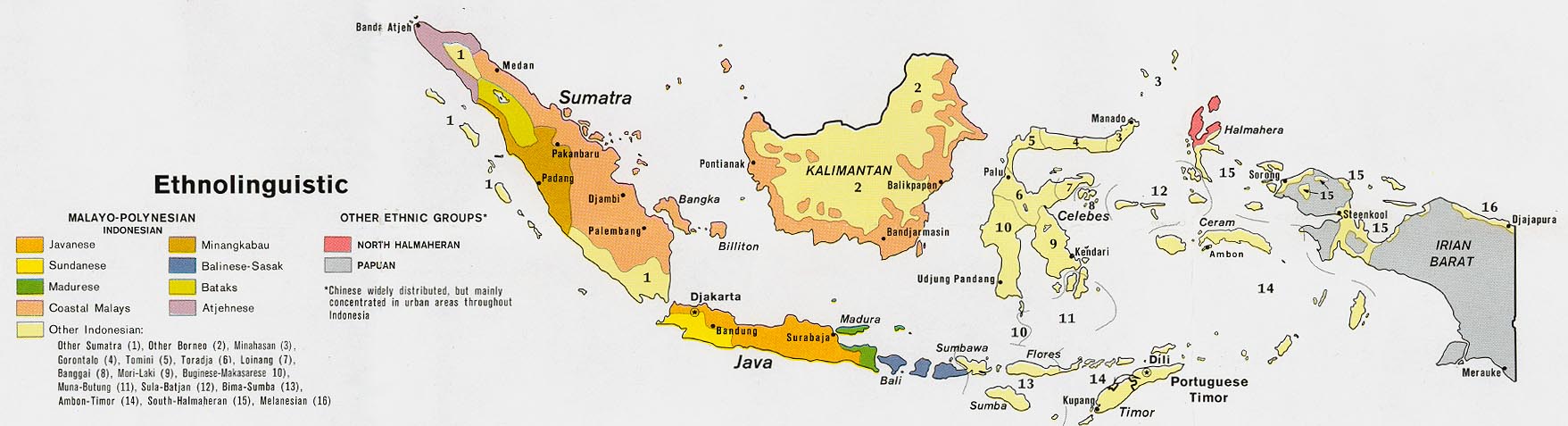
The culture of merantau creates some interesting dynamics for the Bawean people. On one hand, their homeland is isolated and cut off from modern Indonesian life. On the other hand, they are very exposed to the world through their family members who migrate and then return to Bawean. Although early settlers came from the island of Madura (as seen in the similarity of their languages), over the centuries the Baweanese have developed their own unique culture. Influences are evident from Madura, Java, South Sulawesi, Sumatra and Kalimantan. Because of this, an Indonesian journalist, Emmanuel Subangun, wrote in 1976 that the Bawean people are a "crystallization of Indonesian ethnic variety." The main sources of income for those living and working on the island are farming and fishing. Apart from this, some residents own small shops, make grass mats from palm leaf fiber as a local handicraft, or quarry the high quality onyx on the island for export and local sale. Most of the income on the island comes from family members who live and work overseas and send money back to Bawean.
Originally the Bawean embraced animistic beliefs. Then Hindu and Buddhist influences entered the island until the 1600s when the Baweanese people converted to Islam. Their religious devotion is extremely strong, and they pride themselves in the fact that 100% of the island's inhabitants follow Islam. There are many mosques (mesjid), small Islamic prayer houses (musholla) and traditional Islamic schools (pesantren) in every village. Boys and girls from six or seven years of age receive religious instruction including lessons in reciting the Koran and sometimes live in the house of a kyai (Islamic teacher). The kyai is greatly respected by the c people.
Although the standard of living on the island is higher than in many other isolated locations, there are still many unmet needs. Electricity 24 hours a day has recently come to the island, as have telephones, Bawean's first bank and a few computers. Yet many homes are still without indoor bathrooms. The tourism sector is open for development considering Bawean's natural beauty. All the above are assets to improve Bawean's economy and open doors to reach out to the Bawean people.
Pray that the Holy Spirit would begin to work in Bawean hearts.
Pray that God would raise Christians among those who work in Indonesia.
Pray for Bawean disciples to make disciples of family members.
Scripture Prayers for the Bawean in Indonesia.
| Profile Source: Joshua Project |