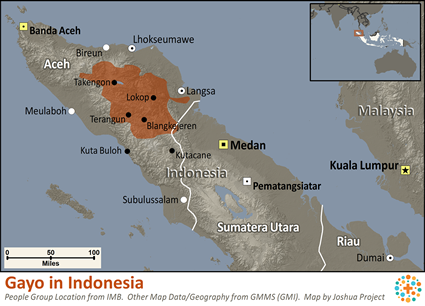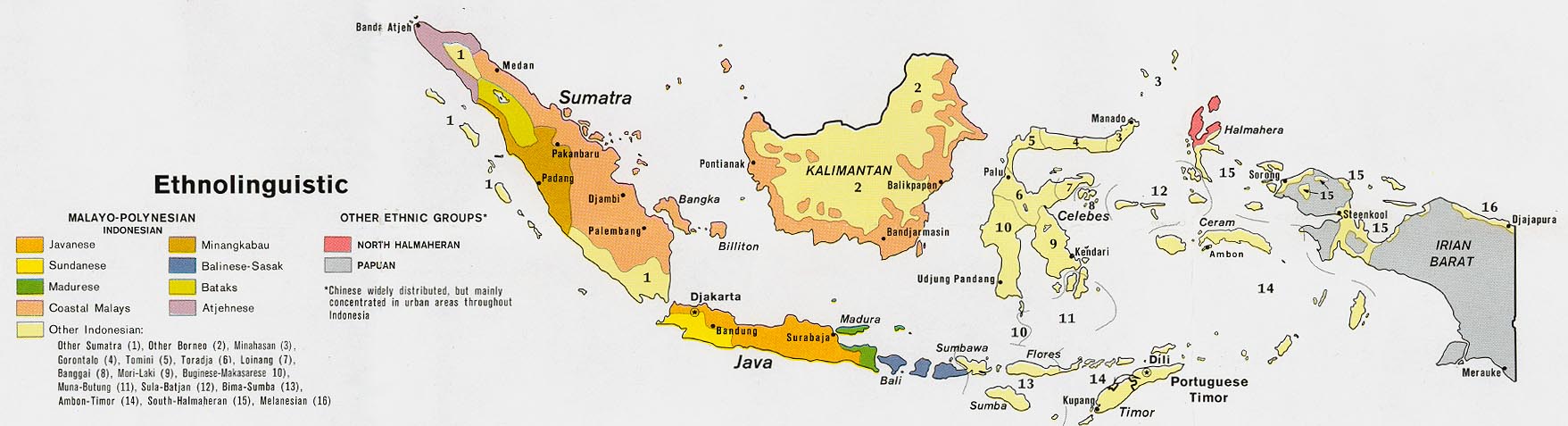

Who are the Gayo? The Gayo of Indonesia live in the remote central highlands of Aceh Province on the island of Sumatera. Their homeland lies across the Bukit Barisan Range ("Parade of Mountains"), which reaches heights of over 12,000 feet and runs for over a thousand miles. The Gayo mainly live in Central Aceh Regency and Southeast Aceh Regency. Their language is Gayo with two dialects, Gayo Lut and Gayo Luwes. The Gayo do not have a written language. Folk tales and oral stories are passed down in the form of poetry.The Gayo are close neighbors to the radical Islamic Aceh people, and in the past, the sultans of Aceh conquered the Gayo region and made the Gayo slaves. After an initial resistance (during which many Gayo were killed), the Dutch occupation from 1904-1942 resulted in the Gayo developing a thriving cash crop economy in vegetables and coffee. During the occupation and during the 50 years of Indonesian independence, the Gayo have gained access to higher levels of education, and participated to some degree in the Islamicization and modernization of their country.
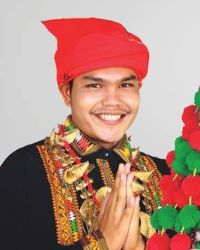
What are their lives like? The main source of income for the Gayo people is farming with the main crop being coffee. Other sources of income are fishing and gathering forest products. They also have developed skills in ceramics, weaving mats and weaving cloth. Another well known handicraft, called Kerawang Gayo, is embroidery with gold/colorful designs. In a traditional Gayo house (umah) uses palm thatch and wood. Several related families typically live together. There is also a meresah where older boys, bachelors, widowers, and male visitors sleep. This is also used for studying and religious activities. Gayo arts include saman and didong, which are mixtures of movement, literature, poetry, and singing. Apart from entertainment and recreation, these arts have ritual, educational, and informational functions, as well as being a means of maintaining balance in the social structure. The Gayo marriage pattern calls for marriage outside one's own family. However, marriage between cousins is not forbidden. Most men marry women from the same area. This is done so that the man will already know the woman and the woman's family can continue to look after her. A first marriage must be approved by both families (polygamy is rare, but allowed). Divorce and remarriage are quite common.
What do they believe? The Gayo people are mostly Muslim, but their understanding and conviction are lacking. Most Gayo still believe in good and bad spirits and holy men both dead and alive. They also continue to worship and make offerings to spirits, saints, and their ancestors.
What are their needs? The Gayo need medical workers to improve health conditions, as local understanding about health matters is very low. The national government has provided little assistance but still refuses permission for foreign medical workers to fill the vacuum left by a dearth of Indonesian doctors and nurses. The Gayo also need educators for senior high school. They need more educational facilities such as libraries. In addition, agricultural extension officers are needed to help the Gayo experiment with growing and marketing a new and wider variety of crops.
Register your ministry
activity among this people group. Contact the Adopt-A-People
Clearinghouse to learn about others that might be focused on this
people group.
Significant effort is made to match photos with people groups. In most cases the photo source has identified the people group. However, in some instances when the exact people group is not identified Joshua Project has made educated attempts at matching. As a result some photos may be representative of the people cluster rather than the specific people group. Mismatches are the fault of Joshua Project, not the photographer. Please contact us if you believe a photo is not matched with the correct people group.
Percentages may be printed as '0.00%' because of space limitations, but some are slightly greater than zero.
The exactness of the above numbers can be misleading. Numbers can vary by several percentage points or more.
People group population figures are now maintained as a percentage of the national population. Click here for details.
Joshua Project does not have specific ministry activity data supporting the "Other Progress Indicators."
Discrepancies may exist between "Other Progress Indicators" because of the varying sources of information.
Joshua Project does not know the exact content of web audio recordings. In general they are Bible reading and teaching.
As on-site realities are understood, barriers of acceptance may be found in many of the larger people groups that will require multiple distinct church planting efforts.
This data may contain errors and needs continual correcting and updating. Click here to send feedback.