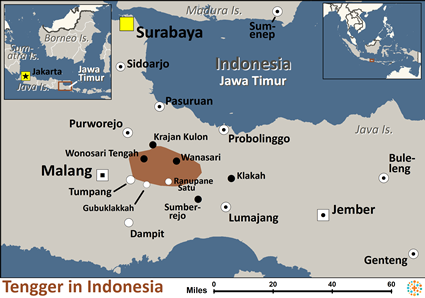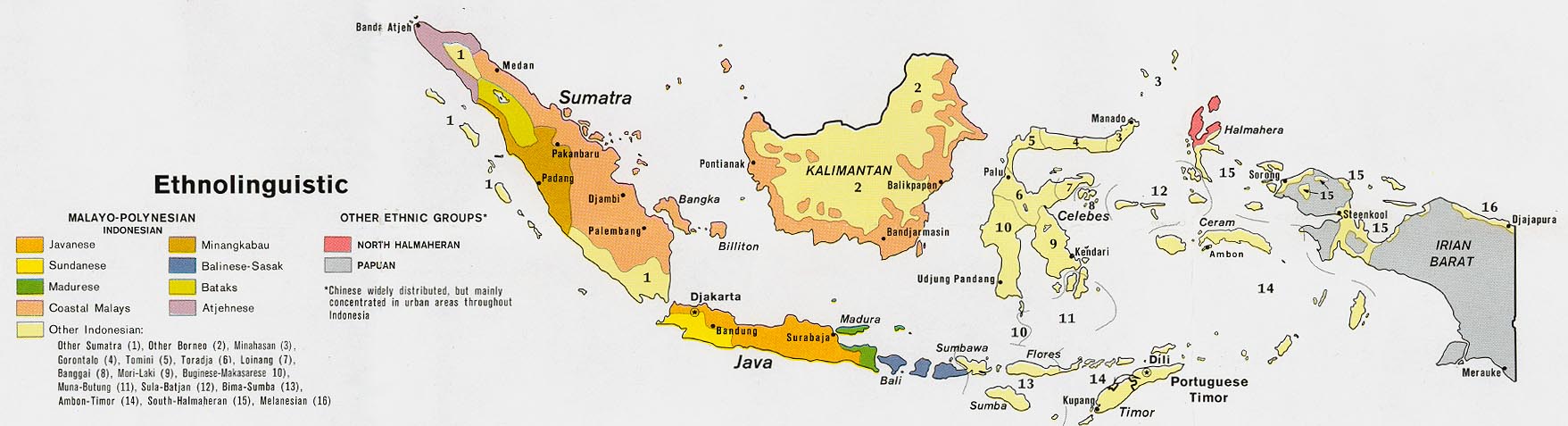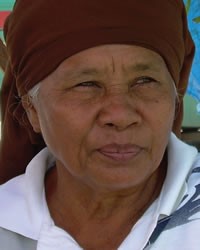

The Tengger people group lives around Mount Bromo in East Java. They live in portions of four regencies, namely Pasuruan, Probolinggo, Lumajang and Malang. The Tengger adhere to Hinduism. According to legend, they are the direct descendents of the Majapahit Empire. The name Tengger comes from a combination of the two names of the founders of the people group: Joko Seger and Roro Anteng. "Teng" comes from 'An-teng' and "ger" comes from 'Se-ger'. The Tengger dialect of Javanese is thought to come from the old Kawi variety of Javanese. Some evidence of this includes the pronouns 'reang' (I – masculine) and 'esun' (I – feminine). In addition, words that end in 'a' in Old Kawi Javanese are also pronounced with word-final 'a' in Tengger Javanese, whereas in modern Javanese the convention is to pronounce these words with word-final 'o'.
The Tengger community lives in a cool mountainous region (with average temperatures of 40-50 degree Fahreinheit at night). The fertility of the land makes it ideal for planting vegetables. As a result, about 80% of the Tengger people work as farmers. Although some Tengger have become quite successful farmers, About half work as hired workers earning about 20,000-50,000 rupiah (US$2.50 - 5.50) per day. The most common crops grown in the Tengger region are potatoes, cabbage and onions. The Tengger area is a tourist destination. All year long local and foreign tourists visit this area to witness the beautiful sunrise over the panoramic view from Mount Bromo as well as experience life in Tengger and the strong local commitment to traditional customs. As a result, many Tengger people also work in the tourism industry as hotel workers, tour guides, etc. Because the Tengger work as farmers and regularly give a warm welcome to tourists, they are considered simple and open. Even their local language, Tengger Javanese, expresses simplicity in that it does not employ the complicated system of politeness levels that are generally found in Javanese dialects.
The Tengger area has long been considered a holy place, ever since the Majapahit era. Since that time the inhabitants have been regarded as worshippers of Sang Hyang Widi Wasa (a Hindu deity). To this day, the Tengger community follows a Hindu tradition stretching back to the Majapahit Empire. There are strong similarities between the Hinduism in Bali and the Tengger variety; both are called Hindu Dharma. However, the Tengger variety does not have a caste system and the Tengger people's traditions are based on those originating from the Majapahit era. For the Tengger, Mount Bromo (Brahma) is believed to be a holy mountain. Every year the Tengger hold a ritual known as Kasada. This event is held in the temple at the foot of the Mount Bromo crater. In the middle of the night on the full moon of the 10th Javanese month (Kasodo), adherents bring offerings and throw them into the smoking and still active crater.
Most Tengger only have a junior high school education. Although those who are more well-off are able to send their children to the city for studies, opportunities for education in the area are still lacking.
Pray for the Lord to thrust out loving and committed workers to the Tengger people.
Pray for disciples to make more disciples and plant churches.
Pray for a desire for spiritual truth that will drive them to the cross and the empty grave.
Scripture Prayers for the Tengger in Indonesia.
IPN, 2011 Copyrighted © Used with permission
| Profile Source: Joshua Project |