
People-in-Country Profile
Peoples Data Filter:
Printer friendly version:
Step 1 - Select a Country:  
Send us your updates!
Can you provide any of the following for this people?
Step 2 - Select a People:
Zuwarah of Libya
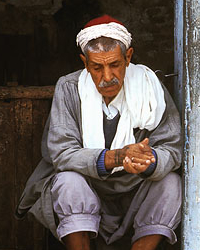
Zuwarah People Photo
View Zuwarah in all countries.
Submit People Photo:
Peoples
               
Geographic
Global
               
Global
           
 
Affinity Bloc
           
Global


People Cluster
       
Region


People
   
Country


People-by-Country (Profile)


Religion
Language


Global
   
Language


Religion
                             
Zuwarah of Libya
 
Profile Text
Submit Profile Text:
The Zuara Berber are one of many groups of Berbers. The Berbers are a North African people group who were conquered by Muslim invaders in the seventh century. The name Berber, which is derived from the Latin word "barbarian," was given to them by the Romans in the third century A.D. Today, the term 'Berber' refers to any native speaker of one of the Berber languages.

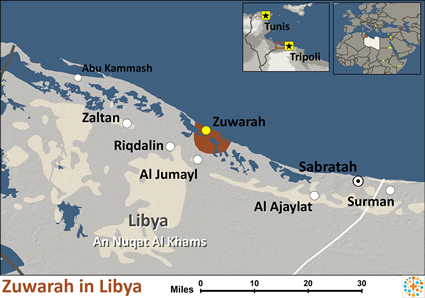
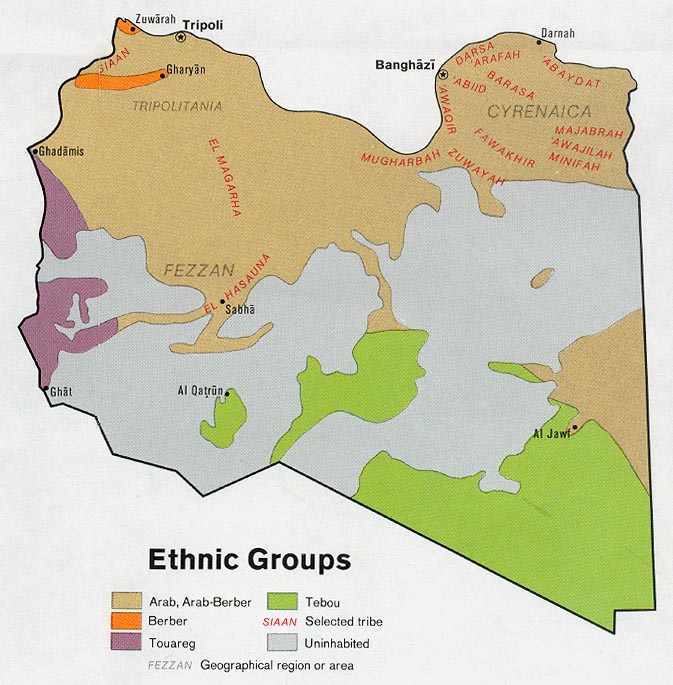
There are three main groups of Berbers in Libya: the Luata, the Nefusa, and the Adassa. Each group contains several smaller tribes. The Zuara is one of the smallest tribes. They live in the far northwest part of Libya, on the Mediterranean Sea. They are primarily located just west of the city of Tripoli, in an area known as Jebal Nefusa. Today, most Berbers refer to themselves as the Imazighen, which means "men of noble origin." The Zuara, like other Berbers, are generally bilingual, speaking both Zuara and Arabic.

What Are Their Lives Like?
Due to their location along the Mediterranean Sea, the Zuara are farmers. They produce and consume large amounts of barley, corn, wheat, and rye. Chickens, goats, and sheep are also raised. This supplemental food source provides milk, eggs, butter, and meat.

Because of its proximity to Tripoli, the region west of the city is becoming increasingly more urbanized. However, many of the Zuara still live in homes made of mud brick and stone. Mountain village homes are quite similar. They are usually flat-roofed houses made of stone that has been reinforced with dried mud.

The Berber dress is very similar to that of the Arabian community. The men wear the traditional djellaba cloak, which is made of cotton with wide sleeves and a hood. They also wear cotton turbans or caps. The men work in the fields, herd the animals, and hunt; while the women do the housework and care for the children. The women only help the men in the fields during harvest time, when they take the newly cut grain to the threshing floor.

For the Berber, life revolves around important ceremonies such as births, marriages, and deaths. Many rites of passage are important parts of their culture as well, such as the first haircut and circumcision for boys. The most elaborate of all is the marriage ceremony.

The Zuara, like other Berbers, live in a society that is male-dominated. The line of descent is traced through the fathers and all inheritances are passed down through the males. Also, as a means of preserving themselves as a people, the Zuara are not permitted to marry outside of their own group.

What are their beliefs?
The Zuara, like other Berbers, are virtually all Muslims. The Islamic religion is based on the teachings of Mohammed. The Koran ("holy book" of Islam) was supposedly given to Mohammed by the angel Gabriel. Islam is a religion of works that is based on five "pillars": (1) A Muslim must affirm that "there is no god but Allah, and Mohammed is his prophet." (2) Five times a day he must pray while facing Mecca. (3) He must generously give alms. (4) He must fast during Ramadan, the ninth month of the Muslim year. (5) He must try to make one pilgrimage to Mecca in his lifetime.

There are many different branches of Islam and the Zuara belong to the Kharijite sect. The Kharijites are unique in that they believe that Muslims have the right to eliminate unjust rulers. They also allow for non-Arabs to hold Islamic leadership positions. Most Muslims do not accept these beliefs.

What are their needs?
A profession of faith in Jesus Christ can cost a Muslim his life. This explains why there are currently only a few known Zuara believers in Libya. At the present time, Zuara is only a spoken language. A written script must be developed so that the Bible can be translated for the Zuara tribe.

Prayer Points
Ask the Lord to call people who are willing to go to Libya and share Christ with the Zuara Berber.
Pray that the doors of Libya will soon open to missionaries.
Ask God to provide evangelistic tools and equipment needed to reach them both spiritually and geographically.
Pray that God will raise up qualified linguists to translate the Bible into the Zuara language.
Ask the Holy Spirit to soften the hearts of the Zuara toward Christians so that they will be receptive to the Gospel.
Take authority over the spiritual principalities and powers that are keeping the Zuara bound.
Ask God to call forth prayer teams who will begin breaking up the soil through intercession.
Ask the Lord to raise up strong local churches among the Zuara Berber.

View Zuwarah in all countries.

 
Prayer Links Submit Links:
PrayerGuard.net
 
Web Profile Links Submit Links:
www.everyculture.com/Africa-Middle-East/index.html
www.muslimjourneytohope.com
imazighen.vze.com
www.arabbible.com
 
Web Resource Links Submit Links:
None Reported

 
Maps
Submit Map:
Country Map:
Detailed UN Political map
Ethnolinguistic Map:
University of Texas map collection
Linguistic Map:
Ethnologue language map
  
  Submit Update:
Country: Libya
Continent:
Africa
Region:
Middle East and North Africa
Country Persecution Rank:25 (Only top 50 ranked, 1 = highest persecution ranking)
Yes
Country Details: World Factbook
Location within Country:Tripolitania, in western Libya.
(Source: www.ethnologue.com)
   
 
People
Submit Update:
People Name in Country: Zuwarah
People Name General:
Zuwarah
Alternate People Names:
JemmariNefusa Berber
ZuaraZuraa
Zwara
People Code: 111196
Population in this Country: 38,000
Population in all Countries: 38,000
Yes
   
 
Arab World
Berber-Saharan
People Name General:
Zuwarah
CMT32z
Ethnic Relationships:
Affinity Bloc -> People Cluster -> Peoples Ethnicity Tree
   
 
Language
Submit Update:
Primary Language:
Nafusi (38,000 Speakers)
Language Code (16th): jbn    Ethnologue Listing
JBN
Primary Dialect:
Zuara
Dialect Code:
jbn01
Total Languages Spoken:
1
   
 
Religion
Submit Update:
Primary Religion:
Islam
% Christian Adherents:0.03 %
% Evangelical:0.00 %
   
 
Joshua Project Progress Indicators
Yes
Progress Scale: 1.1     Few, if any, known believers. Christian Adherents <=5%.
Need-Ranking Score: 80        Details
   
 
Other Progress Indicators *
Global Evangelical Status:Level 1   Less than 2% Evangelical. Some evangelical resources available, but no active church planting within past 2 years
Unengaged Status:Yes   Unengaged
Agency Progress (API):Level 0   No agency commitment
Church Progress (CPI):Level 0   No known believers
 
 
Bible Translation Status
Submit Update:
Bible Portions: Help start a Bible Translation
New Testament: None Reported
Complete Bible: None Reported
 
 
Ministry Activity
Register Ministry Activity:
Description: Register your ministry activity among this people group. Contact the Adopt-A-People Clearinghouse to learn about others that might be focused on this people group.
 
Zuwarah of Libya
* Notes:
  • Significant effort is made to match photos with people groups. In most cases the photo source has identified the people group. However, in some instances when the exact people group is not identified Joshua Project has made educated attempts at matching. As a result some photos may be representative of the people cluster rather than the specific people group. Mismatches are the fault of Joshua Project, not the photographer. Please contact us if you believe a photo is not matched with the correct people group.
  • Percentages may be printed as '0.00%' because of space limitations, but some are slightly greater than zero.
  • The exactness of the above numbers can be misleading. Numbers can vary by several percentage points or more.
  • People group population figures are now maintained as a percentage of the national population. Click here for details.
  • Joshua Project does not have specific ministry activity data supporting the "Other Progress Indicators."
  • Discrepancies may exist between "Other Progress Indicators" because of the varying sources of information.
  • Joshua Project does not know the exact content of web audio recordings. In general they are Bible reading and teaching.
  • As on-site realities are understood, barriers of acceptance may be found in many of the larger people groups that will require multiple distinct church planting efforts.
  • This data may contain errors and needs continual correcting and updating. Click here to send feedback.