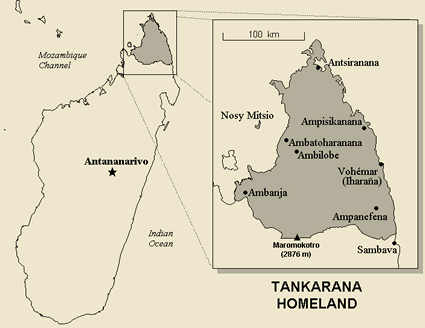

The Tankarana (literally 'people of the rocks') occupy the far northern part of Madagascar where they are geographically cut off from the southern regions of Madagascar by the Tsaratanana mountain range.
In spite of their geographic isolation, the Antakarana were conquered during the eighteenth and nineteenth centuries by the Sakalava, the Merina and the French. Some believe that the Antakarana language and ethnography would reflect the strong Sakalava influence in the area, but the Tankarana historically had closer bonds to the Betsimisaraka of the north.
They are mostly fishermen, although those in the interior raise cattle.
At the center of their group identity is the story of their survival in the nineteenth century when they were being exploited and pursued by the Merina. On one occasion, they have safely hidden in caves for more than a year before they were discovered. King Tsimiaro I made a prayer, vowing that if his people survived the Merina onslaught, the Tankarana would embrace Islam. This vow was honored and today the Muslim religion is evident there, strongly intermingling with traditional Malagasy customs. This syncretistic and mostly nominal practice of Islam has inspired concentrated effort on the part of zealous Muslims to teach and give the prescribed doctrinal content.
The Antankarana people need to put their identity and faith in the Lord of lords.
Pray for the Antankarana people to experience and embrace the glory of Christ.
Pray for the Lord to thrust out loving and dedicated workers to them.
Pray for Antankarana disciples to make more disciples.
Scripture Prayers for the Antankarana in Madagascar.
| Profile Source: Joshua Project |