
Tamasheq is the polite term for the Tuareg people, but the latter is so well-established that we often use that term instead. Tamasheq are a subgroup of the larger Berber group. The Berbers are the original peoples of North Africa who have been there for hundreds or even thousands of years. As a Berber subgroup, the Tamasheq stand out because of linguistic differences. For example, their unique alphabet uses "tifinagh" characters. Their language is Tamasheq.
Although the origin and early history of the Tamasheq are cloudy, these tribal nomads appear to have traveled down from North Africa in a series of migrations as early as the seventh century. By the end of the 1300s, Tamasheq tribes had established themselves as far south as the Nigerian border. During that time, the Tamasheq became well known as livestock producers and merchants in the Saharan and Sahelian regions. They controlled key trade routes, making much money through selling luxury goods.
In 1972, the worst drought in 50 years struck the Sahara, bringing disaster and severe stress to the Tamasheq tribes. The nomads were forced to travel southward with their families in search of pastures for their herds. This massive migration intensified as water supplies began to fail. Conflicts over rights and obligations among the people and governments of the regions were also generated. Many animals died of thirst, hunger, or fatigue during the long journey. Thousands of Tamasheq drifted to the cities where they set up cowhide shelters and lean-to shanties on the fringes of town.
Although the rains in 1974 were good, they did not wash away the serious economic and social effects of the drought, and life for the Tamasheq was never to be the same. Many Tamasheq, tempted by the less rigorous urban lifestyle, never returned to their original homeland.
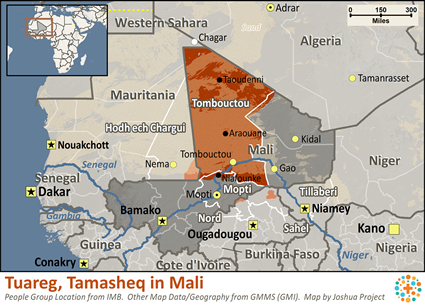
The Tuareg people are most likely to be found in Burkina Faso, Mali and Mauritania, but they also live in other parts of West Africa as well.
Most governments, including those in Burkina Faso and Mali, strongly favor settled people over nomads. This means that the Tamasheq nomadic and semi nomadic herders are marginalized. They are being pressured into becoming settled farmers.
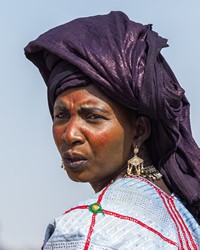
The Tamasheq are divided into several main political groups. You can often identify members of the Tamasheq people by their blue clothes. They are also unique in that the men, not the women, wear veils. The Tamasheq see it as shockingly indecent for a man's mouth to be seen by anyone to whom he owes formal respect. Therefore, he will always cover his face when in the presence of someone of higher social standing.
Tamasheq marriages usually take place between couples within the same clan, or extended family unit. Tamasheqs prefer marriages between cousins. A newlywed couple generally lives for about a year in the camp of the bride's parents. Then they will move over to the husband's camp. The typical age for marriage is between 20 and 25 for women and almost 30 for men. Monogamy (one husband, one wife) is the rule, and divorce is very unusual and generally frowned upon.
Marriage always requires the payment of a bride price. The size of the gift varies according to the beauty and social standing of the bride, as well as the wealth of the groom. A young man needs quite a few camels to pay the bride price. He must also accumulate a large enough flock to feed his family and still have extra to sell to provide for his household needs.
Tamasheq culture embraces many forms of art. They have a large collection of music, poetry, and songs that are often used during festivals, courtship and various rituals. They make metal, wood and dyed and embroidered leather crafts. Women play single-chord violins called imzads, and men often play drums or wooden flutes. Often they have parties around campfires during the evenings where both men and women sing.
Though the Tamasheq are virtually all Sunni Muslims, they have a reputation among other Muslims for being lukewarm in their faith. They practice a passive form of Islam, infused with folk beliefs and magic. Most do not even celebrate the most important Muslim fast of Ramadan.
They often wear protective charms or amulets. Many also believe in jinnis, which are according to Muslim legend, spirits capable of assuming human or animal form and exercising supernatural influence over people. There are many marabouts (those of the "holy class") living among Tuareg people. Some marabouts manage Islamic schools.
The Tamasheq have peculiar beliefs about the afterlife. The soul is free to roam after death, though they usually stay near graves. A dead soul might bring news to a “client” who sometimes must sleep on the grave to get an answer.
The Tamasheq people in Mali need adequate water for their herds and their crops. Water is in short supply. Hopefully they find new water supplies.
Pray for the very few believers among the Tamasheq people in Mali, that the Lord will nurture and protect their faith and send them qualified pastors and teachers.
Pray for the Lord to provide adequate rains this year so the Tamasheq people are blessed with healthy crops and herds.
Pray for Christ followers to have the opportunity to pray for and reach out to Tamasheq people in Mali.
Pray for the Tamasheq people to have a powerful spiritual hunger that will drive them to the cross no matter what the social cost.
Pray there will soon come a day when Tamasheq disciples will make more disciples.
Pray for Tamasheq elders and family leaders to have dreams of the righteous and all powerful Savior.
Scripture Prayers for the Tuareg, Tamasheq in Mali.
https://en.wikipedia.org/wiki/Tuareg_people
https://www.101lasttribes.com/tribes/tuareg.html
| Profile Source: Joshua Project |