
People-in-Country Profile
Peoples Data Filter:
Printer friendly version:
Step 1 - Select a Country:  
Send us your updates!
Can you provide any of the following for this people?
Step 2 - Select a People:
Jebala of Morocco
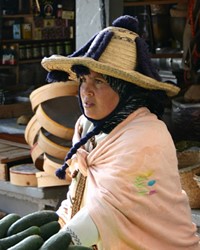
Jebala People Photo
View Jebala in all countries.
Submit People Photo:
Peoples
               
Geographic
Global
               
Global
           
 
Affinity Bloc
           
Global


People Cluster
       
Region


People
   
Country


People-by-Country (Profile)


Religion
Language


Global
   
Language


Religion
                             
Jebala of Morocco
 
Profile Text
Submit Profile Text:

The roots of the Jebala Arab go back to the original Arabs from the Arabian Desert. From there, their ancestors migrated into northern Africa. Although there was some mingling with the native Berbers of the area, the Arabs remained a distinct group.

In northern Morocco, there are two contrasting groups of Arabs: the rural dwellers and the city dwellers. Most of the city dwellers are descendants of the Moors; rural inhabitants are largely "Arabized" Berbers. Within the rural segment, there are several classes: nobles (allegedly descended from Mohammed), large land owners, peasants, and tenant farmers.

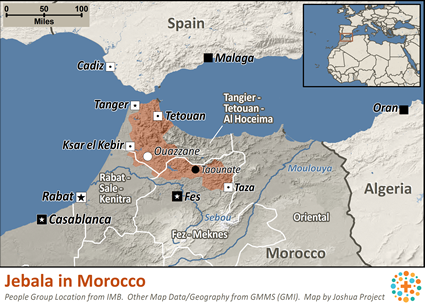
The Jebala Arab are one of the smaller groups of Arabs and compose only a tiny fraction of Morocco's population. Most of them live in the northern and western portions of the country, particularly near the tip that reaches northward toward Spain. Many live in or near the cities of Tangier and Tetouan, stretching south toward Fez.

What Are Their Lives Like
Most Jebala Arab are rural peasants who farm for a living. Large amounts of barley and wheat are both produced and consumed. In areas where water is plentiful, tomatoes, potatoes, beans, and peas are grown. Grapes, olives, oranges, peaches, and pears are also cultivated. The Jebala Arab also raise animals such as chickens, goats, and sheep. This provides eggs, milk, butter, and meat to supplement their diets. Little hunting or fishing occurs, but trading flourishes.

The coastal areas of the Atlantic Ocean and Mediterranean Sea are increasingly becoming urbanized; however, many Jebala Arab still live in small towns and villages. Housing ranges from villas to slums, with slums being dominant. In the towns, rectangular homes made of adobe and stone line very narrow streets. In the villages, rectangular homes have frameworks of poles, walls of earth or dry stones, and roofs of thatch.

Jebala Arab dress is typical of that of other Arabs. Most men wear faded, brown, long-sleeved Moroccan tunics made of cotton. Cotton turbans or caps and small leather pouches complete the outfit. Originally, Jebala Arab women covered themselves from head to foot with a white woolen blanket known as the haik. Now, most wear woolen skirts, tied with two foot long, red wool belts.

In the villages, Jebala Arab women do the housework and care for the children, while the men work the fields, herd the animals, and provide protection. The women also perform some farm tasks, such as milking the cows, goats, and sheep and making butter. In the towns and cities, women do not work outside the home. Traditional roles still exist, but they are under tremendous influence from Western culture.

As a means of preserving their people and as an influence of their Muslim religion, Arabs practice endogamous marriages (marrying only within a small social circle). Inheritance is patrilineal (traced through the males), and rule is patriarchal (male dominated). As is typical of Arabs, life for the Jebala Arab is centered around important ceremonies and family. Major ceremonies include birth, marriage, and death, with the most elaborate being marriage.

What Are Their Beliefs?
Virtually all Jebala Arab are Muslims. As such, they follow the teachings of the prophet Mohammed. In order to attain heaven, one must adhere to these teachings as revealed in their holy book, the Koran. The Muslim religion is a religion of works based on five "pillars," or duties. These include affirming that there is no god but Allah, and Mohammed is his prophet; praying five times a day; giving alms to the poor; fasting during the month of Ramadan; and making a pilgrimage to Mecca, if possible.

What are their needs?
Very few of the Jebala Arab have heard a clear presentation of the Gospel. Even among the few who have heard, a profession of faith in Jesus may cost them their families, honor, jobs, and sometimes their lives. Evangelization among them will be challenging, due to the nature of the Arabs' lifestyle and belief system. Prayer remains the key to seeing them reached.

Prayer Points
Ask the Lord to open the doors of Morocco to the preaching of the Gospel.
Pray for effective evangelistic tools to be translated for the Jebala Arab.
Ask the Holy Spirit to supernaturally reveal Jesus as the Way, the Truth, and the Life to the Jebala Arab.
Ask the Lord to soften the hearts of the Jebala Arab towards the Gospel message.
Pray that God will save key leaders among the Jebala Arab who will boldly declare the Lordship of Jesus.
Take authority over the spiritual principalities and powers that have kept the Jebala Arab bound for many generations.
Ask God to raise up prayer teams who will begin breaking up the soil through worship and intercession.
Pray that strong local churches will be raised up among the Jebala Arab.

View Jebala in all countries.

 
Prayer Links Submit Links:
PrayerGuard.net
 
Web Profile Links Submit Links:
www.everyculture.com/Africa-Middle-East/index.html
www.muslimjourneytohope.com
en.wikipedia.org/wiki/Jebala
www.alnour.com
www.arabbible.com
www.arabicbible.com
www.arabvision.org
www.ariseshinemorocco.org
 
Web Resource Links Submit Links:
Audio RecordingsMegaVoice Audio Bible and Stories
Audio RecordingsArabic Bibles Online
Audio RecordingsGlobal Recordings
Audio RecordingsGospel Widgets
Film / VideoGods Story
Film / VideoJesus Film, versions available
Film / VideoJesus Film, view now
Film / VideoWorld Christian Videos
GeneralBible Visuals
GeneralFour Spiritual Laws
ScriptureBible-in-Your-Language
ScriptureUnbound Bible
ScriptureWorld Scriptures

 
Maps
Submit Map:
Country Map:
Detailed UN Political map
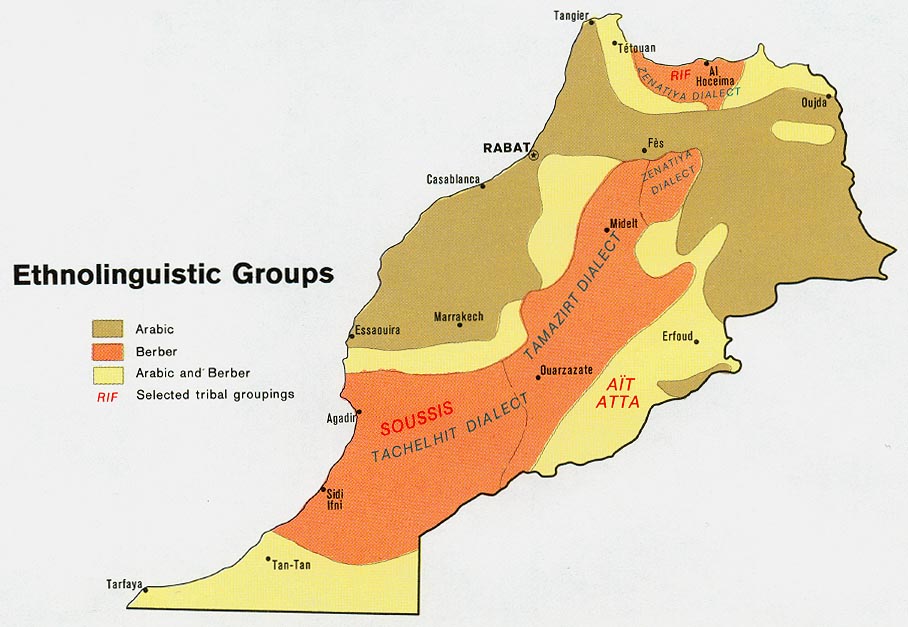
Ethnolinguistic Map:
University of Texas map collection
Linguistic Map:
Ethnologue language map
 
  Submit Update:
Country: Morocco
Continent:
Africa
Region:
Middle East and North Africa
Persecution Rank:37 (Only top 50 ranked, 1 = highest persecution ranking)
Yes
Country Details: World Factbook
   
 
People
Submit Update:
People Name in Country: Jebala
People Name General:
Jebala
Alternate People Names:
Jebala BerberRif
People Code: 104224
Population in this Country: 1,101,000
Population all Countries: 1,101,000
Yes
   
 
Arab World
Arab, Maghreb
People Name General:
Jebala
CMT30
Ethnic Relationships:
Affinity Bloc -> People Cluster -> Peoples Ethnicity Tree
   
 
Language
Submit Update:
Primary Language:
Arabic, Moroccan Spoken (1,101,000 Speakers)
Language Code (16th): ary    Ethnologue Listing
ARY
Primary Dialect:
Jebli
Dialect Code:
ary09
Total Languages Spoken:
1
   
 
Religion
Submit Update:
Primary Religion:
Islam
% Christian Adherents:0.03 %
% Evangelical:0.00 %
   
 
Joshua Project Progress Indicators
Yes
Progress Scale: 1.1   Few, if any, known Evangelicals. Professing Christian <=5%
   
 
Other Progress Indicators *
GSEC Status:Level 1   Less than 2% Evangelical. Some evangelical resources available, but no active church planting within past 2 years
Agency Progress (API):Level 0   No agency commitment
Church Progress (CPI):Level 0   No known believers
 
 
Bible Translation Status
Submit Update:
Bible Portions: 1902-1952
New Testament:
1932
Complete Bible: None Reported
Possible Bible Sources: Forum of Bible Agencies
 World Bible Finder
 World Christian Resource Directory
 
 
Ministry Activity
Register Ministry Activity:
Description: Register your ministry activity among this people group. Contact the Adopt-A-People Clearinghouse to learn about others that might be focused on this people group.
 
Jebala of Morocco
* Notes:
  • Significant effort is made to match photos with people groups. In most cases the photo source has identified the people group. However, in some instances when the exact people group is not identified Joshua Project has made educated attempts at matching. As a result some photos may be representative of the people cluster rather than the specific people group. Mismatches are the fault of Joshua Project, not the photographer. Please contact us if you believe a photo is not matched with the correct people group.
  • Percentages may be printed as '0.00%' because of space limitations, but some are slightly greater than zero.
  • The exactness of the above numbers can be misleading. Numbers can vary by several percentage points or more.
  • People group population figures are now maintained as a percentage of the national population. Click here for details.
  • Joshua Project does not have specific ministry activity data supporting the "Other Progress Indicators."
  • Discrepancies may exist between "Other Progress Indicators" because of the varying sources of information.
  • Joshua Project does not know the exact content of web audio recordings. In general they are Bible reading and teaching.
  • As on-site realities are understood, barriers of acceptance may be found in many of the larger people groups that will require multiple distinct church planting efforts.
  • This data may contain errors and needs continual correcting and updating. Click here to send feedback.