
People-in-Country Profile
Peoples Data Filter:
Printer friendly version:
Step 1 - Select a Country:  
Send us your updates!
Can you provide any of the following for this people?
Step 2 - Select a People:
Tubu, Daza of Niger
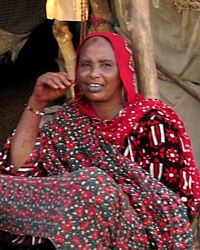
Tubu, Daza People Photo
View Tubu, Daza in all countries.
Submit People Photo:
Peoples
               
Geographic
Global
               
Global
           
 
Affinity Bloc
           
Global


People Cluster
       
Region


People
   
Country


People-by-Country (Profile)


Religion
Language


Global
   
Language


Religion
                             
Tubu, Daza of Niger
 
Profile Text
Submit Profile Text:

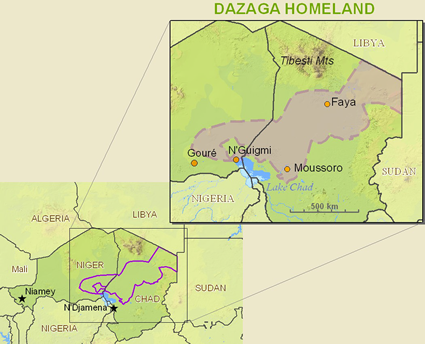
The Daza of southeastern Niger are a rugged, nomadic Muslim people inhabiting the southern fringes of the Sahara Desert. Many more Daza live in neighboring Chad, where they are also referred to as the Goran. Their language, which is called Dazaga, is part of the Nilo-Saharan language family.

The area in which the Daza live ranges from grassy steppes in the south, to open desert in the north. Temperatures often reach 120 degrees Fahrenheit during the hottest months of the year. Annual rainfall ranges from zero to four inches. The severe conditions under which the Daza live have greatly molded their rugged, fierce character.

The Daza, traditionally a warring people, are still disliked and feared by some of their neighbors. Other Nigerians tend to despise the Daza as thieves and murderers. However, the Daza seem to take pride in their reputation, particularly in their ability to go for long periods of time with little food or water.

What Are Their Lives Like?
The Daza have traditionally been a nomadic, pastoral people, but the population is presently divided between those in rural camps and a lesser number in the small towns. Many have been forced to leave the nomadic lifestyle because of the droughts of recent decades. In the past, the Daza herded cattle, camels, and goats. Cattle are raised less often now, as the Sahara continues to advance southward, destroying the pasture lands necessary for their support.

The basic diet of the Daza consists of cooked millet eaten with a sauce, which usually contains dried tomatoes, onions, and various leaves. Meat is occasionally added to the sauce but is eaten infrequently, as the people are generally poor. Milk is obtained from camels and goats, and dates are cultivated in some areas. Drinking strong, sweet tea is a daily part of Daza social life.

Marriages are often arranged, but couples may have some voice in the matter. Camels, tea, and sugar are usually given as gifts to the bride's family, and gifts are also given to the groom's family. The Daza practice polygamy (have multiple spouses), but many men can afford to have only one wife. Because it is important to have children, a second wife is especially desirable, if the first wife does not conceive. Men are the heads of their families, but Daza women are relatively independent, compared to many neighboring groups. Unfortunately, divorce is common among the Daza.

What are their beliefs?
Being Muslim is a large part of Daza cultural identity, and the Daza are practically 100% Muslim. There is great social pressure to participate in the prayers and the month-long fast during Ramadan, and much attention is paid to the giving of alms. Though staunchly committed to Islam, the Daza do incorporate some animism (the belief that non-human objects have spirits) in their religious activities.

Community adherence to Islam is very stable, but the impact on individual character is not necessarily deep. There is evidence of some are Muslim in name only, especially among the youth; nonetheless, there are still many very sincere, devout Muslims among the Daza.

What are their needs?
Though there are individual exceptions, most of the Daza are very poor. Many Daza lost nearly everything they had during the severe droughts of the mid-1970's and mid-1980's.

There are no medical facilities available to most Daza, and various serious illnesses and diseases abound. Many Daza have access only to contaminated well water, thereby contributing to the health problems.

Divorce, adultery, and prostitution are common social problems among the Daza, despite the relatively high moral standards of Islam. Slavery still exists in Daza society.

The spiritual needs of the Daza are as overwhelming as are the physical needs. Christian resources are scarce and missionaries are few. Intercession and committed workers are necessary to see the Daza of Niger come to Jesus.

Prayer Points
Ask the Lord of the harvest to send medical missionary teams to work among the Daza of Niger.
Ask the Holy Spirit to grant wisdom and favor to the missions agency that is targeting the Daza.
Pray that God will reveal Himself to the Daza through dreams and visions.
Take authority over the spiritual principalities and powers that have kept the Daza bound for many generations.
Ask God to raise up a mighty army of prayer warriors who will intercede for the Daza.
Pray that Christian radio broadcasts, evangelical literature, and the Jesus film will be made available to the Daza.
Pray for the conversion of influential Muslim teachers and tribal chiefs among the Daza.
Ask the Lord to establish a strong local church among the Daza of Niger.

View Tubu, Daza in all countries.

 
Prayer Links Submit Links:
PrayerGuard.net
Global Prayer Digest: 2007-01-28
 
Web Profile Links Submit Links:
www.everyculture.com/Africa-Middle-East/index.html
www.muslimjourneytohope.com
www.sim.org/index.php/content/toubou
 
Web Resource Links Submit Links:
Audio RecordingsMegaVoice Audio Bible and Stories
Audio RecordingsGlobal Recordings
Film / VideoGods Story
Film / VideoJesus Film, versions available
Film / VideoJesus Film, view now
Film / VideoWorld Christian Videos

 
Maps
Submit Map:
Country Map:
Detailed UN Political map
Linguistic Map:
Ethnologue language map
 
  Submit Update:
Country: Niger
Continent:
Africa
Region:
West and Central Africa
Yes
Country Details: World Factbook
Total Provinces on file:1
   
 
People
Submit Update:
People Name in Country: Tubu, Daza
People Name General:
Tubu, Daza
Alternate People Names:
DasaDaza
DazagaDazagada
DazzaTeda
Toubou
People Code: 102484
Population in this Country: 54,000
Population all Countries: 447,000
Yes
   
 
Sub-Saharan African
Kanuri-Saharan
People Name General:
Tubu, Daza
NAB61
Ethnic Relationships:
Affinity Bloc -> People Cluster -> Peoples Ethnicity Tree
   
 
Language
Submit Update:
Primary Language:
Dazaga
Language Code (16th): dzg    Ethnologue Listing
DAK
Total Languages Spoken:
1
   
 
Religion
Submit Update:
Primary Religion:
Islam
Religion Sub-division:Sunni
% Christian Adherents:0.01 %
% Evangelical:0.00 %
   
 
Joshua Project Progress Indicators
Yes
Progress Scale: 1.2   Evangelicals >.01% but <=2%. Professing Christians <=5%
   
 
Other Progress Indicators *
GSEC Status:Level 1   Less than 2% Evangelical. Some evangelical resources available, but no active church planting within past 2 years
Agency Progress (API):Level 0   No agency commitment
Church Progress (CPI):Level 2   One known church
 
 
Bible Translation Status
Submit Update:
Bible Portions: Help start a Bible Translation
New Testament: None Reported
Complete Bible: None Reported
 
 
Ministry Activity
Register Ministry Activity:
Description: Register your ministry activity among this people group. Contact the Adopt-A-People Clearinghouse to learn about others that might be focused on this people group.
 
Tubu, Daza of Niger
* Notes:
  • Significant effort is made to match photos with people groups. In most cases the photo source has identified the people group. However, in some instances when the exact people group is not identified Joshua Project has made educated attempts at matching. As a result some photos may be representative of the people cluster rather than the specific people group. Mismatches are the fault of Joshua Project, not the photographer. Please contact us if you believe a photo is not matched with the correct people group.
  • Percentages may be printed as '0.00%' because of space limitations, but some are slightly greater than zero.
  • The exactness of the above numbers can be misleading. Numbers can vary by several percentage points or more.
  • People group population figures are now maintained as a percentage of the national population. Click here for details.
  • Joshua Project does not have specific ministry activity data supporting the "Other Progress Indicators."
  • Discrepancies may exist between "Other Progress Indicators" because of the varying sources of information.
  • Joshua Project does not know the exact content of web audio recordings. In general they are Bible reading and teaching.
  • As on-site realities are understood, barriers of acceptance may be found in many of the larger people groups that will require multiple distinct church planting efforts.
  • This data may contain errors and needs continual correcting and updating. Click here to send feedback.