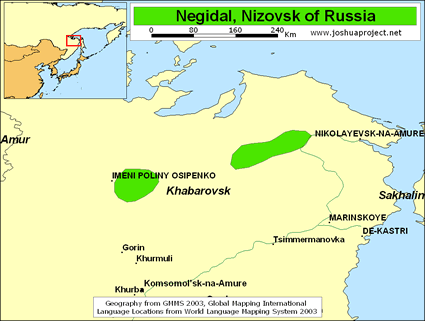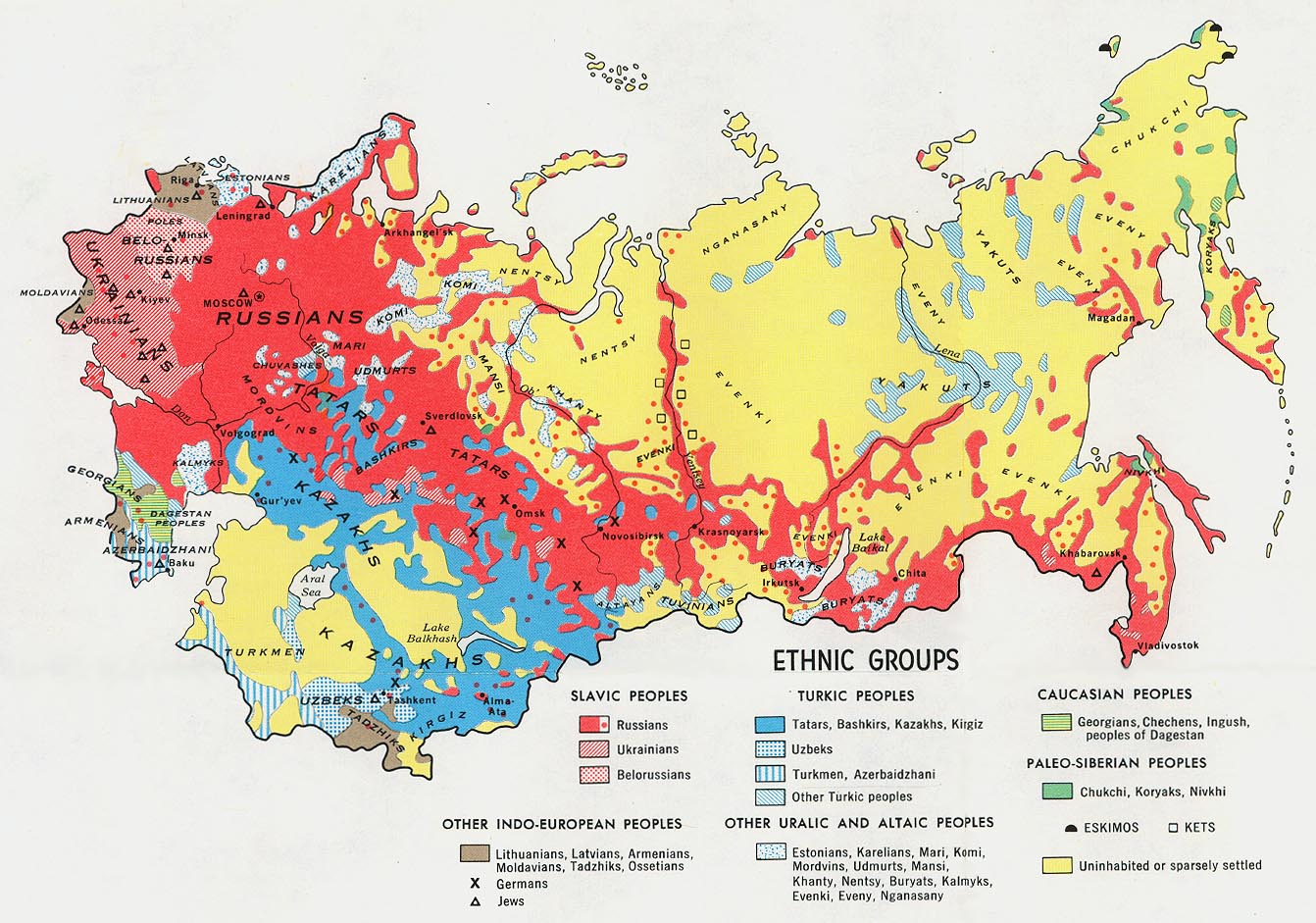

The Negidal belong to the Tunguso-Manchu people group. "Negidal" means "a man of these parts," their official name is a Russian form of the Evenki word ngegida, which means "coastal" or "outermost." Their history and ethnicity are closely intertwined with that of neighboring people groups, Nivhs, Ulches, Nanaitses, and Evenks. They have and Upper and Lower dialect in the Negidalts language. The upper dialect has much to do with language of Ulches, Oroches, Nanaitses; while the Lower dialect is influenced by the Evenks. There is, however, no written language. Negidal is now only spoken at home.
They live mainly near the river Amgun in Khabarovsk Krai where there are several hundred people, however, in the Russian Federation there are also several hundred more people. Therefore a few are scattered around Russia at different locations. Modern Negidal lived in the Ulchesky region of Pauline Osipenko.
The people of Negidal had household farms, where they raise cattle, pigs, and birds. They also have kitchen gardens where they can grow vegetables. The Negidal jobs mainly were either a fishermen and/or hunters. Today in some places the Negidals have converted to agriculture rather than fishing. One of the few differences between the Upper and Lower Negidal is that the Upper does reindeer production while the Lower raises sledge dogs. When they went fishing they would use, small and large fishing nets, hooks, fishing rods, and spears. Each family would make for themselves dried elk, called yukols. At the end of the 19th century the Negidal food ration would consist of potatoes; which they would switch the potatoes for fish from neighboring Russians. Eventually some of the lower Negidal began to grow potatoes for themselves.
As far as clothing is concerned, the women knew how to create the clothes and footwear for them; sometimes they decorated them with fine ornaments. For clothes, they use the skin of fish. Out of the fish's skin, they would create clothes, footwear, and homemade articles. The Negidals typically live in Russian style log cottages.
The Negidal people customarily are animist and shamanist.
They need the chance to hear the gospel and be discipled in the ways of Christ.
Pray for believers to present the gospel to the Negidal people in a way they can understand and respond to so that churches may be planted and those who respond be discipled.
Pray that there is openness to God and his word and hearts are ready to hear the good news.
Pray for protection over those who would try to work among the Negidal.
Scripture Prayers for the Negidal, Nizovsk in Russia.
Jubilee Adleta
| Profile Source: Joshua Project |