
People-in-Country Profile
Peoples Data Filter:
Printer friendly version:
Step 1 - Select a Country:  
Send us your updates!
Can you provide any of the following for this people?
Step 2 - Select a People:
Arab, Bedouin of Saudi Arabia
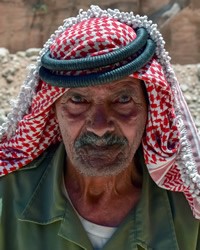
Arab, Bedouin People Photo
View Arab, Bedouin in all countries.
Submit People Photo:
Peoples
               
Geographic
Global
               
Global
           
 
Affinity Bloc
           
Global


People Cluster
       
Region


People
   
Country


People-by-Country (Profile)


Religion
Language


Global
   
Language


Religion
                             
Arab, Bedouin of Saudi Arabia
 
Profile Text
Submit Profile Text:

Who are the Bedouins?
Bedouins traditionally live a nomadic lifestyle, spreading from the Persian Gulf to the Atlantic Ocean, and from the borders of Turkey to Yemen. The word 'bedouin' comes from the Arab word 'Bedou' that means "desert dweller." Estimates say nomadic Bedouins constitute about 10% of the population of the Middle East.

What are their lives like?
Bedouin life is generally pastoral, herding camels, sheep, goats and cattle. They normally migrate seasonally, depending on grazing conditions. In winter, when there is some rain, they migrate deeper into the desert. In the hot, dry summer time, they camp around secure water sources. Bedouins define themselves as members of tribes and families. People are divided into social classes, depending on ancestry and profession. Passing from one class to another is relatively feasible, but marriage between a man and a woman of different classes is difficult.

Traditionally, the Bedouin's home, the tent, is divided into three sections by curtains: the men's section, the family section and the kitchen. In the men's area, guests are received around the hearth where the host prepares coffee on the fire. This is the center of Bedouin social life. Tea is served as a welcome drink; coffee is usually prepared after the meal and is the last drink before the guest leaves. The serving of food and drink represents the generous hospitality of the host. The men pass the evening trading news and discussing their animals. Separated from them by a curtain, the women gather in the family area and kitchen along with their small children to bake bread and prepare the main meal. A dinner of rice and chunks of mutton or lamb are then served to the gathered guests.

Women occupy a very important position in Bedouin society. Not only do they raise the children, herd the sheep, milk the animals, cook, spin yarn and make the clothes, but they also weave the cloth that constitutes the tent. The Bedouin men gather around the fire, sharing stories and sipping coffee. They might discuss falconry, the saluki greyhound and Arabian stallions, all animals the Bedouins are credited with breeding, as well as other matters of importance to the tribe. Traditionally, one of the men recites poetry or sings. To mark the end of the evening, the host burns incense in a mabkhara (incense burner) passing it to each of his guests to inhale and fan their clothes. Poetry has been a central cultural form of expression for the Bedouins throughout their history. In early centuries of Islamic history, Bedouin poetry represented the ideal standard for other literary achievements, as well as for the Arabic language. The traditional foods of the Bedouin are dairy products and meat. Bedouins sell and barter products in order to obtain agricultural food from sedentary peoples.

Bedouin society has a strict code of honor which dictates proper behavior for all members, including children. Because of the demanding nature of the Bedouin lifestyle, children are expected to assume a considerable amount of responsibility in order to help their families survive. Although modernization has changed the Bedouin lifestyle somewhat, emphasis is placed on teaching children to carry on traditional ways of life, and the advancement of modern technology is not considered important to children's education.

Modern societies have made the traditional Bedouin lifestyle less attractive since as it is demanding and often dangerous. Because of that, many tribes have settled in urban areas. It is not uncommon to see a young Bedouin building a house and living in it; however, his parents will pitch their tent in the garden, where they will live very happily until the end of their days. Governments have a strong tendency to regulate Nomadic lifestyles since it is only then that taxation works. Providing services for the people also works best in an urban setting. Today, the Arab world has one of the highest rates of urbanization in the world.

What do they believe?
Islam's prophet Mohammed was born and raised in the Bedouin tribe of the Quraish. The Qur'an, first revealed to Mohammed, was later written and compiled in the Arabic language. The first converts to Islam came from the Bedouin tribes living in and around Mecca. Therefore, Islam is embedded and deeply rooted in Bedouin culture. Although there are pockets of Christians in Bedouin tribes, by and large the word Bedouin is synonymous with being a follower of Islam. Prayer is an integral part of Bedouin life. As there are no formal mosques in the desert, they pray where they are, facing Mecca and performing the ritual washing, preferably with water. Since water is not always readily available, they 'wash' with sand instead.

What are their needs?
In modern Arab states and Israel, Bedouins are faced with challenges in their lifestyle, as their traditional Islamic, tribal culture has begun to mix with western practices. Men are more likely to adjust and interact with the modern cultures, but women are bound by honor and tradition to stay within the family dwelling. They therefore lack opportunity for advancement. Problems facing the Bedouin population of Israel include dispossession and the struggles connected to the Israeli-Palestinian conflict. Some live in townships, while others either live as squatters on land they claim as their own, or in the original 1948 refugee camps.

The Bedouins who have Israeli citizenship receive free education and medical services as well as cash benefits for children, something that has attributed to the high birthrate among Bedouins (5% growth per year). Unemployment, on the other hand, is very high, and few obtain a high school degree (4%), and even fewer graduate from college (0.6%). Even though the Bedouin population exceeds 110,000 in the Negev, there are still many physical, social, and spiritual problems. The Bedouins are almost untouched by the gospel. Christian resources are available in the Arabic language, the Bedouin's mother tongue.

View Arab, Bedouin in all countries.

 
Prayer Links Submit Links:
PrayerGuard.net
Global Prayer Digest: 2006-11-25
Global Prayer Digest: 2007-12-31
Global Prayer Digest: 2009-12-11
Global Prayer Digest: 2009-12-15
Global Prayer Digest: 2009-12-18
 
Web Profile Links Submit Links:
www.everyculture.com/Africa-Middle-East/index.html
www.muslimjourneytohope.com
en.wikipedia.org/wiki/Bedouins
www.alnour.com
www.arabbible.com
www.arabicbible.com
www.arabvision.org
www.thefellowship.info/Missions/Global-Missions/Pe...
 
Web Resource Links Submit Links:
Audio RecordingsMegaVoice Audio Bible and Stories
Audio RecordingsArabic Bibles Online
GeneralFour Spiritual Laws
ScriptureBible-in-Your-Language
ScriptureUnbound Bible

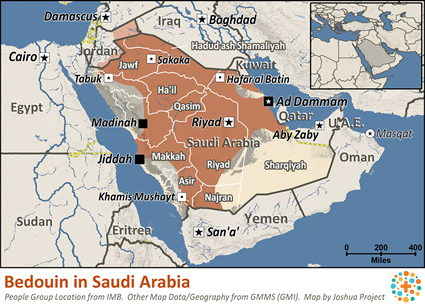
Send Joshua Project a map of the Bedouin of Saudi Arabia to display here.
Submit People Map:


Maps
Submit Map:
 
  Submit Update:
Country: Saudi Arabia
Continent:
Asia
Region:
Middle East and North Africa
Persecution Rank:3 (Only top 50 ranked, 1 = highest persecution ranking)
Yes
Country Details: World Factbook
   
 
People
Submit Update:
People Name in Country: Arab, Bedouin
People Name General:
Bedouin
Alternate People Names:
Algerian SpeakingBedouin, Algerian Speaking
Hasaaniya SpeakingNajdi Bedouin
People Code: 101193
Population in this Country: 1,003,000
Population all Countries: 1,760,000
Yes
   
 
Arab World
Bedouin, Arabian
People Name General:
Bedouin
CMT30
Ethnic Relationships:
Affinity Bloc -> People Cluster -> Peoples Ethnicity Tree
   
 
Language
Submit Update:
Primary Language:
Arabic, Najdi Spoken (1,003,000 Speakers)
Language Code (16th): ars    Ethnologue Listing
ARS
Total Languages Spoken:
1
   
 
Religion
Submit Update:
Primary Religion:
Islam
Religion Sub-division:Sunni
% Christian Adherents:0.01 %
% Evangelical:Unknown
   
 
Joshua Project Progress Indicators
Yes
Progress Scale: 1.1   Few, if any, known Evangelicals. Professing Christian <=5%
   
 
Other Progress Indicators *
Finishing the Task Status:Level W   No one is reaching this people group
GSEC Status:Level 0   No evangelical Christians or churches. No access to major evangelical print, audio, visual, or human resources
Unengaged Status:Yes   Unengaged
 
 
Bible Translation Status
Submit Update:
Bible Portions: Help start a Bible Translation
New Testament: None Reported
Complete Bible: None Reported
 
 
Ministry Activity
Register Ministry Activity:
Description: Register your ministry activity among this people group. Contact the Adopt-A-People Clearinghouse to learn about others that might be focused on this people group.
 
Arab, Bedouin of Saudi Arabia
* Notes:
  • Significant effort is made to match photos with people groups. In most cases the photo source has identified the people group. However, in some instances when the exact people group is not identified Joshua Project has made educated attempts at matching. As a result some photos may be representative of the people cluster rather than the specific people group. Mismatches are the fault of Joshua Project, not the photographer. Please contact us if you believe a photo is not matched with the correct people group.
  • Percentages may be printed as '0.00%' because of space limitations, but some are slightly greater than zero.
  • The exactness of the above numbers can be misleading. Numbers can vary by several percentage points or more.
  • People group population figures are now maintained as a percentage of the national population. Click here for details.
  • Joshua Project does not have specific ministry activity data supporting the "Other Progress Indicators."
  • Discrepancies may exist between "Other Progress Indicators" because of the varying sources of information.
  • Joshua Project does not know the exact content of web audio recordings. In general they are Bible reading and teaching.
  • As on-site realities are understood, barriers of acceptance may be found in many of the larger people groups that will require multiple distinct church planting efforts.
  • This data may contain errors and needs continual correcting and updating. Click here to send feedback.