
People-in-Country Profile
Peoples Data Filter:
Printer friendly version:
Step 1 - Select a Country:  
Send us your updates!
Can you provide any of the following for this people?
Step 2 - Select a People:
Tunni of Somalia
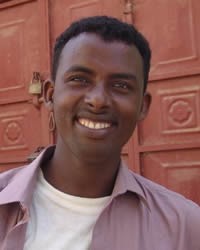
Tunni People Photo
View Tunni in all countries.
Submit People Photo:
Peoples
               
Geographic
Global
               
Global
           
 
Affinity Bloc
           
Global


People Cluster
       
Region


People
   
Country


People-by-Country (Profile)


Religion
Language


Global
   
Language


Religion
                             
Tunni of Somalia
 
Profile Text
Submit Profile Text:
Somalia is located on the Horn of Africa on the continent's easternmost coast. The Somali are the largest ethnic group in the country and form one of the most uniform populations of the continent. Some Somali also live in neighboring countries, such as Ethiopia and Kenya. They speak a common language, follow a common religion, and share a cultural heritage.

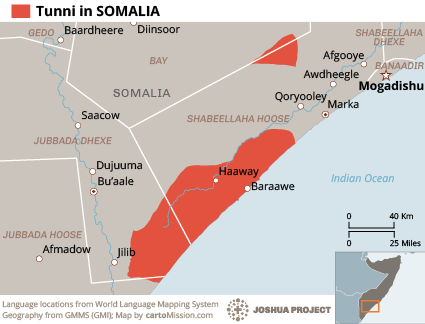
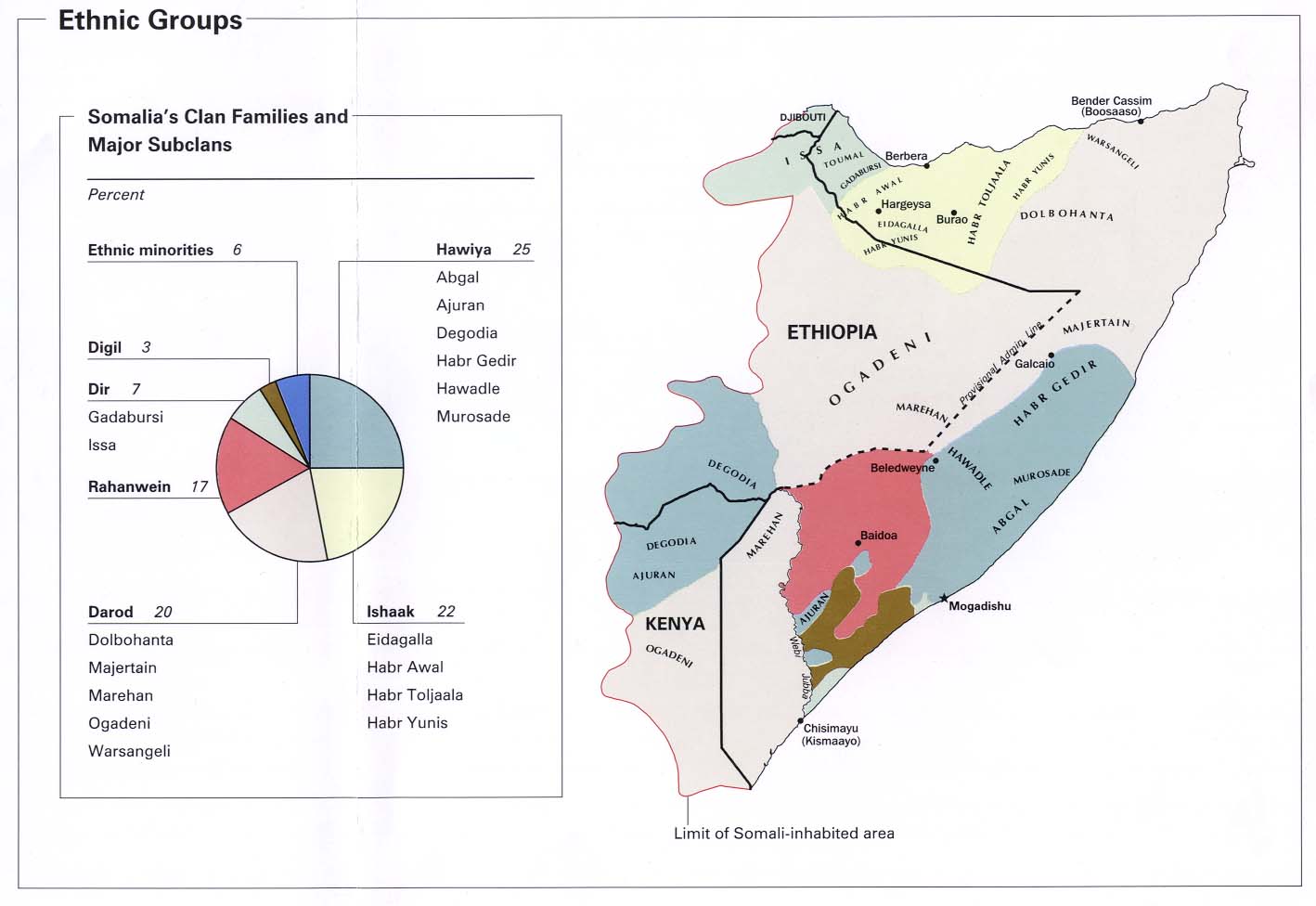
The Somali are divided into various sub-groups. One of these groups is the Digil, which includes not only the Tunni but also the Dabarre and the Jiddu. They are located in southern Somalia, between the Juba and Shebelle Rivers. This region has the richest agricultural land in the country, and the average temperature is only in the low 80's. Area wildlife includes lions, elephants, foxes, and zebras.

The Tunni speak Af-Tunni from the Afro-Asiatic language family. Many also speak Arabic as a secondary or trade language. They are closely related to the Afar and Beja, sharing similarities in culture, language, and religion.

What Are Their Lives Like?
The Tunni, like other Digil peoples, are primarily farmers. Bananas are the chief commercial and export crop, but sugarcane, corn, sorghum, beans, sesame, and fruits are also grown. Agriculture is organized on a system of mutual help work parties. Men are recruited from within the village and are presided over by a chief, who is given gifts and coffee. The men must appear for work anytime the chief calls them. These associations work on special "work days" and cultivate the land of their members and of other villages, who must pay them a fee and feed them. Although women are not members of these work groups, they help the men in the fields and also grind grain for flour. Most also herd cattle and to a lesser extent, camels. These animals provide meat, milk, and skins. In addition to farming, the Tunni also engage in fishing and hunting.

The Tunni live in round huts with mud walls and cone-shaped grass roofs. The inside of the hut is divided by a curtain or branch partition. The man sleeps on the side facing the door, the wife on the other, more secluded side. Wealthier Tunni may also have a porch attached to the hut's entrance. Each family is ruled by the male head of the household. The village is ruled by a council of elders from each family, who meet with the village head. Decisions and business with other villages are conducted by the council.

The Tunni wear mainly cotton cloth, which can be obtained through trade or made on local looms. The dress of both men and women closely resembles a Roman toga and is typically white or gray in color. The cloth is usually saturated with butter in order to protect the person against damp or cold. Most Tunni go barefoot, but sandals are sometimes worn. Most women wear pearl, leather, or silver necklaces, as well as bracelets and anklets.

When a young man desires to marry, he must first obtain the consent of his parents and the girl's parents. The young man must pay a bride-price to the girl's family, and if the bride-price is satisfactory, the engagement will result in marriage. A man is responsible for his wife, as are his brothers and all the members of his family. If a wife is murdered, the husband and his family will resort to blood-vengeance. Under Islamic law, a Tunni is allowed up to four wives. Each wife, however, occupies her own hut where she raises her children.

What Are Their Belief?
The Tunni are 100% Muslim. Although they are quite orthodox in their religious practices, few have a deep understanding of their faith. As Muslims, the Tunni believe that Jesus was only a prophet, not God's Son. They believe that after death all men will give an account for their actions, being judged by their works and knowledge of the Koran. The Tunni consider Christians to be inferior to themselves.

What are their needs?
The Tunni have no Christian resources available to them. The majority have not had a chance to hear a clear presentation of the Gospel. Much prayer and evangelistic work are needed to lead these Muslims to the Truth.

Prayer Points
Ask the Lord of the harvest to send loving Christians to share the Truth with the Tunni.
Pray that Christian radio broadcasts, the Jesus film, and evangelistic literature will be made available to the Tunni.
Ask the Lord to raise up linguists who will translate the Bible into their language.
Pray that God will reveal Himself to the Tunni through dreams and visions.
Ask the Lord to save key leaders among the Tunni who will profess Jesus as Lord.
Take authority over the spiritual principalities and powers that are keeping the Tunni bound.
Ask God to raise up prayer teams who will begin breaking up the soil through worship and intercession.
Pray that strong local churches will be raised up among the Tunni.

View Tunni in all countries.

 
Prayer Links Submit Links:
PrayerGuard.net
 
Web Profile Links Submit Links:
www.everyculture.com/Africa-Middle-East/index.html
www.muslimjourneytohope.com
prayer4thenations.org/guides/SomaliPrayer.pdf...
 
Web Resource Links Submit Links:
None Reported

 
Maps
Submit Map:
Country Map:
Detailed UN Political map
Ethnolinguistic Map:
University of Texas map collection
Linguistic Map:
Ethnologue language map
  
  Submit Update:
Country: Somalia
Continent:
Africa
Region:
East and Southern Africa
Country Persecution Rank:5 (Only top 50 ranked, 1 = highest persecution ranking)
No
Country Details: World Factbook
   
 
People
Submit Update:
People Name in Country: Tunni
People Name General:
Tunni
People Code: 110289
Population in this Country: 39,000
Population in all Countries: 39,000
Yes
   
 
Horn of Africa-Cushitic Peoples
Somali
People Name General:
Tunni
CMT33e
Ethnic Relationships:
Affinity Bloc -> People Cluster -> Peoples Ethnicity Tree
   
 
Language
Submit Update:
Primary Language:
Tunni
Language Code (16th): tqq    Ethnologue Listing
TQQ
Secondary Languages:
Maay (Unknown)
Total Languages Spoken:
2
   
 
Religion
Submit Update:
Primary Religion:
Islam
Religion Sub-division:Sunni
% Christian Adherents:0.00 %
% Evangelical:0.00 %
   
 
Joshua Project Progress Indicators
Yes
Progress Scale: 1.1     Few, if any, known believers. Christian Adherents <=5%.
Need-Ranking Score: 88        Details
   
 
Other Progress Indicators *
Global Evangelical Status:Level 1   Less than 2% Evangelical. Some evangelical resources available, but no active church planting within past 2 years
Unengaged Status:Yes   Unengaged
Agency Progress (API):Level 0   No agency commitment
Church Progress (CPI):Level 0   No known believers
 
 
Bible Translation Status
Submit Update:
Bible Portions: Help start a Bible Translation
New Testament: None Reported
Complete Bible: None Reported
 
 
Ministry Activity
Register Ministry Activity:
Description: Register your ministry activity among this people group. Contact the Adopt-A-People Clearinghouse to learn about others that might be focused on this people group.
 
Tunni of Somalia
* Notes:
  • Significant effort is made to match photos with people groups. In most cases the photo source has identified the people group. However, in some instances when the exact people group is not identified Joshua Project has made educated attempts at matching. As a result some photos may be representative of the people cluster rather than the specific people group. Mismatches are the fault of Joshua Project, not the photographer. Please contact us if you believe a photo is not matched with the correct people group.
  • Percentages may be printed as '0.00%' because of space limitations, but some are slightly greater than zero.
  • The exactness of the above numbers can be misleading. Numbers can vary by several percentage points or more.
  • People group population figures are now maintained as a percentage of the national population. Click here for details.
  • Joshua Project does not have specific ministry activity data supporting the "Other Progress Indicators."
  • Discrepancies may exist between "Other Progress Indicators" because of the varying sources of information.
  • Joshua Project does not know the exact content of web audio recordings. In general they are Bible reading and teaching.
  • As on-site realities are understood, barriers of acceptance may be found in many of the larger people groups that will require multiple distinct church planting efforts.
  • This data may contain errors and needs continual correcting and updating. Click here to send feedback.