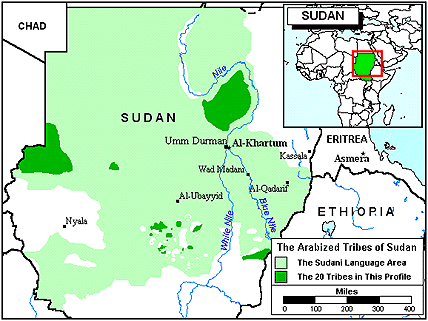

The Arabs are one of the world's largest and most rapidly growing ethnic groups. In the seventh and eleventh centuries, Arabs invaded North Africa, causing many tribes and pre-Islamic Saharan nomadic groups to be displaced. These invasions also overran and absorbed, to some extent, the passive communities of black farmers, Jewish artists, and Berber refugees who lived in and around the oases and trading centers of the northern desert. For this reason, many different Arab groups exist throughout North Africa today, including those tribes of Sudan that have become "Arabized."
The Arabs are subdivided into thousands of ethnic groups and subgroups based on their particular Muslim sect, Arabic dialect, and regional adaptation. A majority of the Arabized tribes of Sudan speak Sudani, one form of Arabic; however, one group, the Mongallese Arab, speaks Creole Arabic, a somewhat different form. Arabic, the official language of Sudan, is used by both Sudan's government leaders and its commercial businessmen.
What Are Their Lives Like? Sudan is one of the poorest and least developed countries of the world. Most of its inhabitants are dependent on farming and animal breeding for their livelihoods. For most of the Arabized tribes, agriculture is the basis of the economy. Sorghum and millet are their staple crops, along with watermelons, gourds, okra, sesame, and cotton. They also raise cattle, sheep, goats, donkeys, and dogs. Cheese and butter are made from the milk of both the cows and goats.
Not all of the Arabized tribes are farmers. Some tribes, such as the Arabized Midob and the Mongallese Arab, are nomadic herdsmen, traveling from place to place with their herds of cattle and camels in search of better grazing lands. Other Arabized tribes, such as the Hasania and Husseinat, have become successful businessmen and merchants in Sudan. These groups are deeply engaged in the commercial activities of the cities in their region.
Most of the Arabized tribes live in permanent settlements or villages. Their houses are simple round huts with thatched roofs. The nomadic groups live in temporary camps due to their constant migrating tendencies. They usually live in dome-shaped shelters made of branches covered with grass. In the cities, where the few merchants and businessmen live, the houses are generally rectangular in shape and have tin roofs.
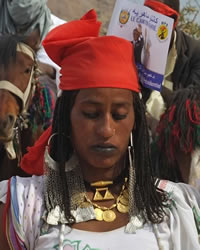
The Arabized tribes of Sudan dress in similar fashion to those people of other Arabic communities. They typically wear sandals, cotton turbans or caps, and long-sleeved cotton tunics called djellabas.
Most of these groups live much like the Arabs of other regions. Their lives revolve around important ceremonies such as birth, marriage, death, and the first haircut and circumcision for boys. The most elaborate of all ceremonies is the marriage ceremony. Polygamy (having more than one wife) is a common practice among the Arabized tribes. However, according to Islamic law, a man cannot have more than four wives. After marriage, the newlywed couple generally lives with or near the husband's parents. However, in some groups, the young couple will live with the wife's family until after the birth of the first child.
What are their beliefs? With the death of Mohammed in A.D. 632, the Arabs erupted from the desert pastures of Arabia and migrated to the lands to the east and west. They intermarried with the local North African tribes and introduced them to Islam. The tribes began adopting the traditions and practices associated with Islamic culture. The spread of Islam continued and became even more advanced in the sixteenth and seventeenth centuries, when many schools of religious learning were founded. Today, virtually all of the Arabized tribes are 100% Muslim.
What are their needs? Sudan is a nation in crisis. The tension between the Islamic north and the predominantly Christian south has boiled over many times in recent years. This civil war has resulted in drastic shortages of food and a flood of refugees moving south to avoid persecution. Many have died along the way.
The majority of the Arabized tribes are not being ministered to by any missions agencies, and there are no known believers living among them. Further evangelistic work and much prayer are needed to penetrate the hearts of these precious people with the Light of the Gospel.
Prayer Points Pray against the spiritual principalities and powers that have kept these tribes bound for many generations.
Ask the Lord to call people who are willing to go to North Africa and share Christ with these peoples.
Pray that the Christians of southern Sudan will be compelled to take the Gospel to their unreached neighbors.
Ask God to strengthen, encourage, and protect the small number of Tira Christians.
Pray that Bibles, Christian broadcasts, and other literature will be made available in the Sudani language for each of these tribes.
Ask the Lord to raise up Christian medical teams to work among the Arabized tribes.
Pray that these tribes will once again turn to the God of their fathers.
Ask the Lord to raise up strong local churches among the Arabized tribes of Sudan.
Register your ministry
activity among this people group. Contact the Adopt-A-People
Clearinghouse to learn about others that might be focused on this
people group.
Significant effort is made to match photos with people groups. In most cases the photo source has identified the people group. However, in some instances when the exact people group is not identified Joshua Project has made educated attempts at matching. As a result some photos may be representative of the people cluster rather than the specific people group. Mismatches are the fault of Joshua Project, not the photographer. Please contact us if you believe a photo is not matched with the correct people group.
Percentages may be printed as '0.00%' because of space limitations, but some are slightly greater than zero.
The exactness of the above numbers can be misleading. Numbers can vary by several percentage points or more.
People group population figures are now maintained as a percentage of the national population. Click here for details.
Joshua Project does not have specific ministry activity data supporting the "Other Progress Indicators."
Discrepancies may exist between "Other Progress Indicators" because of the varying sources of information.
Joshua Project does not know the exact content of web audio recordings. In general they are Bible reading and teaching.
As on-site realities are understood, barriers of acceptance may be found in many of the larger people groups that will require multiple distinct church planting efforts.
This data may contain errors and needs continual correcting and updating. Click here to send feedback.