People-in-Country Profile
Peoples Data Filter:
Printer friendly version:
Step 1 - Select a Country:  
Send us your updates!
Can you provide any of the following for this people?
Step 2 - Select a People:
Bolon of Burkina Faso
Bolon People Photo
View Bolon in all countries.
Submit People Photo:
Peoples
               
Geographic
Global
               
Global
           
 
Affinity Bloc
           
Global


People Cluster
       
Region


People
   
Country


People-by-Country (Profile)


Religion
Language


Global
   
Language


Religion
                             
Bolon of Burkina Faso
 
Profile Text
Submit Profile Text:

The Bolon are an agricultural people living primarily in Kenedougou and Houet provinces of Burkina Faso. They are closely related to a number of other groups in the area, and their language, also called Bolon, is a part of the Niger-Congo language family. Very little is known about the Bolon in particular; thus, some assumptions have been made about their lifestyle based on their proximity to the Bobo Jula and the Jula.

Burkina Faso consists of an extensive plateau, which is slightly inclined towards the south. The country's climate is generally dry, and the soil, infertile. Three principal rivers can be found in Burkina Faso: the Black Volta, Red Volta, and White Volta. Converging to the south in Ghana, these three rivers form the Volta River.

In the southwestern part of Burkina Faso are sandstone plateaus bordered by the 500 feet high Banfora Escarpment. About 90% of the population is rural and lives in some 7,700 villages.

What are their lives like?
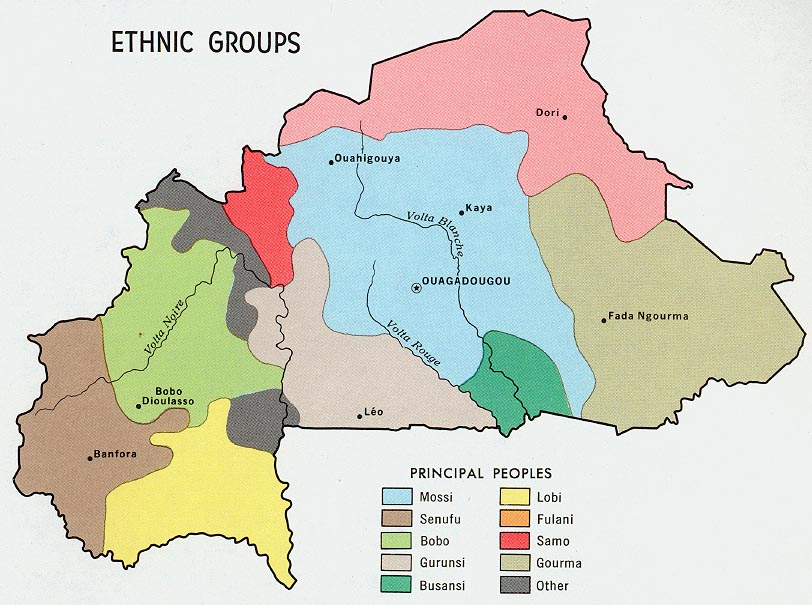
Burkina Faso is home to approximately 90 distinct ethnic groups. The Bolon represent only 0.1% of the population. Historically, the Bobo, the Lobi, and the Gurunsi were the earliest known inhabitants of the country. In about the fifteenth century A.D., conquering horsemen invaded the region from the south and established the Gurma kingdom in the east and the Mossi kingdom in the central area. Several Mossi kingdoms developed, the most powerful of which was Ouagadougou. This state, headed by an emperor titled the Morho Naba ("great lord"), defeated attempted invasions by Muslim Songhai and Fulani neighbors. Despite the warfare, the kingdom managed to maintain valuable commercial links with major West African trading powers, such as the Dyula, the Hausa, and the Asante (Ashanti).

Today, the Bolon grow staples such as millet, sorghum, and a wide variety of other crops. Crop rotation and some irrigation techniques are used, and small numbers of cattle and other animals are tended. Hunting, fishing, and the gathering of wild plants provide additional food for the Bolon.

In a particular locality, a clan composed of a local lineage dominates. Individual households consist of extended family units. Their houses are rectangular in shape, with mud walls, beaten-earth roofs, and, frequently, defensive outer walls. Many of the men have more than one wife. The levirate (compulsory marriage of a widow to her dead husband's brother) and the sororate (compulsory marriage of a woman to her dead or barren sister's husband) are commonly practiced.

Bolon society is patrilineal, that is, inheritances and lines of descent are traced through the males. Private property is passed to the eldest son, and household property is passed to the younger brother of the father. Married sons live in the household of their father.

Bolon social structure is relatively democratic without rigid classes. However, slavery was once present in the culture of the area, and despised castes of blacksmiths and leather workers still exist.

What are their beliefs?
About 90% of the Bolon are Muslims of the Sunni tradition, and about 3% are Christians. The remainder practice various forms of animism, believing that non-living objects have spirits. In particular, ancestor worship (praying to the dead for help and guidance) is practiced. It is believed that the supreme god is too distant to worship directly; therefore, the only way to serve or worship him is through a spirit. They will often worship a statue or other object that is believed to "house" a spirit. The spirit, in return, will give the worship to the supreme god.

What are their needs?
There are no Scriptures or Christian broadcasts available to them in their own language. Like many other West African tribes, the Bolon are dominated by Islam. This stronghold can only be loosened through prayer. Intercession and evangelism are needed to teach the Bolon that salvation comes only through the cross of Jesus.

Prayer Points
* Ask the Lord of the harvest to send forth laborers to work among the Bolon of Burkina Faso.
* Ask the Holy Spirit to grant wisdom and favor to missions agencies that are targeting the Bolon.
* Pray that Christian radio broadcasts, evangelical literature, and the Jesus film will be made available to the Bolon.
* Ask the Lord to raise linguists who will translate the Scriptures into the Bolon language.
* Pray that God will strengthen, embolden, and protect the Bolon believers.
* Take authority over the spiritual principalities and powers that have kept the Bolon bound for many generations.
* Ask God to raise prayer teams who will begin breaking up the soil through worship and intercession.
* Ask the Lord to bring forth a triumphant Bolon church to the glory of His name!

View Bolon in all countries.

 
Prayer Links Submit Links:
PrayerGuard.net
 
Web Profile Links Submit Links:
www.everyculture.com/Africa-Middle-East/index.html
www.muslimjourneytohope.com
www.gowestafrica.org/peoplegroups/bolon/
 
Web Resource Links Submit Links:
Audio RecordingsMegaVoice Audio Bible and Stories
Audio RecordingsGlobal Recordings

 
Maps
Submit Map:
Country Map:
Detailed UN Political map
Ethnolinguistic Map:
University of Texas map collection
Linguistic Map:
Ethnologue language map
 
  Submit Update:
Country: Burkina Faso
Continent:
Africa
Region:
West and Central Africa
Yes
Country Details: World Factbook
Total Provinces on file:1
   
 
People
Submit Update:
People Name in Country: Bolon
People Name General:
Bolon
People Code: 101573
Population in this Country: 24,000
Population all Countries: 24,000
Yes
   
 
Sub-Saharan African
Malinke
People Name General:
Bolon
NAB63z
Ethnic Relationships:
Affinity Bloc -> People Cluster -> Peoples Ethnicity Tree
   
 
Language
Submit Update:
Primary Language:
Bolon
Language Code (16th): bof    Ethnologue Listing
BOF
Total Languages Spoken:
1
   
 
Religion
Submit Update:
Primary Religion:
Islam
Major Religions:
Buddhism0.00 % 
Christianity3.00 %(Evangelical: 1.45 %)
Ethnic Religions7.00 % 
Hinduism0.00 % 
Islam90.00 % 
Non-Religious0.00 % 
Other / Small0.00 % 
Unknown0.00 % 
Christianity Segments:
Anglican0.00 %
Independent0.00 %
Protestant50.00 %
Orthodox0.00 %
Other Christian0.00 %
Roman Catholic50.00 %
 
(Evangelicals distributed across Christianity segments)
   
 
Joshua Project Progress Indicators
Yes
Progress Scale: 1.2   Evangelicals >.01% but <=2%. Professing Christians <=5%
   
 
Other Progress Indicators *
GSEC Status:Level 1   Less than 2% Evangelical. Some evangelical resources available, but no active church planting within past 2 years
Agency Progress (API):Level 3   Multiple agencies involved
Church Progress (CPI):Level 3   Group of churches
 
 
Bible Translation Status
Submit Update:
Bible Portions: Help start a Bible Translation
New Testament: None Reported
Complete Bible: None Reported
 
 
Ministry Activity
Register Ministry Activity:
Description: Register your ministry activity among this people group. Contact the Adopt-A-People Clearinghouse to learn about others that might be focused on this people group.
 
Bolon of Burkina Faso
* Notes:
  • Significant effort is made to match photos with people groups. In most cases the photo source has identified the people group. However, in some instances when the exact people group is not identified Joshua Project has made educated attempts at matching. As a result some photos may be representative of the people cluster rather than the specific people group. Mismatches are the fault of Joshua Project, not the photographer. Please contact us if you believe a photo is not matched with the correct people group.
  • Percentages may be printed as '0.00%' because of space limitations, but some are slightly greater than zero.
  • The exactness of the above numbers can be misleading. Numbers can vary by several percentage points or more.
  • People group population figures are now maintained as a percentage of the national population. Click here for details.
  • Joshua Project does not have specific ministry activity data supporting the "Other Progress Indicators."
  • Discrepancies may exist between "Other Progress Indicators" because of the varying sources of information.
  • Joshua Project does not know the exact content of web audio recordings. In general they are Bible reading and teaching.
  • As on-site realities are understood, barriers of acceptance may be found in many of the larger people groups that will require multiple distinct church planting efforts.
  • This data may contain errors and needs continual correcting and updating. Click here to send feedback.