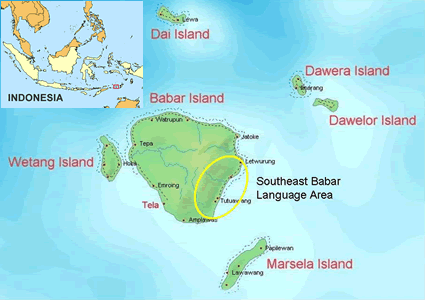

The South East Babar people live in the Babar Islands in the South West Pacific near North Australia. The Babar islands are thought to have been inhabited for 40,000 years, starting with Australoid people, then more recently, (from 3000 years ago), with waves of Austronesians mixing in. The Babar Islanders were traditionally animists and pretty much left alone until about 100 years ago when the former Dutch colonial government made all the Babar 1st nations move down out of their cliff-top fortresses and take up living by the beach and stop warring with each other.
Church officers from the Maluku Protestant Church (Gereja Protestan Maluku-GPM) were dispatched to christianize and baptize the Babar Islanders en masse, build church structures and install priests to conduct religious services. The GPM, the dominant religious institution in the Babar Islands, is 403 years old (founded in 1605); Asia's oldest Protestant denomination. The communities of the Babar Islands are nominally Christian, but they express discontent with their current lifestyles that they feel are inconsistent with their confession. The Babar Islanders layer surface Christian symbols and rituals over top their deeper traditional animistic and occult practices.
The Babar Islands are located roughly 160 miles east of East Timor and 300 miles north of Darwin, Australia or 7 degrees 66 minutes south of the equator and 129 degrees 40 minutes east of Greenwich. The arid Australian climate has a significant effect on the Babar islands. While there is plentiful rain from Christmas till August, there is very little to no rain from August till Christmas again. The wind blows almost constantly from the East from April through September, and from the West it blows from January to March. There is a calm season in October- November and again in March.
Babar Island, the archipelago's namesake, at a height of around 700 meters, dominates the local horizon. While Babar Island itself is relatively fertile and has abundant water due to its size and height which attracts rain clouds, it is surrounded by five much smaller and lower islands (located roughly at the cardinal directions) which are relatively much more arid and infertile. Drinking water is abundant on Babar Island, but there are always seasonal shortages on the smaller surrounding islands. Every year during the 4 month drought season the outlaying Babar Islanders suffer chronic dehydration and are forced to either defer bathing and clothes washing or do it in salt water.
Most villages are located at the seashore either on flat sandy areas or nestled amongst house-sized coral boulders, cliffs and outcroppings. Every village has coconut palm trees towering above the thatch roofs providing shade and a constant whispering of the leaves in the never-ending trade winds. The coconut meat is ground up and its oil extracted and used for cooking. The exhausted coconut meat grounds are fed to the pigs. The coconut meat is also a cash crop when dried and sold to local merchants who send it on by ship to oil extraction factories far away in the city.
Everyone lives in villages within a few metres of the ocean. Most people rise at 5 am before dawn with the crowing roosters. From every household comes the rhythmic swishing of some older female sweeping their dirt yard with a long whisk. A deep thumping shakes the earth from various quarters signifies women using large mortars and pestles to pulverize maize (a kind of white, starchy, tasteless corn), their chief staple. They grind the maize into a coarse meal, which is boiled and eaten like rice, often times mixed with red beans. An older female starts a wood fire in their kitchen hut and boils up some cassava tubers or rice or pulverized maize for the day's staple. The smoke of the cook fires seeping through all the thatch roofs rises to form a temporary haze in the still season. Many ladies fry wheat-flour donuts in homemade coconut oil from their own coconut trees, and fresh or day-old doughnuts are sold to the kids on their way to school.
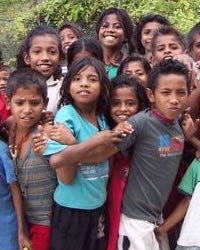
Mothers, aunts or older sisters serve up some rice or ground corn or a donut or a cassava tuber to the school aged children after they have washed their faces and put on their red and white school uniforms. At 7 am a teacher in a tan uniform at the school rings the hand bell and the children line up at attention and then all march into school. Some girls will carry a large Tupperware bucket full of donuts for sale at school. Dogs, chickens, pigs and goats all prowl about the sandy streets and yards looking for morsels to eat. Partially clad toddlers wander around in gangs gleefully terrorizing grasshoppers.
On Babar Island itself where there is a lot more forest, many of the men have already saddled up (with a pile of burlap sacks) their thin diminutive ponies and headed off into the forest to chop down trees for a new garden, move their cattle they have tethered in the bush, or to hunt wild boar, repair a storage shed, get building materials (rope from jungle vines, or palm leaves for thatch roofs, or giant bamboo), or do some weeding in their tangled gardens of corn/squash/beans.
Others of the menfolk, especially on the smaller outlaying Babar islands with less forest and more reef, have paddled out a few kilometers to sea in their small dugout canoes to go fishing for small tuna with a line and hook, no rod. Other men go diving and spear-fishing at the edge of the reef wearing home-made goggles carved from wood with bits of broken glass for lenses, glued in with insoluble tree sap. Children and young women walk around on top of the reef gathering seaweed, shellfish and small fish from tidal pools, often using poisonous vegetation from the forest to steep in the tidal pools to stun the little fish.
Some of the women bundle up their dirty clothes and detergent and head off on bicycle or foot to the beach or a stream a few kilometers away to pound their wash on the ancient, worn rocks. Some villages have no nearby stream so the women draw well water (sometimes salty) to wash the clothes at the concrete public laundry plazas strategically placed throughout the villages. In the few villages with gravity-fed springs and piping to bring the water to town, each neighbourhood washing plaza offers one faucet serving all comers, rather than a well.
At 8 am adult men and women in uniforms of brown, green, tan, grey or blue stroll along the streets on their way to their respective government offices, the men invariably puffing on a cigarette. In most remote villages the only kinds of government work are the elementary schools, a couple village staff and possibly a small health clinic. In the 3 municipal capitols there are senior high schools, various kinds of church officials, policemen, military, postal, environmental, agricultural, education, taxation, electrical grid, water system, harbour and a few other kinds of civil servants.
Around 10 am you might see old men from every quarter shuffling their way to one particular house. If you passed by that house you would see them sitting around in a tribal justice circle using the local indigenous language discussing the days' lawsuits. One younger man stands by holding a bottle of home-made coconut whiskey and a glass ready to take a drink to each elder who makes a short speech before quaffing back about an ounce's worth.
Around 1 o'clock the civil servants amble home from work. If you pass by some teacher's house in mid-afternoon you might see a group of 3 or 4 students getting a paid, private tutorial.
On many mornings can be heard the loud, slow chug of small multi-purpose plank-built wooden diesel boats (functionally equivalent to a 3 ton farm truck or a cube van) or fibreglass speedboats (called "Jonson" because of the outboard motor), or large motorized canoes powered by a 5 hp lawnmower engine, arriving or leaving, ferrying goods and passengers to and from the municipal capitol to villages on other islands or villages that have no road. The boat weighs anchor 100 meters from shore beyond the pounding surf and young men paddling dugout canoes weave their way out from shore through the breakers to unload cement bags, boards, boxes of ceramic floor tile or corrugated metal roofing panels, along with passengers. People take live chickens, pigs and goats and garden produce or fruit, if it is in season. Kitchen wares, plastic lawn chairs and stereo equipment or even a fridge might be seen unloaded. Sacks of dried coconut meat or dried fish or seaweed may be loaded to go to town for sale.
On any given day people will catch a ride in a boat, or paddle themselves in a canoe, or walk, bicycle, horse-ride or hitch-hike on a local merchant's 3 ton truck to other villages on their island to shop, go to a government office or visit relatives or take garden produce and dried fish to children boarding in the municipal capitol town where they attend high school.
By 10 am the youngest children are already headed home from school, the older ones getting out at 12. Older girls have many chores around the house like fetching water, washing the dishes and pots, boiling the drinking water, feeding bathing and watching younger relatives, sweeping, grinding corn etc. Boys on the other hand have few set chores but are encouraged to mimic as occasion permits their fathers' caring for and training hunting dogs and the wild pigs they capture and domesticate, hunting and gathering on the reef or in the forest, and crafting and maintaining their tools, weapons, traps, boats, fishing equipment and structures.
By mid afternoon most of the children are out playing. Swimming, marbles, dolls, complicated games that look like a combination of tag, British bulldog, and ten other games rolled into one, hopscotch, skipping rope, hunting and trapping birds or going with dad or mom to the gardens in the forest to do some "work" in the garden or to the clothes washing spot at the creek or seashore.
Oftentimes they go play in the ocean, the boys especially liking to surf with dugout canoes and home made surf boards, while the girls and smaller boys dive and swim in natural pools in the reef. Once or twice a week a couple girls from each family are sent out to gather firewood, which consists of dead branches the size of their arms. The wood is carried back in the large freight-basket that hangs on the woman's back by a strap going over the shoulders and suspended from the forehead. Men are not allowed to carry this basket, but traditionally walk with weapon at the ready to fend off attackers from hostile neighbouring tribes. This practice persists although the inter-tribal raiding has long since ceased! The men have come back from fishing and two kids in single file carry a pole horizontally between their shoulders with a few large tuna-like fish swinging by string from the centre and the boys loudly call out in a lilting sing-song "Ikan! Ikan!" as they walk up and down the lanes looking for buyers.
At 5pm there is often some kind of religious service so just before sunset you can usually see men, women or children freshly bathed, hair combed, faces baby-powdered, wearing their best clothes and carrying an Indonesian Bible and prayer book strolling off to some kind of religious rite. The sun slips behind the mountain and about 30 minutes later outdoor electric lights all over town flick silently and simultaneously to life as the island's power comes on. All the children hoot and holler in celebration of a bright evening ahead of them with televisions and stereos mumbling or blaring throughout the village and a dim light-bulb by which to do their homework.
The South East Babar people believe first of all that there is a profound connection between all things physical and spiritual. Something done in the physical always has an impact on the spiritual, and vice versa. The other fundamental assumption is solidarity. They must remain united in their activities at all costs. Spending time alone is seen as a symptom of imbalance if not derangement. Doing things individualistically could also have negative spiritual and physical consequences. They think it is very important to be together corporately at the various religious services and rites prescribed by the church. Private personal prayer and Bible reading at home is not a cultural value. While they say they do not understand the written Indonesia Bible nor the meaning of the religious rites they attend, they always complain about those who are absent from religious meetings, believing that the lack of solidarity will have a bad consequence like crop failure, injuries or epidemics. They believe that there are malevolent spirits all around them just waiting to pounce at the slightest provocation. So they have many folk beliefs for every aspect of life, designed to appease the spirits. They are afraid to go into the forest alone at any time, and especially not at night at which time they believe that blood-thirsty spirits wander about seeking whom they may devour.
The South East Babar people feel it is impossible for them to develop a decent standard of living. They are a minority in various ways (visibly, linguistically, culturally, economically, religiously, geo-politically) and they feel they are not allowed to advance and develop as they would like. There are resources and potential at their disposal which they could develop, however. Beyond the need for self-directed development of their islands, what the South East Babar people need most is the comforting, empowering and life-changing presence of the Holy Spirit received as pure gift by faith alone in the redemptive life, death and resurrection of Jesus. While the written Bible in Indonesian is available, they are not proficient readers, they do understand Indonesian that well, they do not understand all the abstract material in their religious rites and the Indonesian written New Testament, and they do not feel much emotional attachment to it. They appreciate and understand oral stories in their tribal indigenous language far more.
Pray for a spiritual awakening.
Pray for a Holy Spirit-directed emergence of spiritually hungry people who will commit to praying together daily for awakening.
Pray for the priest couple heading up the South East Babar mainline church, that they all will intensely, unrelentingly and unmistakably sense God loving them and exulting over them, unconditionally just as they are, that they will sense and understand and respond to His call to them to surrender to Him totally and unconditionally regardless of cost or consequence, to give up anything, go anywhere, do anything, be anything He wants- to let Him help them live His way, not their way. To so experience God-in-Christ to the fullest extent possible and as a result be gifted, empowered and motivated to understand the life-transforming core message of the NT and explain it to others effectively, successfully challenging many to respond to the Holy Spirit and let God take over and change their lives.
Pray for God to raise up South East Babar prophets, evangelists, apostles, pastors and teachers (Eph 4:11) to rise in the power of the Spirit to preach repentance and reconciliation to God, to pray for the sick and see supernatural healings, to confront and cast out demons, casting down demolishing and taking into captivity every thought and principality opposed to God, training other lay people to go do likewise.
Pray for miraculous healings and signs that confirm the trustworthiness of His chosen messengers and the truth of God's simple effective message of reconciliation to Him and abundant life in His loving presence by His unconditional mercy alone through the agency of Jesus alone.
Pray for the exposure, disarming and expulsion of the works of darkness and the deceiving spirits that keep people in bondage. Pray the South East Babar people will come to believe in and accept God's desires for joyous intimacy with them, spiritual transformation, permanent progressive victory over specific kinds of sin. Pray that they are infected with God's passion to reach out in loving service to the many millions of others in Indonesia.
Pray for godly sorrow and true repentance for behaviours that is sensual, escapist, selfish, egotistical, arrogant, independent, cruel, God-ignoring; specifically unfaithfulness, deference to other spirits, promiscuity, pornography use, herbally-induced miscarriages, drunkenness, brawling, domestic violence, thievery.
Pray that the South East Babar people be truly reconciled to God and indwelt by Him by faith and grace alone. Pray specifically so the South East Babar people will listen and respond to the pure simple message of reconciliation to God and a transformed, abundant life by the power of the indwelling Spirit alone, by God's unilateral and unconditional kindness and mercy alone, and the agency of Jesus alone.
Pray for the translation and availability of the JESUS Film and God'sStory in the South East Babar language.
Pray for the spread of God-enabled and empowered ministry of the effective life-transforming core message of the Bible stories through adaptation of Tela-Mas Buar oral Bible stories into the other closely-related language of South East Babar. Pray for God to call, inspire, rise up and send already-spiritually transformed people to South East Babar to start Spirit-directed and empowered ministry.
Scripture Prayers for the Babar, Southeast in Indonesia.
| Profile Source: Anonymous |