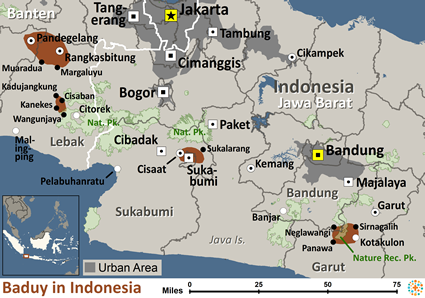

The Baduy or Kanekes are a traditional Sunda community who live in Lebak Regency of Banten Province. "Baduy" may have been a name given to them by Dutch researchers. It is also possible that the name Baduy comes from the name of the Baduy River and Baduy Mountain in the northern part of their territory. The group prefers to call themselves the Kanekes people, which comes from the name of the land where they live. They live at the foot of the Kendeng Mountain in Kanekes Village, Leuwidamar District, Lebak Regency, about 40 km from Rangkasbitung city. They speak a dialect of the Sundanese language called Badui.
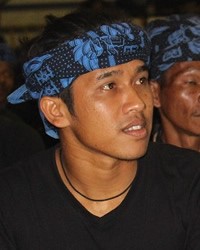
In general, the Baduy are divided into three groups, called tangtu, panamping and dangka. The tangtu group, also known as the Inner Baduy, is the strictest in following their traditional customs and wears characteristic clothing that is white or dark blue with white head scarves (worn by men). The panamping community, also known as the Outer Baduy, lives in various settlements spread around the territory of the Inner Baduy and can be recognized by their black clothing and head scarves. While the Inner Baduy and the Outer Baduy live in the Kanekes region, the Dangka Baduy live outside of Kanekes, in the two remaining Baduy settlements. The Dangka Baduy area functions as a buffer zone from outside influences.
The highest-ranking leaders of the community are the three puun, who live in each of the three Inner Baduy settlements. Daily administration of customary law is carried out by members of the community who carry the title jaro. There are four types of these leaders: jaro tangtu (Inner Jaro), jaro dangka (Outer Jaro), jaro tanggungan (Security Jaro) and jaro pamarentah (Government Jaro). For hundreds of years, the Kanekes community has practiced dry rice cultivation. They also obtain additional income from selling fruit harvested from the forest such as durian and tamarind as well as wild honey.
Their traditional belief system, known as Sunda Wiwitan, is based on sacrifices made to their ancestor spirits. Throughout its development, Sunda Wiwitan has been influenced by Buddhism, Hinduism and Islam. Their core belief is in pikukuh, which means following an absolute set of determined traditions in their daily lives. The most important teaching of pikukuh is the concept of "no change whatsoever" or as little change as possible. A Baduy proverb translates as, "The long must not be cut short, the short must not be lengthened."
The most important object of this belief system is Arca Domas, a secret location that the Baduy consider to be the most sacred place in the world. The Baduy visit Arca Domas to make sacrifices once a year in the month of Kalima according to the Baduy calendar. Only the puun as the highest chief and a few chosen members of the community may join the group that sacrifices at Arca Domas. Hollows in the rocks at Arca Domas store rain water. The Baduy believe that at the time of the annual sacrifices, if the rocks are full of clear water, this is a sign that there will be plentiful rain that year and the harvest will be good. If the rocks are dry or contain muddy water, this is a sign that the harvest will be poor.
Most Baduy people are still very isolated from modern technology, especially those who live in the Inner Baduy area. This is due to their cultural value of pikukuh. The Baduy need to choose between retaining their culture and technological advancement or else work to find a balance between the two in their way of life.
A translation of the Bible into the Badui language has begun, and some gospel recordings are available.
Ask God to free the Baduy from the darkness of false religion; pray that God will remove the barrier of resistance to change that could stand in the way of the gospel.
Pray for the completion of the translation of the Bible into the Badui language and for a hunger among the Baduy for the truth of God's Word.
Ask God to raise up a team of workers to take the gospel to the Baduy and to lead them to people who are ready to hear and respond.
Pray for a movement to Christ among the Baduy that will lead to vibrant, multiplying house churches.
Scripture Prayers for the Baduy in Indonesia.
| Profile Source: Joshua Project |