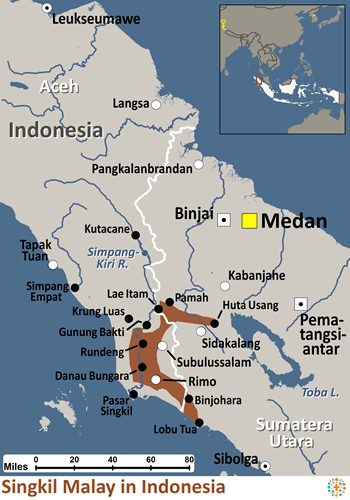

The Singkil people live in the southwestern part of Aceh Province, South Aceh Regency, in the areas of Singkil, Simpang Kiri, Simpang Kanan and Pulau Banyak. The Singkil area borders on North Sumatra Province. The Singkil people are thought to be a mixture of the Mandailing, Aceh, Minangkabau and Nias peoples. Singkil oral mythology provides insight into the origins of the Singkil people. Their language is called Pesisir Singkil and is influenced by the Minangkabau and Batak languages. There are actually two different groups who called themselves the Singkil: The Ulu people who speak Kade-Kade and those who speak the Ba'Apo language. The two groups live side by side in Singkil, the Ba'Apo in the center of the port and the Kade-Kade on the outskirts.
The main source of income for the Singkil is farming and fishing. Some work as day laborers and craftsmen. Others make a living by processing nipa palm leaves and fruit that grow along the rivers and in the swamps. Nipa leaves are used to make roof thatch and cigarette wrapping and the fruit can be eaten. The Singkil live in villages on the coast, along the rivers and in the hills. The Singkil River is important in local daily life and is used for drinking water, bathing, dumping trash and river transportation. Singkil houses are built on wooden stilts about three meters off the ground. Togetherness and strong family ties are important in the Singkil people's way of life. Their life is regulated by traditional culture and Islamic laws. Cultural and religious leaders are very influential and respected in the community. The main traditional political institution in the community is called ninik-mamak. This institution functions not only in cultural affairs but also in solving village government problems. Ninik-mamak consists of older people and those chosen as elders, such as the kepala mukim (district head), pemuka adat (cultural leader) and khatib (preacher). The Singkil have a patrilineal kinship system, meaning that they trace descent from the father. The smallest kinship group is the nuclear family. The extended family is called dulsanak. They also have clans, which are made up of several extended families. The largest Singkil clans are the Beramu and Tinambunan clans. One must marry outside one's own clan. In recent years there have been two natural disasters: a tsunami and an earthquake. During the 2004 tsunami that destroyed the west coast beach of Aceh, the Singkil were spared from the greal wall of water, however the earthquake that caused the tsunami did many kinds of damage to the Singkil. While the people were spared from the tsunami wave, it did, however cause fear in the community. However, the Nias Island earthquake caused significant damage to Singkil town. The elevation of the land sank as much as one meter in places and many houses were destroyed, but no lives were lost. Because of the earthquake, many locals moved from Singkil town to higher areas.
The Singkil people follow Islam, although some of them still trust in the spirits of their ancestors and religious leaders that have died. Places that are considered sacred include the grave of Abdul Rauf, a great religious teacher. The Singkil people also regularly seek the services of a shaman.
The Singkil people are looking for economic advancement as they try to find ways to earn higher income. Many do not understand the complexities of their economic situation. For most Singkil, improvement of agriculture and fishing enterprises would also be very beneficial. Clean water is quite difficult for most Singkil to obtain especially those living in swamp area and or the sea.
Pray for the Holy Spirit to prepare the hearts of the Singkil leaders to hear and respond to the gospel.
Pray for God to raise up, prepare and thrust out workers.
Pray for Singkil disciples to make disciples of family members.
Scripture Prayers for the Malay, Singkil in Indonesia.
IPN, 2011 Copyrighted © Used with permission.
| Profile Source: Joshua Project |