


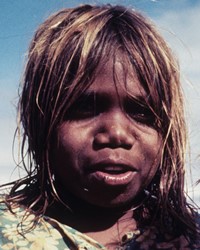

The Kuku-Yalanji are an Aboriginal Australian people who are the traditional owners of the coastal lowlands, mountains, rivers, and rainforests of Tropical North Queensland. Their traditional lands extend from south of Mossman north to Cooktown and inland to the Great Dividing Range. For thousands of years, the Kuku-Yalanji lived as hunter-gatherers with a deep knowledge of the rainforest environment. They developed survival techniques, including seasonal food gathering, fishing, and the use of medicinal plants.
From 1887 to 1902, a Lutheran mission was established by the Germans in the Bloomfield River to evangelize the Kuku-Yalanji people. Although the mission was a shelter providing food and material items, its main mission to evangelize was futile. Invasion in the 19th century by miners due to the Palmer River gold rush and the expansion of agriculture caused major and severe disruption to the lives of the Kuku-Yalanji. Despite strong resistance from the Kuku-Yalanji, their armed conflicts with Europeans inevitably resulted in numerous casualties. Government policies imposed on the Aboriginal Australians resulted in a loss of their basic human rights, as many Kuku-Yalanji people were separated and removed from their families and their country.
Today, many Kuku-Yalanji people live in communities such as Mossman Gorge, Wujal Wujal, and Hope Vale, while others reside in regional towns and cities. To ensure that their voices are heard and that their welfare is taken care of, the Jabalbina Aboriginal Corporation — the Registered Native Title Body Corporate represents the Eastern Kuku Yalanji people. In recent decades, the Eastern Kuku Yalanji people have regained recognition of their traditional owner's hip through native title agreements. In 2021, large areas of the Daintree Rainforest and surrounding national parks were formally returned to Aboriginal ownership under joint management arrangements.
Known as bama (rainforest people), they act as caretakers of their land, caring for country is viewed as both a cultural responsibility and a way of honoring their ancestors. The Kuku-Yalanji people prioritize the right to own, manage and protect their traditional lands through the development of tourism, businesses and managing cultural heritage under the direction of the Elders.
Family and kinship remain central to Kuku-Yalanji identity. Elders are highly respected because they preserve oral history, ceremonies, and knowledge of sacred sites. Traditional practices such as storytelling, dance, art, and ceremonies continue alongside modern Australian life. Although many people participate in contemporary Australian society, they continue to value their spiritual relationship with the natural elements of their country.
For instance, "on country" projects for the Eastern Kuku Yalanji people in Far North Queensland focus on cultural revitalization, environmental management, and tourism. They hope that each Aboriginal and Torres Strait Islander young person will discover their inherent connection to the country and subsequently desire to contribute to their local community and mainstream society positively. The Eastern Kuku Yalanji community has embarked on youth-led storytelling projects, utilizing music, film, and digital media to explore culture, country, and community well-being.
Employment opportunities vary. Some individuals work in tourism, land management, art, and community services, while others face unemployment or limited job prospects due to geographic isolation. Mossman Gorge Cultural Centre provides a valuable connection to the Indigenous community, protects a vulnerable ecosystem and promotes economic wellbeing for the communities because the workforce consists predominantly of local Kuku Yalanji people who take pride in raising awareness of their culture.
Education access has improved, but challenges remain in achieving equitable outcomes. Nationally recognized hospitality training and employment pathways for young Aboriginal and Torres Strait Islander people as an entry into the workforce.
Traditional Kuku-Yalanji spirituality is deeply connected to the land and the Dreaming. These Dreaming stories explain the creation of natural features, animals, and social laws, and they continue to hold great cultural significance. There are key sites throughout their territory that are linked to these ancestral narratives, and ceremonies, songs, and rituals such as Welcome to country and smoking ceremonies are used to maintain spiritual balance and connection to the land. The landscape is not just physical; places like Wundu (Thornton Peak) and Manjal Dimbi (Mount Demi) are considered spiritual, powerful, and sometimes dangerous.
Christianity was introduced through missions and colonial influence, and today some Kuku-Yalanji people identify as Christian, often within Catholic or Protestant traditions. However, in many cases, Christian beliefs are blended with traditional spiritual understandings. The New Testament and some audio recordings are available in the Kuku-Yalanji language, although additional Christian resources are limited.
The Kuku-Yalanji people continue to face challenges connected to the long-term effects of colonization, displacement, and social disadvantage. Like many Indigenous communities, the Kuku-Yalanji face social and health challenges, including higher rates of chronic illness, housing shortages, and the effects of historical trauma. Many communities experience difficulties related to health, employment, education, and housing.
Young people often struggle to balance modern Australian culture with the preservation of traditional identity and language. There is also a continuing need for cultural preservation. Although the Kuku-Yalanji language is still spoken, it remains vulnerable, and many Elders are working hard to pass it on to younger generations. Community-led programs in education and tourism are helping preserve both language and culture.
Spiritually, many Kuku-Yalanji people identify with Christianity but have limited access to culturally appropriate discipleship, Bible teaching, and leadership training in their own language and cultural setting. Greater support for Indigenous Christian leaders and locally rooted churches could strengthen the growth of faith communities.
Pray for the wisdom and strength of Kuku-Yalanji elders as they lead and make decisions that will ensure land sustainability for their future generations.
Pray for the young Kuku-Yalanji to honor their families and use their talents for the betterment of society.
Pray for Aboriginal Christians to share the gospel as prompted by the Holy Spirit in their traditional lands.
Pray for God's power to help the Kuku-Yalanji people to release forgiveness and receive healing from him.
Scripture Prayers for the Kuku-Yalanji in Australia.
https://www.mossmangorge.com.au/about-us/our-story
https://www.qld.gov.au/firstnations/cultural-awareness-heritage-arts/community-histories/community-histories-u-y/community-histories-wujal-wujal
https://anglicanfocus.org.au/2020/06/01/qa-with-kuku-yalanji-woman-and-anglicare-cultural-support-worker-lalania-tusa/
http://douglas.qld.gov.au/download/miscellaneous/Daintree-Gateway-Kuku-Yalanji.pdf
https://en.wikipedia.org/wiki/Kuku_Yalanji#:~:text=They%20were%20further%20subjected%20to,in%20Mossman%20and%20Wujal%20Wujal.
https://www.countryneedspeople.org.au/outon_country_with_allira_alvoen
https://www.jabalbina.com.au/wp-content/uploads/2021/12/Bamangka_Kaban_DECEMBER.pdf https://australianstogether.org.au/assets/External-Files/PD190+Engaging+with+Communities+Paper-web-FA-1.pdf
| Profile Source: Joshua Project |


