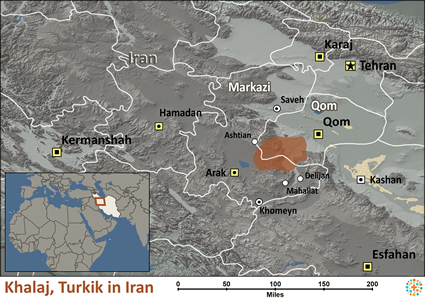

The Khalaj people are a Turkic ethnic group living primarily in central Iran, especially in Markazi Province, with smaller communities elsewhere. They speak the Khalaj language, an ancient Turkic language also known as Arghu, which preserves features no longer found in most other Turkic languages.
Historically, the Khalaj trace their origins to Central Asia, where early records describe them as a Turkic tribe living along the steppes. Over time, they migrated westward into the Iranian plateau, often as a result of war, conquest, and shifting political powers. Their long history includes periods of movement during the medieval era, including the time of the Mongol invasions.
Today, the Khalaj are part of the broader cultural landscape of Iran while still maintaining a distinct linguistic identity. However, their language is under pressure as Persian increasingly dominates public life, and younger generations may not consistently learn it.
There is very little specific information available about the daily lives of the Khalaj people. However, their communities are primarily located in rural villages across central Iran, where patterns of life are shaped by agriculture, local trade, and family-centered living.
Many Khalaj likely engage in farming or livestock herding, practices that are typical in the semi-arid regions where they live. Daily routines are influenced by the climate and availability of water, requiring careful management of crops and animals. In such settings, men often handle fieldwork and herding, while women contribute significantly through food preparation, household management, and sometimes agricultural labor.
Family and community relationships are central. Extended families commonly live in proximity, supporting one another and preserving traditions. Respect for elders and shared responsibility are important values, helping maintain strong social cohesion. Meals often reflect broader Iranian cuisine, including bread, grains, dairy products, and locally available produce and meats.
Culturally, the Khalaj maintain elements of both Turkic and Persian heritage. Traditional crafts, music, and storytelling may be part of community life, especially during gatherings or local celebrations. Within the home, the Khalaj language may still be spoken among older generations, though Persian is widely used in education and public interaction. The gradual shift toward Persian presents an ongoing challenge for preserving their linguistic identity.
The Khalaj people are entirely Muslim and follow the Shia branch of Islam, which is the dominant religious tradition in Iran. Their beliefs are based on the teachings of the Koran and shaped by the practices and traditions of Shia Islam.
They are taught that the Koran is the final and complete revelation from God, and that it provides the path to salvation. Like many Muslim communities, they may also believe that the Bible has been altered, which can create barriers to accepting its message. Without clear exposure to biblical teaching, they do not understand salvation through Jesus Christ. Their worldview is strongly influenced by Islamic theology, affecting both religious devotion and everyday decision-making.
The Khalaj people have limited access to the gospel in their own language. There are no widely available Christian materials, and even basic resources such as Scripture or gospel recordings are scarce or nonexistent in the Khalaj language. This creates a significant barrier to understanding the message of Jesus Christ in a meaningful and personal way.
Because they are an unreached group, there is a need for workers who are willing to invest time in learning their language and culture, building trust, and sharing the gospel clearly. Translation efforts, oral Bible stories, and culturally appropriate teaching would play an important role in this process.
Practically, as a rural population, they may face challenges related to economic opportunity, education, and access to healthcare. In addition, the gradual loss of their language poses a cultural challenge, as younger generations shift toward Persian. Supporting both their physical well-being and cultural preservation can open doors for deeper engagement.
Pray that the Khalaj people will be adopted through the People Group Adoption program, leading to faithful, long-term prayer and intentional gospel outreach.
Pray that Christians will be called and equipped to go to the Khalaj, building relationships and sharing the truth of Jesus Christ with humility and wisdom.
Pray that a deep spiritual hunger will awaken among the Khalaj, leading them to seek truth and follow Jesus Christ no matter the cost.
Pray for their daily needs to be met, including stable livelihoods, access to healthcare, and opportunities for education in their communities.
Scripture Prayers for the Khalaj, Turkic in Iran.
https://www.ethnologue.com/language/klj/
https://en.wikipedia.org/wiki/Khalaj_language
https://culturesherpa.org/Khalaj.html
| Profile Source: Joshua Project |