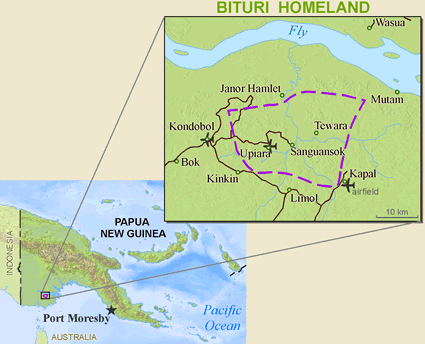

The Mutum Paswam people live in remote areas of Papua New Guinea, primarily in forested regions where rugged terrain and limited transportation routes contribute to their relative isolation. Their communities are often small and dispersed, with footpaths and waterways serving as the main means of connection between villages. The people speak the Bitur language, which is central to their cultural identity, while Tok Pisin may be used for trade or communication beyond their immediate group. Their history has been preserved largely through oral tradition, with stories that recount their origins, migrations, and relationships with neighboring groups. Contact with the outside world has been limited, though mission efforts and government outreach have gradually increased awareness of broader society while leaving much of their traditional way of life intact.
Life for the Mutum Paswam people is closely tied to the natural environment. Gardening is the foundation of daily activity, with crops such as sweet potatoes, taro, and bananas forming the main diet. Hunting and fishing provide additional sources of food, and knowledge of the surrounding forest is essential for both survival and livelihood. Daily routines are shaped by the demands of tending gardens, preparing food, and maintaining homes built from local materials.
Family relationships are central, with extended families often living near one another and sharing responsibilities. Men and women contribute in complementary ways. Children learn through observation and participation, gradually taking on roles as they grow older. Social life includes communal gatherings, storytelling, singing, and traditional celebrations. While some modern influences have reached the area, many still live with limited access to healthcare, education, and economic opportunities, making daily life both physically demanding and deeply communal.
The Mutum Paswam people traditionally follow animistic beliefs that recognize spiritual forces as active in the natural world. Spirits are often associated with elements of the environment, and maintaining harmony with these forces is considered essential for health and success. Rituals, taboos, and traditional practices are used to seek protection and avoid misfortune. Ancestors may also be honored, with a belief that they continue to influence the living.
There has been some exposure to Christianity, and in certain communities elements of biblical teaching are present. However, traditional beliefs often remain influential, sometimes blending with Christian ideas without a full understanding of the gospel. Many people continue to live with a sense of fear regarding spiritual forces, rather than the assurance that comes from knowing Jesus Christ.
Improved access to healthcare would address common illnesses and reduce preventable suffering, especially in areas where medical assistance is difficult to reach. Opportunities for education could equip individuals with skills that benefit both their families and their communities. Reliable access to clean water and improved agricultural practices would strengthen food security and overall well-being.
Spiritually, there is a need for the gospel to be communicated clearly and consistently in a way that connects with their cultural understanding. More Scripture in the Bitur language would allow individuals to engage personally with God's Word and grow in faith. Long-term Christian presence within the community could foster discipleship, encourage spiritual growth, and help establish a strong local church. Local believers, once equipped, could take an active role in sharing the message of Christ with neighboring groups who have little access to the gospel.
Pray for improved healthcare, clean water, and sustainable food sources that will strengthen daily life for the Mutum Paswam people.
Pray that the message of Jesus Christ will be clearly understood, bringing freedom from fear and a living hope.
Pray for committed Christian workers to serve among them with wisdom, humility, and perseverance.
Pray that believers within the community will grow in faith and become effective witnesses to others who have not yet heard the gospel.
Scripture Prayers for the Paswam, Mutum in Papua New Guinea.
https://www.peoplegroups.org
https://www.ethnologue.com
https://www.operationworld.org
| Profile Source: Joshua Project |