




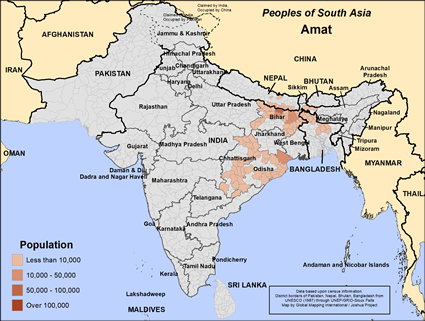
The Amat, also called Amanat in some regions, are a community found mainly in the eastern Indian states of Odisha, Bihar, Jharkhand, and Chhattisgarh. They primarily speak Hindi along with regional dialects shaped by local culture and geography. Historically, the Amat have been connected to agricultural work and village life, though some families also became known as carpenters, artisans, or daily laborers. Their identity has been shaped by the broader caste-based social structure common throughout much of India.
Like many communities in India, the Amat maintain a strong sense of social identity tied to family heritage, occupation, and regional customs. In some places they identify themselves within the traditional Hindu caste framework differently than neighboring groups view them. These social distinctions continue to influence marriage patterns, community relationships, and social mobility. Though modernization has changed village life in many areas, traditional customs and inherited identities still remain influential.
Most Amat families are connected in some way to agriculture, either through farming their own small plots of land or working as agricultural laborers for others. Some also work as carpenters, craftsmen, construction workers, transport laborers, or seasonal workers in nearby towns and cities. Economic conditions vary widely depending on region, rainfall, education, and access to employment opportunities.
Family and village relationships are central to daily life. Extended families often live close together, and important decisions are commonly shaped by elders and community expectations. Marriages are usually arranged, and social life frequently revolves around religious festivals, weddings, harvest celebrations, and local traditions. Meals commonly include rice, lentils, vegetables, flatbreads, and locally available foods depending on the region.
Younger generations are increasingly exposed to modern education, mobile technology, and urban employment opportunities, yet many Amat communities still face financial instability and limited access to quality healthcare and education. Migration to larger cities for work has become more common, especially among younger men seeking steady income for their families.
The Amat are primarily Hindu and participate in a mixture of mainstream Hindu worship and local folk religious practices. Devotion to Hindu gods and goddesses such as Mahadev and Thakurani is common, along with observance of regional festivals, rituals, and temple ceremonies.
Astrology often plays an important role in personal and family decisions. Astrologers may be consulted to determine favorable dates for weddings, business activities, travel, or major life events. In some communities, spiritual beliefs also include fear of curses, evil influences, ancestral spirits, or unseen powers that affect health and prosperity. These beliefs can blend traditional Hindu practice with animistic and folk religious elements.
Although many Amat people are religious and sincere in their devotion, most have had little exposure to the biblical gospel. They need to hear that forgiveness of sins and eternal life come through Jesus Christ alone rather than through rituals, astrology, offerings, or religious effort.
The Amat need greater access to clear biblical teaching and faithful Christian witness presented with humility and compassion. In many areas there are few mature churches or trained believers equipped to share the gospel effectively among them. Family and social pressure can also discourage individuals from openly following Christ.
Practical needs remain significant in many communities. Poverty, unstable employment, limited educational opportunity, poor healthcare access, and economic uncertainty continue to affect many families, especially in rural areas. Seasonal labor and migration can create additional family stress and instability.
There is a need for long-term Christian workers who can build relationships, disciple new believers, and provide Scripture resources in languages people understand well. Compassionate ministry that addresses both spiritual and practical needs can help open doors for meaningful gospel conversations and lasting transformation.
Pray that the Amat people will hear and understand the gospel message and place their faith in Jesus Christ for salvation.
Pray that God will raise up faithful Christian workers who will serve among the Amat with wisdom, humility, and perseverance.
Pray that the Amat people will be adopted through the People Group Adoption program so that churches and believers will commit to sustained prayer and future gospel outreach among them.
Pray that any existing believers among the Amat will grow strong in biblical truth and boldly share Christ with their families and neighboring communities.
Scripture Prayers for the Amat in India.
https://en.wikipedia.org/wiki/Caste_system_in_India
https://pmc.ncbi.nlm.nih.gov/articles/PMC10764522/
https://www.worldhistory.org/article/1152/caste-system-in-ancient-india/
| Profile Source: Joshua Project |



