



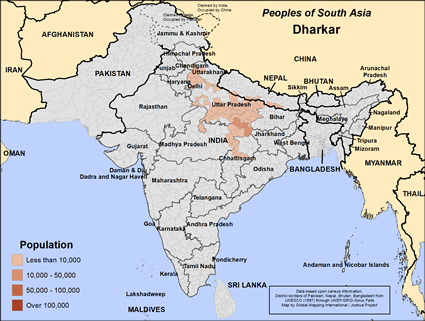
The name "Dharkar" comes from dhar, meaning rope or cane making. The name fits the people; they have always made bamboo and rope products such as baskets that they sell in the markets. They often use "Dharkar" as a family surname as well as the name of their group. Each marriage is a joining of two families more than it is a joining of two individuals.
They are much stricter about divorce than other Hindu communities. Dharkar women are very active in household jobs, and they play a major role in ritual and economic activities. Because their children are usually wage laborers and don't get the education they need, their literacy rate remains low.
The Dharkar of India enjoy recreational activities that are simple, community-oriented, and closely tied to their daily lives. Because many Dharkar families are engaged in labor-intensive occupations such as bamboo work and basket making, leisure time is limited and usually occurs in the context of social interaction.
Children and young people engage in simple outdoor games, while adults find enjoyment in conversation and shared cultural activities. Overall, the recreational life of the Dharkar reflects a strong emphasis on community, tradition, and shared celebration.
Evenings often provide opportunities for relaxation, as men gather to talk, share news, and discuss village matters, while women socialize during household tasks. These informal gatherings strengthen relationships and reinforce community unity.
Festivals and social ceremonies are the primary occasions for recreation. During Hindu festivals and local celebrations, the Dharkar participate in singing, dancing, and communal meals. Weddings and family events also serve as important times of enjoyment, bringing extended families and neighbors together.
The Dharkar people practice Hinduism, the ancient religion of India. Hinduism is a catch-all term for the local religions of South Asia, so it is very diverse. At the popular level, Hindus worship and serve the gods of the Hindu pantheon. They visit Hindu temples and offer prayers, food, flowers, and incense to their gods in hopes of gaining protection and benefits. They do not have a personal or familial relationship with their gods like Christians or Jews. There are other Hindus who are much more philosophical, especially among the Brahmins.
Almost all Hindus participate in yearly celebrations like Holi, the festival of colors and the start of spring / Diwali, the festival of lights / Navratri, the celebration of autumn / and Rama Navami, Rama's birthday.
There may be no Christ followers among the Dharkars, and they live in some of India's least reached states. They are not likely to meet someone who follows the Lord.
Pray for excellent Christian materials like gospel recordings to be produced and widely distributed among the Dharkar in the Awadhi and Hindi languages.
Pray that radio broadcasts will address their spiritual need to be joined with Jesus.
Pray that the Holy Spirit will give them a willingness to seek and find the only savior.
Pray for loving and dedicated workers among them.
References
Scripture Prayers for the Dharkar in India.
| Profile Source: Joshua Project |



