




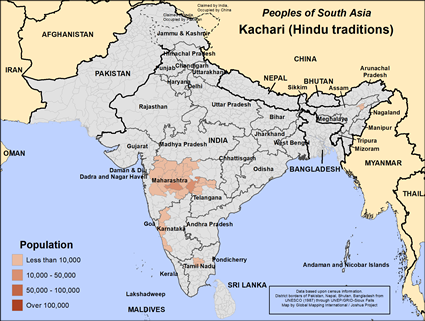
The Kachari people are one of the ancient ethnic communities of northeastern India, primarily found in Assam and nearby regions. The name "Kachari" has historically been used broadly for several related groups connected to the larger Bodo-Kachari heritage of the Brahmaputra Valley. Those identified with Hindu traditions have largely integrated into Assamese Hindu society while still retaining aspects of their older cultural identity, customs, and community traditions. Their primary language is generally Assamese, though some also speak Bodo-related dialects or regional tribal languages depending on location.
Historically, the Kachari were connected to powerful kingdoms and tribal societies that once ruled portions of northeastern India. Over centuries, many Kachari communities gradually adopted Hindu practices through interaction with Assamese culture, regional rulers, and Vaishnavite movements in Assam. Even with these influences, many families preserved older customs, clan structures, folk traditions, and cultural practices rooted in their indigenous heritage.
Today, Kachari communities may live in rural villages, tea-growing regions, towns, or expanding urban areas. Their history reflects a blending of tribal roots, Assamese cultural influence, and Hindu religious traditions shaped over many generations in northeastern India.
Many Kachari families continue to live in rural areas where agriculture remains central to daily life. Rice cultivation, fishing, livestock care, weaving, and manual labor are common occupations in village communities. Others work in government jobs, education, transportation, tea plantations, trade, or urban labor depending on economic opportunities available in their region.
Family and community relationships are highly valued. Extended families often maintain close ties, and traditional festivals, marriages, and village gatherings remain important parts of social life. In many households, women play a significant role in weaving traditional clothing and maintaining cultural customs passed down through generations. Meals commonly include rice, fish, lentils, vegetables, and foods typical of Assamese cuisine.
Although modernization and migration have influenced younger generations, many Kachari continue to preserve elements of their cultural heritage through music, dance, festivals, and family traditions. In poorer rural communities, challenges such as limited healthcare access, flooding, unemployment, and educational barriers continue to affect daily life.
The Kachari identified with Hindu traditions generally practice forms of Hinduism influenced by Assamese Vaishnavism along with older indigenous customs and folk beliefs. Religious life may include devotion to Hindu gods and goddesses, participation in temple worship, observance of Hindu festivals, and household rituals connected to family life and agricultural seasons.
At the same time, some Kachari families continue to maintain traditional beliefs involving ancestral reverence, local spirits, village deities, and ceremonies connected to nature, protection, healing, and blessing. In certain communities, syncretism between Hindu worship and older tribal religious practices remains strong. Religious identity is often deeply tied to ethnic heritage and local community customs.
While Christianity has spread among some related tribal groups in northeastern India, many Hindu Kachari still have limited exposure to clear biblical teaching centered on salvation through Jesus Christ alone. In some areas, Christian witness remains limited or culturally distant from the community.
The Kachari people face both practical and spiritual challenges. Rural communities may struggle with poverty, seasonal flooding, limited healthcare access, unemployment, educational barriers, and economic instability. In some regions, younger generations also face pressure from urban migration, cultural change, and loss of traditional identity.
Spiritually, many Hindu Kachari remain unreached with the gospel. There is a need for faithful Christian workers who can build genuine relationships, understand the cultural background of the Kachari people, and communicate biblical truth with humility and compassion. Strong local churches, discipleship efforts, and Scripture-centered teaching are needed so that those who come to faith can grow spiritually and share the gospel within their own communities.
Practical ministries involving education, healthcare outreach, literacy, agricultural assistance, vocational training, and family support can also help address real-life needs while opening doors for meaningful gospel witness among the Kachari people.
Pray that the Kachari people would hear the gospel clearly and come to faith in Jesus Christ as Lord and Savior.
Pray for Christian workers to serve among the Kachari with humility, wisdom, perseverance, and genuine compassion.
Pray that the Kachari people would be adopted through the People Group Adoption program so that ongoing prayer, outreach, discipleship, and future gospel engagement would continue among them.
Pray that believers in northeastern India would faithfully share biblical truth with the Kachari and demonstrate the love of Christ through both word and action.
Scripture Prayers for the Kachari (Hindu traditions) in India.
https://www.peoplegroups.org/explore/GroupDetails.aspx?peid=45849
https://en.wikipedia.org/wiki/Bodo-Kachari_peoples
https://www.britannica.com/place/Assam-state-India
https://censusindia.gov.in
| Profile Source: Joshua Project |




