

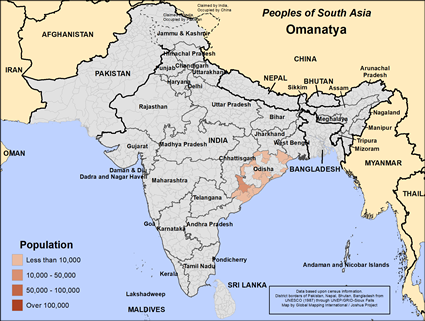
Omanatya in India

The Omanatya have only been reported in India
Population
Main Language
Largest Religion
Christian *
Evangelical
Progress
Progress Gauge
* Data can be from various sources including official census, agencies, and local research. Data from these sources can sometimes differ even by orders of magnitude. Joshua Project attempts to present a conservative, balanced estimate.

Subgroups: 2

Subgroup Name Population
Bodo 6,100
Sanno 6,100

Introduction / History

The Omanatya are a tribal community found primarily in the Koraput and Nabarangpur districts of Odisha in eastern India. They are also known by related names such as Omanatyo, Amanatya, Omanaito, and Omaito. Historical traditions within the community connect their name to the word "Amatya," meaning minister or counselor, and community legends claim descent from a minister who served in the court of Sri Ram before turning to agriculture for livelihood.

The Omanatya are an Odia-speaking cultivating people who have historically lived in hill slopes and foothill regions where streams and fertile land support farming life. Their settlements are often organized in separate hamlets that help preserve their cultural identity and social traditions. Over generations, they developed a close-knit tribal society shaped by agriculture, clan relationships, oral traditions, and village leadership systems.

Like many tribal communities in India, the Omanatya are experiencing social and economic changes through modernization, government development programs, migration, and increased exposure to urban culture. Even so, many continue to preserve strong traditional customs and community structures.


What Are Their Lives Like?

The Omanatya are traditionally agricultural people. They cultivate paddy, ragi, sugarcane, tobacco, pulses, and oilseeds using simple farming methods and locally made agricultural tools. Many families also raise cattle, goats, sheep, and poultry, and they supplement their livelihood through fishing, occasional hunting, gathering forest products, and seasonal labor.

Family and clan relationships are very important within Omanatya society. Most households are nuclear families, though extended families also exist. The community is divided into clans and totemic groups associated with animals, plants, or natural objects such as tigers, cobras, tortoises, parrots, pumpkins, and stones. Village councils led by hereditary leaders help settle disputes and organize religious and social affairs.

Their houses are commonly built from mud with thatched or tiled roofs and are arranged in clusters along village paths. Meals typically include rice and ragi along with vegetables, fish, meat, and locally gathered foods. Both men and women often participate actively in farming and household work. Traditional songs, dances, and festivals remain important parts of community life, especially during harvest celebrations and weddings.

Modern influences such as education, migration, technology, and economic pressure are gradually reshaping traditional life, especially among younger generations seeking opportunities beyond the village.


What Are Their Beliefs?

The Omanatya follow a blend of Hinduism and animistic tribal beliefs. They worship Hindu gods and goddesses while also maintaining devotion to traditional tribal deities, village spirits, ancestral powers, and local protective beings. Their religious life includes festivals, rituals, sacrifices, and ceremonies tied to agriculture, fertility, family events, and community protection.

Traditional deities such as Thakurani, Bhairab, Gram Devti, and Duma Devta are honored alongside broader Hindu worship practices. Animal sacrifice and ritual offerings are part of some religious ceremonies, and spiritual leaders such as pujari and disari guide ritual life within the community. Folk beliefs concerning spirits, omens, purification, and supernatural protection continue to shape everyday religious practice.

Although the Omanatya may be deeply devoted to inherited religious traditions, they still need the gospel of Jesus Christ and the assurance of salvation that comes through faith in Him rather than through rituals, sacrifices, or ancestral customs.


What Are Their Needs?

The Omanatya need greater access to Scripture, biblical discipleship, and faithful Christian witness presented with humility and cultural understanding. Many tribal communities in Odisha still have limited exposure to clear evangelical teaching and long-term discipleship rooted in God's Word.


Practical needs include improved healthcare, education, agricultural support, economic opportunity, clean water access, and infrastructure development in remote hill regions. Families dependent on farming and seasonal labor often face financial instability and limited access to resources.

There is also a need for mature believers who are willing to build long-term relationships, serve compassionately, and establish strong local fellowships that can disciple future generations while respecting the Omanatya people's cultural dignity.


Prayer Items

Pray that the Omanatya people would hear the gospel clearly and come to know Jesus Christ as Savior and Lord.
Pray that God would raise up compassionate and biblically faithful workers who will serve among the Omanatya with wisdom, patience, and perseverance.
Pray that the Omanatya would be adopted through the People Group Adoption program so that sustained prayer, discipleship, and long-term gospel outreach would continue among them.
Pray for strengthened families, improved education and healthcare, stable livelihoods, and spiritual openness within Omanatya communities throughout Odisha.


Scripture Prayers for the Omanatya in India.


References

https://ostm.in/tribes_of_odisha/omanatya/
https://repository.tribal.gov.in/bitstream/123456789/73814/1/SCST_2013_handbook_0034.pdf
https://atlcodisha.in/uploads/images/tribes/OMANANTYA.pdf
https://kbk.nic.in/koraputtribes/nabomanatya.htm
https://www.koraputlivingheritage.com/people/omanatya


Profile Source:   Joshua Project  

People Name General Omanatya
People Name in Country Omanatya
Alternate Names Amanatha; Amanatya; Omanaito; Ommaite; Onaitho; Onayakae; ओमनतया
Population this Country 33,000
Population all Countries 33,000
Total Countries 1
Indigenous Yes
Progress Scale Progress Gauge
Unreached Yes
Frontier Yes
GSEC 4  (per PeopleGroups.org)
Pioneer Workers Needed 1
PeopleID3 17799
ROP3 Code 113271
Country India
Region Asia, South
Continent Asia
10/40 Window Yes
National Bible Society Website
Persecution Rank 12  (Open Doors top 50 rank, 1 = highest persecution ranking)
Total States on file 2
Largest States
Odisha
30,000
Andhra Pradesh
2,500
Districts Interactive map, listing and data download
Specialized Website South Asia Peoples
Country India
Region Asia, South
Continent Asia
10/40 Window Yes
National Bible Society Website
Persecution Rank 12  (Open Doors top 50 rank, 1 = highest persecution ranking)
Total States 2
  Odisha 30,000
  Andhra Pradesh 2,500
Website South Asia Peoples
Primary Religion: Hinduism
Major Religion Estimated Percent *
Buddhism
0.00 %
Christianity
0.05 %
Ethnic Religions
0.00 %
Hinduism
99.76 %
Islam
0.09 %
Judaism
0.00 %
Non-Religious
0.00 %
Other / Small
0.02 %
Sikhism
0.00 %
Unknown
0.08 %
* From latest India census data.
Current Christian values may substantially differ.
Primary Language Odia (16,000 speakers)
Ethnologue Language Code ory
Ethnologue Language Familly Indo-European
Glottolog Language Family Indo-European
Written / Published Yes   (ScriptSource Listing)
Total Languages 17
Secondary Languages
(only 15 largest shown)
Pengo
5,500
Bhatri
4,800
Telugu
1,900
Hindi
1,500
Desiya
1,200
Bengali
600
Mundari
40
Kuvi
30
Marathi
20
Punjabi, Eastern
10
Gondi, Northern Santhali
Munda Sora Duruwa
Primary Language Odia (16,000 speakers)
Ethnologue Language Code ory
Ethnologue Language Familly Indo-European
Glottolog Language Family Indo-European
Written / Published Yes   (ScriptSource Listing)
Total Languages 17
Secondary Languages (only 15 largest shown)
  Pengo 5,500
  Bhatri 4,800
  Telugu 1,900
  Hindi 1,500
  Desiya 1,200
  Bengali 600
  Mundari 40
  Kuvi 30
  Marathi 20
  Punjabi, Eastern 10
  Gondi, Northern 10
  Santhali 10
  Munda 10
  Sora 0
  Duruwa 0

Primary Language:  Odia

Bible Translation Status  (Years)
Bible-Portions Yes  (1811-1956)
Bible-New Testament Yes  (1809-2000)
Bible-Complete Yes  (1815-2021)
FCBH NT (www.bible.is) Online
YouVersion NT (www.bible.com) Online
Possible Print Bibles
Amazon
World Bibles
Forum Bible Agencies
National Bible Societies
World Bible Finder
Virtual Storehouse
Resource Type Resource Name Source
Audio Recordings Audio Bible teaching Global Recordings Network
Audio Recordings Online Audio Scripture Talking Bibles
Audio Recordings Oral Bible stories One Story
Film / Video God's Story video God's Story
Film / Video Indigitube.tv Video / Animation Create International
Film / Video LUMO film of Gospels Bible Media Group/LUMO
Film / Video World Christian Videos World Christian Videos
General Bible and Resources in text or audio or video Internet Publishing Sevice
General Bible for Children Bible for Children
General Bible in text or audio or video Internet Publishing Sevice
General Bible in text or audio or video South Asia Bibles
General Biblical answers to your questions Got Questions Ministry
General Faith Comes By Hearing - Bible in text or audio or video Faith Comes by Hearing
General Scripture Earth Gospel resources links (Oriya) Scripture Earth
General Voice of the Martyrs resources Voice of the Martyrs
General YouVersion Bible versions in text and/or audio YouVersion Bibles
General Zume Training Zume Project
Mobile App Android Bible app: Odia YouVersion Bibles
Mobile App Android Bible app: Odia (Oriya) / English Bible (AKJV) General / Other
Mobile App Android Bible App: Odiya Bible (ଓଡିଆ ବାଇବେଲ) Indian Revised Version (IRV) Operation Agape
Mobile App Android Bible app: Oriya Study Bible Grace Ministries and Dusty Sandals
Mobile App Android Bible Radio app: Odiya Bible Radio Shalom Design S2dio
Mobile App Children's Bible app Bible4Kidz
Mobile App Download audio Bible app as APK file Faith Comes by Hearing
Mobile App Download audio Bible app from Google Play Store Faith Comes by Hearing
Mobile App iOS Bible app: Odia YouVersion Bibles
Mobile App iOS Bible Radio App: Odiya Bible Radio iOS Revive India
Text / Printed Matter Children and youth resources One Hope
Text / Printed Matter Jesus Messiah comic book General / Other
Text / Printed Matter The Ancient Path Live Global
Text / Printed Matter tools for gospel conversations Cru
Text / Printed Matter Topical Scripture booklets and Bible studies World Missionary Press
Map Source People Group data: Omid. Map geography: UNESCO / GMI. Map Design: Joshua Project.  
Profile Source Joshua Project 
Data Sources Data is compiled from various sources. Learn more.
