



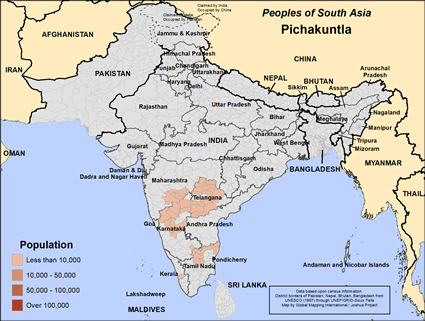
The Pichakuntla are a community found primarily in the southern Indian states of Telangana, Andhra Pradesh, Karnataka, and neighboring regions. They are also known by related names such as Helava, Helova, and Vamsharaj in different areas. Historical descriptions and community traditions connect them with genealogical work, storytelling, wandering occupations, and preserving family lineages for various caste communities.
The community has historically lived a semi-nomadic lifestyle in some regions, moving between villages while serving as genealogists, folk performers, mat makers, laborers, and community messengers. Some historical sources connect their migration patterns to broader religious and political changes in southern India centuries ago. Over time, many Pichakuntla families experienced social marginalization and economic hardship, and the community name itself has sometimes been used as a social insult in parts of Telugu-speaking society. In recent years, some community leaders have sought greater recognition under alternative names such as Vamsharaj to reduce stigma and restore dignity to their heritage.
Traditionally, some Pichakuntla families worked as wandering genealogists, recording family histories and oral traditions for rural communities. Others have worked as agricultural laborers, mat makers, construction workers, folk artists, and village helpers. In Karnataka and nearby regions, some families are still associated with craft work and seasonal labor.
Family and clan relationships are important within the community. Marriages are often arranged by family elders, and cousin marriages are accepted in some areas. Extended family support systems remain significant, especially where poverty or unstable employment creates hardship. Food habits generally reflect regional South Indian cuisine, including rice, lentils, vegetables, and locally available meat. Some groups are not vegetarian and may consume pork or other meats.
Economic conditions vary widely. While some families have entered education, wage labor, or urban employment, others still struggle with poverty, poor housing, irregular work, and social discrimination. Modernization and migration are changing traditional occupations, especially among younger generations seeking more stable livelihoods.
The Pichakuntla primarily follow Hindu religious traditions. Religious life commonly includes devotion to Hindu gods and goddesses, temple worship, participation in regional festivals, and ceremonies connected to marriage, birth, and death. Community traditions in some areas have also been influenced by Shaivite religious movements and regional devotional practices.
Alongside mainstream Hindu practices, folk beliefs, local spiritual customs, ancestral traditions, and ritual observances may also shape everyday religious life. Religion is often closely connected to community identity, inherited custom, and social belonging.
Although the Pichakuntla may be familiar with religious devotion and ritual practice, many still have little understanding of the biblical gospel and the saving work of Jesus Christ.
The Pichakuntla need greater access to Scripture, biblical discipleship, and faithful Christian witness presented with humility and compassion. While there appears to be some existing Christian presence among them, many still need deeper grounding in biblical truth and stronger local fellowships that can disciple future generations.
Practical challenges for many families include poverty, unstable employment, limited education, poor housing conditions, social stigma, and restricted access to healthcare and economic opportunity. Some semi-nomadic or marginalized families continue to face exclusion from broader society and lack long-term stability.
There is a need for mature believers who will serve the Pichakuntla with patience, practical compassion, and long-term commitment while helping establish strong Christ-centered communities rooted in Scripture.
Pray that the Pichakuntla people would clearly understand the gospel and place their faith in Jesus Christ alone for salvation.
Pray that existing believers among the Pichakuntla would grow strong in biblical faith and faithfully reach both their own community and neighboring peoples with the gospel.
Pray that the Pichakuntla would be adopted through the People Group Adoption program so that sustained prayer, discipleship, and long-term gospel outreach would continue among them.
Pray for improved education, stable livelihoods, dignity, and practical provision for Pichakuntla families facing hardship and social marginalization.
Scripture Prayers for the Pichakuntla in India.
https://en.wikipedia.org/wiki/Castes_and_Tribes_of_Southern_India
https://wjarr.com/sites/default/files/fulltext_pdf/WJARR-2023-0005.pdf
https://www.indpaedia.com/ind/index.php/Pichakuntala%3A_Deccan
https://timesofindia.indiatimes.com/city/hyderabad/pitchiguntla-community-seeks-to-be-renamed-vamsharaj-to-erase-stigma/articleshow/115321771.cms
| Profile Source: Joshua Project |




