




For hundreds of years the Tirmali had no permanent residence. They performed sacred dramas and danced for Shiva as they moved from one area to another. Their women sold trinkets and traditional medicines. As a result of their lifestyle, they had no civil rights, voting record or schools to educate their children.
The Tirmali are a Scheduled Caste meaning they are eligible for public jobs and special university admissions. The main language of the Tirmali is Marathi. Many Christian resources are available in Marathi. Many Tirmali also speak Hindi.
In the early 1990s the elders of the caste decided to change the way the Tirmali people lived. They were given land by the government and became farmers. Slowly they learned their new trade. Their children began attending school and a few have become college graduates.
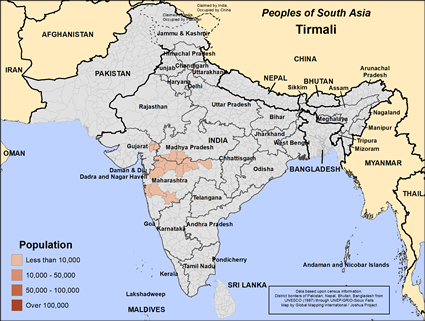
The Tirmali people are scattered throughout western India. Most live in the state of Maharashtra.
The Tirmali marry within their group. Families arrange marriages. Marriage to one spouse is the norm. Sons inherit the property of their father. A caste council of elders settles legal disputes and promotes their interests.
The main foods of the Tirmali are rice, maize, wheat, vegetables, fruit and dairy products. As Hindus, they will not eat beef.
Most Tirmali households depend on agriculture and manual labor as their primary means of livelihood.
A significant portion of the community works as small-scale farmers or agricultural laborers. Those who own land typically cultivate staple crops suited to their local environment, while many others are landless and rely on seasonal farm work for income. Employment in agriculture is often uncertain and dependent on rainfall, leading to periods of underemployment or financial strain.
In addition to farming, some Tirmali men seek daily wage labor in nearby villages or towns. This may include construction work, road building, or other forms of manual labor. Such employment is usually informal and irregular, offering little long-term security. Migration for short-term work is also common, especially during agricultural off-seasons, as individuals travel to urban areas in search of better-paying opportunities.
Women contribute significantly to the household economy, although their labor is often undervalued. They frequently work alongside men in the fields, care for livestock, and manage household responsibilities. In some cases, women may also participate in small-scale income-generating activities such as gathering forest products or engaging in local crafts.
Economic advancement within the Tirmali community is generally limited by low levels of formal education and restricted access to vocational training. These factors make it difficult for many individuals to enter skilled professions or secure stable employment in the formal sector.
The Tirmali people practice Hinduism, the ancient religion of India. They worship and serve selected gods of the Hindu pantheon. The Tirmali pay particular devotion to Shiva, the destroyer god. The Tirmali offer prayers, food, flowers, and incense to their gods in hopes of gaining protection and benefits.
The main yearly holidays of the Tirmali people are Holi, the festival of colors and the start of spring, Diwali, the festival of lights, Navratri, the celebration of autumn and Rama Navami, Rama's birthday.
The Tirmali need help in increasing the crop yield of their land. Many lack access to modern medicine. They need to see Christianity demonstrated to them in practical ways. Most of all, they need to hear and understand the message about Jesus Christ. He alone can show them the way to the Father.
Pray for networks of believing Tirmali families and fellowships that will throw the doors open for others to follow Jesus.
Pray for the Lord to bless the families among the Tirmali people with His presence and mercy.
Pray for believers among this people group to disciple others who will disciple still others.
Pray for Bible believing fellowships and churches among the Tirmali people.
Scripture Prayers for the Tirmali in India.
https://www.thehansindia.com/posts/index/National/2016-08-10/After-6-decades-of-Independence-Tirmali-people-get-a-postal-address-/247753
https://ruralindiaonline.org/articles/we-are-now-self-reliant-and-organised
| Profile Source: Joshua Project |



