




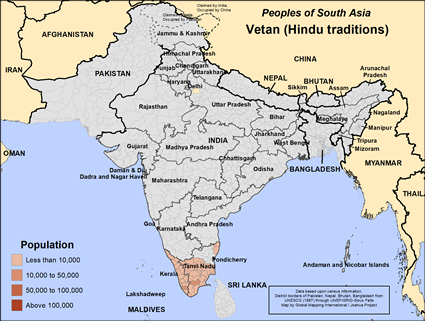
The Vetan are a community found mainly in the southern Indian states of Tamil Nadu and Kerala. Their name is traditionally associated with hunting, though most Vetan families no longer depend on hunting for their livelihood today. They speak Tamil and are shaped by the broader cultural traditions of South India. Over generations, the community adapted to changing economic conditions and increasingly became involved in agriculture, labor, and other village occupations.
The Vetan have historically lived within tightly connected local communities governed in part by community councils that help settle disputes and preserve customs. Their identity has been influenced by regional caste and village structures common throughout southern India. Like many smaller Hindu communities, they maintain traditions tied to family lineage, local customs, and inherited social roles. Though modernization and urban migration have affected younger generations, many Vetan families continue to retain strong village and kinship ties.
Many Vetan families are connected to agriculture, seasonal labor, or small-scale local occupations. Some also engage in fortune telling and traditional practices that have historically provided supplemental income within village settings. Economic conditions can vary greatly depending on land ownership, education, and access to nearby towns or cities.
Family life is generally close-knit, and extended family relationships remain important. Marriages within the wider kinship structure, including cousin marriages, are traditionally accepted in parts of the community. Most marriages are monogamous, though divorce and remarriage are socially permitted in many cases. Property is commonly passed through the male family line.
Village festivals, temple events, and religious celebrations often shape community life and social interaction. Meals commonly include rice, lentils, vegetables, coconut-based foods, and regional South Indian dishes. While younger generations increasingly pursue education and urban employment, many families still face economic limitations, unstable labor opportunities, and uneven access to healthcare and higher education in rural areas.
The Vetan primarily follow Hinduism and participate in both mainstream Hindu worship and regional folk religious traditions. Religious practices may include devotion to Hindu gods and goddesses, temple rituals, offerings, festival observances, and ceremonies connected to family and village life.
In many South Indian village settings, folk religion and animistic beliefs are often blended with formal Hindu traditions. Fear of spirits, curses, evil influences, or displeased local deities can influence daily decisions and religious practices. Ritual specialists or local spiritual leaders may sometimes be consulted during sickness, family hardship, or spiritual concerns. This mixture of Hindu belief and folk spirituality creates a syncretistic religious environment.
Most Vetan people have had limited exposure to clear biblical teaching about salvation through Jesus Christ alone. They need to hear that forgiveness of sins and reconciliation with God come through the grace of Christ rather than through rituals, offerings, inherited customs, or spiritual appeasement practices.
The Vetan need faithful gospel witness presented with patience, humility, and cultural understanding. In many places there are few mature Christian fellowships equipped to disciple new believers from their background. Social pressure and fear of family rejection may discourage individuals from openly following Christ.
Practical needs also remain important. Some Vetan communities continue to experience economic insecurity, limited educational advancement, inconsistent employment, and reduced opportunities for long-term financial stability. Rural isolation in certain areas can further limit access to healthcare, vocational training, and broader economic development.
There is a need for long-term Christian workers who can build genuine relationships, provide biblical discipleship, and help establish healthy local fellowships rooted in Scripture. Christian resources in Tamil and compassionate ministry that addresses both spiritual and practical needs can help open doors for lasting gospel impact.
Pray that the Vetan people will hear and understand the gospel clearly and place their faith in Jesus Christ for salvation.
Pray that God will raise up faithful Christian workers who will serve among the Vetan with wisdom, compassion, and perseverance.
Pray that the Vetan people will be adopted through the People Group Adoption program so that churches and believers will commit to sustained prayer and future gospel outreach among them.
Pray that any believers among the Vetan will grow strong in biblical truth and boldly share Christ with their families and neighboring communities.
Scripture Prayers for the Vetan (Hindu traditions) in India.
https://en.wikipedia.org/wiki/J%C4%81ti
https://en.wikipedia.org/wiki/Caste_system_in_India
https://courses.lumenlearning.com/suny-hccc-worldcivilization/chapter/the-caste-system/
https://pmc.ncbi.nlm.nih.gov/articles/PMC10764522/
| Profile Source: Joshua Project |



