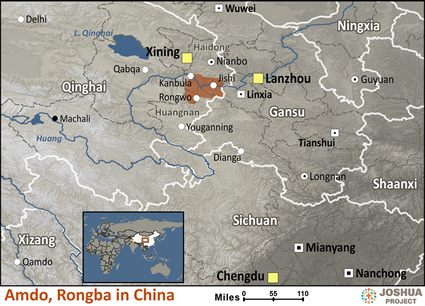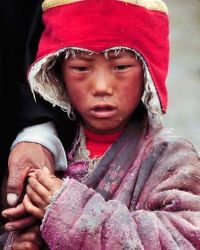

For centuries the Amdo roamed the borderlands of the Tibetan-Chinese world. Their menacing reputation struck fear into all who dared to venture, unwelcomed, into their realm.
The Rongba Amdo are part of the Tibetan nationality. The name Rongba means "farmer" in Tibetan. When the communists took over all of Tibet in the 1950s, thousands of Tibetans were butchered. The official Chinese version of these events is markedly different. "This rebellion accelerated the destruction of Tibet's reactionary forces and brought Tibet onto the bright, democratic, and socialist road sooner than expected."
The Rongba Amdo language has two dialects and contains more Chinese loanwords than any other Tibetan language in China. Rongba is only partially intelligible with the three other Amdo languages; however, all Tibetans use the same written script.
The Rongba Amdo are largely unconcerned about the outside world. They celebrate the Tibetan New Year in February, according to the Tibetan lunar calendar. In the past, celebrations commenced the moment the peach tree blossomed. It is a time for relatives to get together and celebrate the past year's events.
The Rongba Amdo adhere to Tibetan Buddhism, also known as Tantric Buddhism. "Tantra's most striking feature is its technique of occult visualization. The tantric master gives each student a deity which the student has to visualize. These deities, most of which appear in wrathful or monstrous forms, are supposed to be able to help the student achieve liberation. As the student visualizes, he tries to become what he sees, and in fact some Tibetan Buddhists claim to be able to actually materialize demons in front of them."
There are about ten known Christians among the Rongba Amdo today. They have historically proven to be a difficult group to reach with the gospel. The criteria used in the 1920s for missionaries among Tibetan peoples still applies to would-be laborers today: "In sending out missionaries for work among the Tibetans, candidates with a strong constitution should be chosen, as missionary work in Tibet is more strenuous than in most places. Missionaries that are afraid to expose themselves to hardship and even danger should not be sent to Tibet."
Without the guidance of Christ, these people are like sheep without a shepherd. They need the good shepherd in their families and communities.
Pray for the spiritual blindness and bondage to the evil one to be removed so they can understand and respond to Christ.
Pray for the Lord to provide for their physical and spiritual needs as a testimony of his power and love.
Pray that the Rongba Amdo people will have a spiritual hunger that will open their hearts to the King of kings.
Pray for an unstoppable movement to Christ among them.
Scripture Prayers for the Amdo, Rongba in China.
Operation China, Asia Harvest, Copyrighted © Used with permission
| Profile Source: Joshua Project |