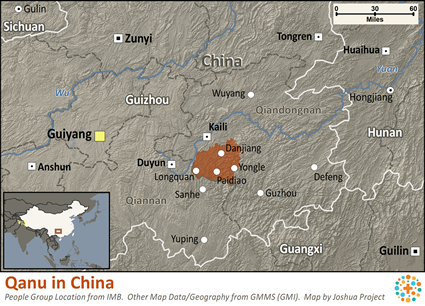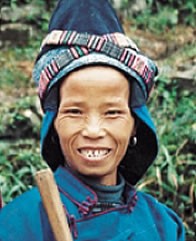

Although they have been officially included as part of the Miao nationality in China, the Qanu possess their own distinct ethnic identity. The Qanu may also be known as the "Miao with Combs in Their Hair" to local people. There are many smaller Miao groups in China, such as the Qanu, who have not yet been thoroughly researched by Chinese linguists. In southern Guizhou, six different Miao "dialects" remain unclassified. One linguist states they are "presumably mutually unintelligible languages."
The lack of a written script has caused great anguish among the Miao for centuries. A Miao pastor, Wang Mingji, declared his feelings: "We Miao do not have writing. For thousands of years we have been like the blind, it has been very bitter. Everybody knows that there is nothing worse in the world than to be blind, however shimmering is the sun in the sky, however shining is the moon in the sky, however clear are the rivers and mountains on the earth, however beautiful are the flowers in the wilderness, the blind cannot see them anyway."
Most Qanu are farmers. Many families also raise livestock to supplement their meager incomes.
The Qanu of China engage in recreational activities that reflect their rural setting, communal values, and traditional way of life. Because most Qanu are involved in agriculture or local labor, leisure time is often limited and usually takes place after daily work has been completed. As a result, recreation is typically simple, relational, and integrated into village life.
Men often spend their free time gathering in small groups to talk and exchange news. These informal gatherings strengthen community bonds and provide opportunities for mutual encouragement. Younger men and boys may participate in light physical activities or informal games in open village spaces, making use of whatever resources are available.
Women generally enjoy recreation through social visits with neighbors and relatives. These interactions are an important part of maintaining close-knit relationships within the community. During such times, women may share meals, converse about daily life, or engage in handicrafts such as sewing, weaving, or mending clothing, which serve both practical and relaxing functions.
Children among the Qanu create their own forms of entertainment. They typically play outdoors in small groups, engaging in running games, exploring their surroundings, or using handmade or improvised toys. These activities help develop cooperation and social skills from a young age.
Festivals and seasonal celebrations provide the most significant opportunities for recreation. During these special occasions, the Qanu may participate in traditional music, dancing, and communal feasts. These gatherings not only bring enjoyment but also reinforce cultural identity and unity within the group.
The majority of Qanu are animists. The spirit of the water is particularly held in great fear.
Many Protestant missionaries focused on the Gha-Mu and A-Hmao in northwest Guizhou and northern Yunnan prior to the advent of communism, but few worked in the region of southeast Guizhou where the Qanu are located. Former missionaries in China are generally remembered as self-sacrificing servants who labored with the love of God for the people they lived among. The communist authorities, however, have a very different view of history: "From the nineteenth century onwards the imperialists propagated Christianity in northwest Guizhou and in other Miao areas. They ... printed the 'Bible' in order to poison and deceive the masses in question. Furthermore, they sowed dissension and discord, spied, exploited, pillaged etc."
The Qanu people need the opportunity to hear and respond to the true Jesus Christ.
Pray that the written word of God can once again come to the Qanu as in the past through missionaries and Christians in their region.
Pray that the Qanu people will be adopted through the People Group Adoption program so that they will have regular prayer and ultimately workers among them.
Pray that the seeds that were planted in the past by missionaries will grow in the hearts of the Qanu.
Pray that they would see in nature the hand of God, who provides for their physical needs.
Pray for their eyes to be opened to the living God, who loves them and desires a relationship with them.
Scripture Prayers for the Qanu in China.
Operation China, Asia Harvest, Copyrighted © Used with permission.
| Profile Source: Joshua Project |