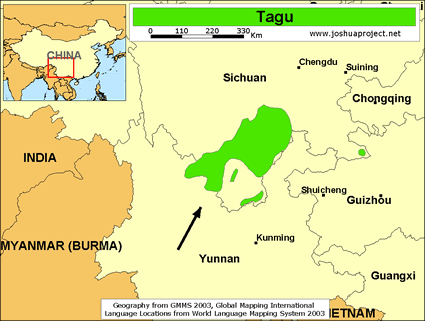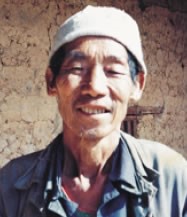

The Tagu are part of the official Yi nationality in China, although they view themselves as distinct from all other ethnic groups. The Tagu are not the same as the Talu, a different Yi group also found in Yongsheng and Ninglang counties.
The Tagu may have been a tribe who came out of southern Sichuan Province centuries ago to escape the slave system practiced by the Nosu people there. After several generations, the ancestors of the Tagu forgot their origins and developed their own ethnicity, language, and culture.
When a missionary visited a Yi village in the early 1900s, he was given a never-to-be-forgotten meal: "As we sat on bear rugs on the ground a goat was brought in and presented to us, and there and then they set to slaughter and prepare it for the meal. This is considered very respectful to the guest and assures him that the meat is fresh, and that the animal has been killed especially for his benefit. When the carcass was ready, the heart and liver were thrown into the ashes of the wood fire and after a few minutes they were taken out, placed on wooden plates and handed to the visitors. I ate mine with as much delight as I could. ... Staying among these wild people convinces me that in their homes and among their own people they are worthy of our best efforts to evangelize among them. I found a warm welcome wherever I went and nowhere met with the ill-treatment predicted for me by the Chinese."
One of the main deities feared by Yi people everywhere, including the Tagu, are the powerful mountain gods they believe dwell inside the largest mountains in each area. Offerings and sacrifices are made to placate these demons. It is possible that the legends related to the power of the mountain gods started as a result of volcanic activity long ago: this convinced the people a powerful being was responsible for displaying his wrath and venting his anger through the mountain. The Tagu also worship many local spirits, such as the spirit of the soil, the spirit of the rice harvest, and the spirit of the forest.
Ninglang and Yongsheng, for all practical purposes, have only been connected to the rest of China for the last few decades. Before the 1950s there were few or no roads in the area and, therefore, they experienced little Chinese influence. For the same reason, no missionaries are known to have lived in the Ninglang or Yongsheng areas before 1949. They have little access to the gospel, and most Tagu have never yet met a Christian.
The Tagu people need to put their trust and identity in the hands of the loving God of Creation who sent his son to make it possible for them to enter the Kingdom of God.
Pray for the spiritual blindness and bondage to the evil one to be removed so they can understand and respond to Christ.
Pray for the Lord to provide for their physical and spiritual needs as a testimony of his power and love.
Pray the Tagu people will have a spiritual hunger that will open their hearts to the King of kings.
Pray for an unstoppable movement to Christ among them.
Scripture Prayers for the Tagu in China.
Operation China, Asia Harvest, Copyrighted © Used with permission
| Profile Source: Joshua Project |