




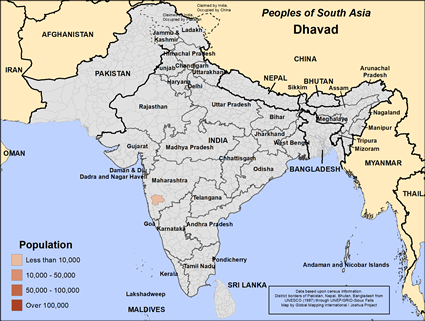
The Dhavad people are found mainly in the Indian state of Maharashtra, particularly in areas connected historically with the Western Ghats region. They speak Marathi and have traditionally been associated with iron-related occupations, including collecting minerals, ironworking, and producing tools and utensils. Over generations, the community became known through settlements connected to this trade, and some villages came to bear names linked to the Dhavad identity.
Historical accounts suggest that many Dhavad families eventually shifted away from iron production as local mineral resources declined and economic conditions changed. Some moved into agriculture, small business activities, wage labor, or urban employment opportunities. The community's history reflects adaptation to changing economic realities while maintaining strong regional and family ties.
The Dhavad have lived within a broader Maharashtrian cultural setting shaped by village life, trade, agriculture, and religious traditions. Although information about the community remains limited, they are recognized as a distinct people group with their own social identity and cultural background.
Many Dhavad families today work in small businesses, agriculture, manual labor, transportation, or other forms of local trade. As traditional iron-related occupations declined, families increasingly sought alternative forms of income to support their households. Economic uncertainty remains a challenge for many within the community.
Family and community relationships are central to Dhavad life. Extended families often maintain close ties, and marriages are commonly arranged within the community. Village traditions, local festivals, and religious observances continue to shape social life. In rural areas, daily routines may revolve around farming seasons, local markets, and caring for livestock.
Food commonly includes rice, lentils, vegetables, millet breads, and regional Maharashtrian dishes. Younger generations increasingly migrate toward towns and cities for work or education, though many families still retain strong connections to their ancestral communities and cultural traditions.
The Dhavad are primarily Sunni Muslims. They believe in Allah as the one true God and follow the teachings associated with the Quran and Islamic tradition. Religious practices commonly include daily prayers, fasting during Ramadan, giving to the poor, and participation in Islamic festivals such as Eid al-Fitr and Eid al-Adha.
Mosque-centered worship and community prayer gatherings are important parts of religious life. Islamic identity strongly shapes family customs, moral expectations, celebrations, and community relationships. In some settings, cultural traditions and local customs may also influence religious practice alongside formal Islamic teaching.
Very few Dhavad have had meaningful exposure to the gospel message or sustained Christian witness. Many know of Jesus primarily through Islamic teaching, where He is regarded as a prophet rather than the Son of God and Savior.
The Dhavad people face both practical and spiritual needs. Economic hardship continues to affect many families due to the decline of traditional occupations and limited employment opportunities. Some communities struggle with poverty, unstable income, educational limitations, and inadequate access to healthcare and vocational training.
Spiritually, the Dhavad have little access to biblical teaching, Christian discipleship, or churches equipped to share the gospel in culturally understandable ways. There is a need for Christian workers willing to serve patiently among them, develop genuine relationships, and clearly explain who Jesus Christ truly is according to Scripture.
Practical ministry through education support, literacy efforts, healthcare assistance, and compassionate community service can help open doors for long-term gospel witness among the Dhavad people. Believers in nearby regions also need encouragement and boldness to reach out to them with the truth of Christ.
Pray that the Dhavad people would come to understand that Jesus Christ is more than a prophet and would trust him as Lord and Savior.
Pray for Christian workers to serve faithfully among the Dhavad with wisdom, humility, compassion, and perseverance.
Pray that the Dhavad people would be adopted through the People Group Adoption program so that ongoing prayer, outreach, discipleship, and future gospel engagement would continue among them.
Pray that believers in Maharashtra would boldly share the gospel with the Dhavad and demonstrate the love of Christ through their lives and service.
Scripture Prayers for the Dhavad in India.
https://en.wikipedia.org/wiki/Dhawad
https://www.peoplegroups.org/explore/GroupDetails.aspx?peid=45877
https://en.wikipedia.org/wiki/List_of_Muslim_Other_Backward_Classes_communities_in_India
https://censusindia.gov.in
| Profile Source: Joshua Project |



