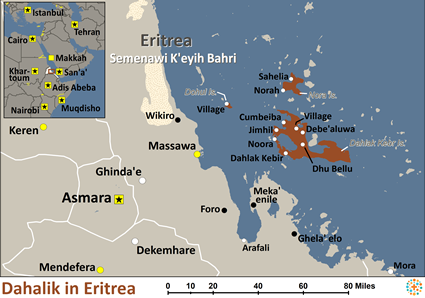

The Dahalik are an indigenous island people living on the Dahlak Archipelago off the Red Sea coast of Eritrea near the city of Massawa. Most Dahalik communities live on the islands of Dahlak Kebir, Nora, and Dehil. Their identity is closely connected to the sea, island life, fishing traditions, and the unique Dahalik language, which was only recognized by linguists in the 1990s as a distinct language rather than simply a dialect of Tigre. The language belongs to the Semitic branch of the Afro-Asiatic language family and is closely related to Tigre and Tigrinya, though it is distinct enough to be considered its own language.
The history of the Dahalik people is tied to the long commercial and cultural history of the Red Sea. The Dahlak Islands occupied an important position along ancient trade routes linking Africa, Arabia, and the wider Islamic world. Historical records describe the Dahlak Archipelago as an early center of Islam in the Horn of Africa, and at one time the islands formed an independent sultanate that prospered through maritime trade. Arab, African, Ottoman, and regional influences shaped the islands over many centuries.
Because of their geographic isolation, the Dahalik have preserved a distinct linguistic and cultural identity despite contact with many outside peoples. Oral tradition, family lineage, and island customs remain important parts of community life. However, the Dahalik language is endangered because of the small population, multilingual pressures, migration, and the dominance of Arabic in education and trade.
The Dahalik traditionally live as fishermen, sailors, and small-scale traders. Fishing remains one of the most important economic activities on the islands, with families relying on the Red Sea for food and income. Sea cucumber harvesting, small livestock raising, and limited agriculture also contribute to daily life where conditions allow. The dry climate and scarce fresh water make survival on the islands difficult and require careful use of available resources.
Island communities are generally small and tightly connected through extended family relationships and shared traditions. Homes are often built using coral stone, mud, or simple modern materials adapted to the harsh coastal environment. Men frequently spend long periods fishing or traveling between islands and the mainland, while women often manage household responsibilities and family life. Oral storytelling, poetry, and shared memory help preserve Dahalik identity and cultural continuity.
Most Dahalik people are multilingual, commonly speaking Dahalik alongside Arabic, Afar, or Tigre because of trade and contact with neighboring communities. Younger generations increasingly encounter outside influences through education, migration, and modern communication, creating pressure on traditional language use and island customs.
Life in Eritrea is also affected by political restrictions, economic hardship, and limited infrastructure. Although the islands are relatively isolated, communities may still struggle with healthcare access, transportation difficulties, limited educational resources, and economic uncertainty.
The Dahalik are overwhelmingly Sunni Muslims, and Islam strongly shapes family life, social customs, and community identity. Religious practices commonly include prayer, fasting during Ramadan, mosque participation, and observance of Islamic customs connected to marriage, burial, and village life. Islam has influenced the Dahlak Islands since the earliest centuries of Islamic expansion across the Red Sea region.
At the same time, traditional spiritual beliefs and folk practices continue to influence many aspects of life. Among peoples in the Horn of Africa, belief in spirits, curses, supernatural powers, and protective rituals is often blended with formal Islamic practice. Fear of unseen spiritual forces may shape decisions involving sickness, protection, family problems, or daily hardships. This creates a syncretistic religious environment rather than strictly orthodox Islamic practice.
Very few Dahalik have had meaningful exposure to biblical Christianity. Because of their isolation and small population, gospel outreach has been extremely limited. Christianity may often be viewed as foreign or associated with outsiders rather than understood through direct exposure to the message of Jesus Christ. They need to hear clearly that forgiveness of sins and reconciliation with God come through Christ alone rather than through religious identity, ritual observance, or fear-driven spiritual practices.
The Dahalik remain largely unreached with the gospel, and there are very few known believers among them. Their small population, island isolation, and unique language make sustained ministry difficult. Christian workers willing to serve among the Dahalik would need patience, humility, cultural sensitivity, and a long-term commitment to relationship building.
One major need is the development of gospel resources in the Dahalik language. Because the language is endangered and spoken by relatively few people, there are limited Christian materials available. Audio Scripture, oral Bible storytelling, and discipleship resources suited to island culture may be especially important.
Practical needs are also significant. Many island communities face limited access to healthcare, education, transportation, and economic opportunity. Fresh water shortages and environmental challenges add further difficulty to daily life. Compassionate ministry addressing both spiritual and practical needs could help demonstrate the love of Christ in meaningful ways among the Dahalik people.
Pray that the Dahalik people will hear a clear presentation of the gospel and place their faith in Jesus Christ for salvation.
Pray that God will provide audio Scripture, Bible translation work, and culturally understandable gospel resources in the Dahalik language.
Pray that the Dahalik people will be adopted through the People Group Adoption program so that churches and believers will commit to sustained prayer and future gospel outreach among them.
Pray that God will raise up faithful Christian workers who are willing to serve among the Dahalik with wisdom, humility, and perseverance despite the challenges of island isolation.
Scripture Prayers for the Dahalik in Eritrea.
https://en.wikipedia.org/wiki/Dahalik_language
https://en.wikipedia.org/wiki/Dahlak_Archipelago
https://en.wikipedia.org/wiki/Dahlak_Kebir
https://www.ethnologue.com/language/dlk/
https://www.speaktigre.com/_files/ugd/7e068a_6e36c3de666941f8b763eefbf4096d20.pdf
https://llacan.cnrs.fr/publications/Eritrean_Studies_2005.pdf
| Profile Source: Joshua Project |