
Before 1921 the various Turkic groups in Xinjiang called themselves by the name of the oasis near which they lived. When Turkic leaders met in Tashkent in 1921, they chose the name Uygur as the mark of their identity. Uygur means "unity" or "alliance."
Uyghur is a Turkic language, related to Uzbek, Kazak, and Kirgiz. It also contains loanwords from Chinese, Arabic, Persian, Russian, and Mongolian.
In the mid-eighth century the Uyghur inhabited part of present-day Mongolia. Around AD 840 they were attacked from the north by the Kirgiz and fled southwest to their current homeland. Their ancestors were among those who helped make the Silk Road happen for hundreds of years. Silk Road trade made many people in China wealthy.
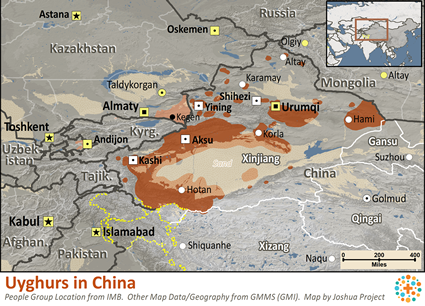
Most Uyghur live in Xinjiang province in western China. Xinjiang is now a police state and has been turned into "something resembling a massive internment camp that is shrouded in secrecy, a sort of no-rights zone."
Many Uyghurs raise cotton, grapes, melons, and fruit trees through an ingenious irrigation system which pipes mountain water into the desert oases.
Today over one million Uyghurs are being detained and placed in internment camps facing imprisonment, torture and brainwashing. Children in orphanages are given new identities, and women are forced to marry Chinese men against their will. Uyghur leaders say the aim of these re-education centers is to wipe out Uyghur culture and say detainees are being forced "to renounce their religion, renounce their culture, renounce their identity, force them to speak Mandarin" and pledge allegiance to the Chinese Communist Party.
Most Uyghur follow a folk Islam mixed with superstition. Islam is stronger in southern Xinjiang than in the north. Today, although almost all Uyghurs profess to be Muslims, few are aware of the time in history when most Uyghurs were Christians.
Nestorian missionaries first appeared in China in 635 AD, after they had already been working in Central Asia for a century. One of the forerunners of today's Uyghur were the Turkic Keirat tribe.
By 1009, 200,000 Keirat had been baptized. During the twelfth and thirteenth centuries "the whole tribe were considered Christian." In the fourteenth century Christianity disappeared from among the Uygur for 500 years, and they converted to Islam.
The Swedish Missionary Society recommenced work among the Uyghur in 1892. By the 1930s more than 300 Uyghurs had found the blessing of God in Jesus Christ, primarily in Kashgar. When Abdullah Khan came to Yarkant in 1933, he expelled the missionaries and eliminated the Uygur believers in a mass execution.
Uyghurs struggle for the survival of their culture, language, and religion in China due to severe and systematic oppression by the Chinese authorities. They need God's protection.
Pray that the millions of Uyghurs who have been detained and placed in internment camps would be treated as ones made in God's image.
Pray that Han Chinese believers would lead the way and demonstrate the compassion of Christ towards the Uyghurs.
Pray that Uyghur believers would be strengthened in the Lord as they suffer
Pray that a movement would begin of Uyghurs finding Jesus in their place of pain, that God would use this very suffering to lead them to the Kingdom.
Scripture Prayers for the Uyghur in China.
Operation China, Asia Harvest, et al Copyrighted © Used with permission
| Profile Source: Joshua Project |