
The Qing (Manchu) Dynasty (1644-1911): The Manchus in the northeast took advantage of the peasant unrest throughout China and seized control of Beijing. Yet again, the Han Chinese majority were ruled by a neighboring minority tribe. It took a further four decades for the Manchu to take control of southern China. Today's Inner Mongolia, Tibet, and Xinjiang were all conquered and subdued, leading to ethnic unrest which persists to this day. The Manchu period witnessed the entrance of foreign powers into China and the seizing of key ports and regions. Hong Kong was taken by the British, Macau by the Portuguese, while the Dutch, Spanish, French, Japanese, and Russians all laid claim to parts of China. The Chinese consider the Manchu Dynasty one of the most humiliating of their long history.
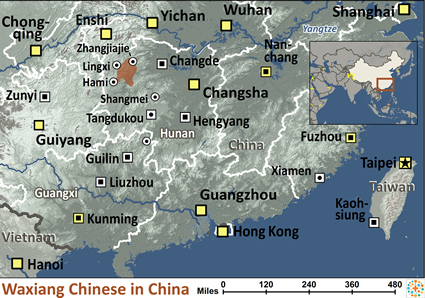
Although officially considered part of the Han Chinese nationality, Waxiang may not even be a Chinese language. Little study has been conducted into Waxiang, but one scholar notes, "Some view it as a special variety of Chinese, others as a minority language, perhaps related to Miao." It is possible that the Waxiang are a mixture of Miao and Chinese people who developed their own distinct characteristics after centuries of mutual contact.
Many of the customs of the more rural Waxiang are similar to those of the neighboring Ghao-Xong.
The majority of Waxiang practice animistic rituals. They appease spirits and ghosts who they believe dwell in their villages and influence their lives for good or for evil.
There are few Christians among the Waxiang. The region has historically given a cold reception to those few missionaries who ventured into the Wuling Mountains. American Catholic priests, from the Blessed Gabriel Monastery in Massachusetts, USA, commenced work along the Hunan-Guizhou border in the 1920s. One early missionary reported, "The good work is moving but very slowly. The people are as hard as steel. They are eaten up both soul and body by the world, and do not seem to feel that there can be reality in anything beyond sense. To them our doctrine is foolishness, our talk jargon. We discuss and beat them in argument. We reason them into silence and shame; but the whole effort falls upon them like showers upon a sandy desert."
Without the guidance of Christ, these people will be lost in this life and the life to come. They need someone to go to them as Christ-bearers.
Pray for the spiritual blindness and bondage to the evil one to be removed so they can understand and respond to Christ.
Pray for the Lord to provide for their physical and spiritual needs as a testimony of his power and love.
Pray that the Waxiang people will have a spiritual hunger that will open their hearts to the King of kings.
Pray for an unstoppable movement to Christ among them.
Scripture Prayers for the Han Chinese, Waxiang in China.
Operation China, Asia Harvest, Copyrighted © Used with permission
| Profile Source: Joshua Project |