




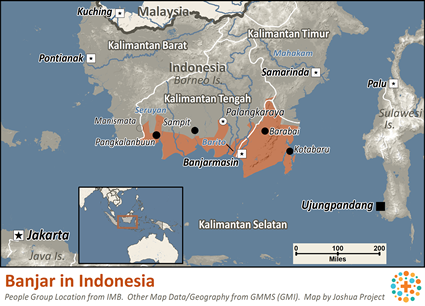
The Banjar people live primarily in the southern, central, and eastern provinces of Kalimantan, Indonesia. Several thousand Banjar also live in Malaysia.
The Banjar speak a language called Banjar, which is a regional language in Indonesia. Speakers of other languages in the provinces must also learn Banjar to buy and sell in the markets. Banjar speech is difficult for other Indonesians to understand because the Banjar speak with a different intonation and speed.
The Banjar proudly trace their origins to a Hindu kingdom, the Nagara Dipa. Buddhism, then Hinduism, and finally Islam were introduced from Java into South Kalimantan. In 1526, Banjar Prince Samudera accepted Islam and took the name of Sultan Suriansyah as a condition of receiving help from a Javanese army in overthrowing his uncle. Today, the Banjar are almost entirely Muslim.
After they established Islam in South Kalimantan, the Muslim Sultan agreed to give a strategic portion of prime land downtown to the largest Christian denomination in Kalimantan. In exchange, this denomination had to agree not to evangelize Muslims. This is one major reason there are still no churches that worship God in the Banjar language.
Banjarmasin is the heartland of the Banjar language and is also the capital city of South Kalimantan. Since portions of the city are below sea level, the city rises and falls with the tides. Waterways crisscross the city, lined by houses on stilts. Life revolves around these waterways; taking a small klotok (motorized boat) around the rivers and canals shows a wide variety of activity: people bathing, washing laundry, gossiping and buying fruit, vegetables and fish from female vendors in small canoes. The Banjar people seldom move to other areas of Indonesia. They marry and settle near their parents or other relatives in Kalimantan.
Most Banjar find their livelihood through farming or plantation work near the rivers. Trade, transport and mining are also prominent occupations. Many Banjar work in traditional manual sawmills but are reluctant to work in plywood factories because of the unhealthy conditions.
Since the period of Dutch colonialism, the Banjar have looked suspiciously at government schools as attempting to secularize their children. Since independence, they have developed modern Islamic schools claiming identity as government schools.
The Banjar shun modern methods and technologies and tend to avoid interaction with other people groups.
Islam pervades every aspect of individual and family life among the Banjar. Religion is the primary force in controlling crime, such as thievery and gambling. They rigorously observe the Islamic celebrations and month-long fast of Ramadan. The most famous building in Banjarmasin is the Agung Sabilal Muthadin Mosque, in the center of the city.
Despite their devotion to Islam, the Banjar (like many other Muslim groups in Indonesia) also retain animistic beliefs and practices. Animistic beliefs teach that certain supernatural powers live in objects such as stones, trees and mountains.
In early 2020, spiritual changes started taking place among the Banjar. Over 300 people signed up to pray daily for the Banjar at www.pray4thebanjar.com. After that, a mission agency from the Philippines agreed to come to this area to train believers in Disciple Making Movements. They completed the Gospel of Luke in the Banjar language. They made a Banjar scripture app available on the Google Play store. A certified Bible translation consultant checked and approved 35 oral Bible stories in Banjar.
The self-imposed isolation of the Banjar has limited their development of education, health care and water purification. In the interior, villages have a limited infrastructure for distribution of crops and goods. The proliferation of coal, diamond and gold mines has also created tension throughout Kalimantan.
Pray for spiritual growth and vision for multiplication among the believers in the city of Kalimantan.
Pray that God would inspire at least 1000 intercessors who would sign up to pray daily for the Banjar.
Ask God to raise up more mother-tongue speakers of Banjar to help with the Bible translation project.
Pray that the entire Bible will soon be available in the Banjar language along with scripture apps which can be downloaded and used on cell phones.
Pray for a movement of multiplying fellowships of believers who worship God in the Banjar language to emerge throughout the Banjar speaking areas of Indonesia and Malaysia.
Scripture Prayers for the Banjar in Indonesia.
| Profile Source: Joshua Project |




.jpg)