
People-in-Country Profile
Peoples Data Filter:
Step 1 - Select a Country:  
Send us your updates!
Can you provide any of the following for this people?
Step 2 - Select a People:  
Manobo, Matigsalug of Philippines

We do not have a photo of the Manobo, Matigsalug to display here.
Please send us one!
Send Joshua Project a photo:  [1]
View Manobo, Matigsalug in all countries.
Peoples
               
Geographic
Global
               
Global
           
 
Affinity Bloc
           
Global


People Cluster
       
Region


People
   
Country


People-by-Country (Profile)


Religion
Language


Global
   
Language


Religion
                             
Manobo, Matigsalug of Philippines
 
Profile Text
Submit Profile Text:

Introduction / History
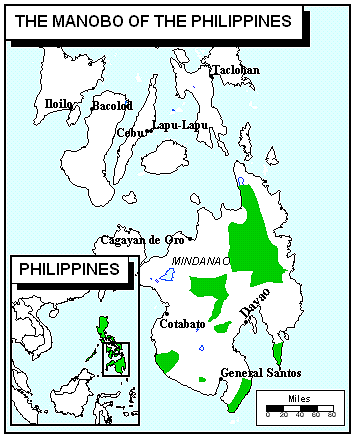
The Manobo are several people groups who inhabit the island of Mindanao in the Philippines. They speak one of the languages belonging to the Manobo language family. Their origins can be traced back to the early Malay peoples who came from the surrounding islands of Southeast Asia. Today, their common cultural language and Malay heritage help to keep them connected.

The Manobo cluster includes eight groups: the Cotabato Manobo, Agusan Manobo, Dibabawon Manobo, Matig Salug Manobo, Sarangani Manobo, Manobo of Western Bukidnon, Obo Manobo, and Tagabawa Manobo. The groups are often connected by name with either political divisions or landforms. The Bukidnons, for example, are located in a province of the same name. The Agusans, who live near the Agusan River Valley, are named according to their location.

The eight Manobo groups are all very similar, differing only in dialect and in some aspects of culture. The distinctions have resulted from their geographical separation.

What are their lives like?
The most common lifestyle of the Manobo is that of rural agriculture. Unfortunately, their farming methods are very primitive. For example, the Bukidnon grow maize and rice as their principal crops. Some of the farmers have incorporated plowing techniques, while others have continued to use the "slash-and-burn" method. The Cotabato use a farming system called kaingin. This is a procedure in which fields are allowed to remain fallow for certain periods of time so that areas of cultivation may be shifted from place to place. This is very inefficient since many plots of land are not being used at one time.

Social life for the Manobo is patriarchal (male-dominated). The head of the family is the husband. Polygyny (having more than one wife at a time) is common and is allowed according to a man's wealth. However, among the Bukidnon, most marriages are monogamous. The only exception is that of the powerful datus (headmen).

The political structures of the Manobo groups are all quite similar. A ruler, called a sultan, is the head of the group. Beneath him are the royal and non-royal classes. Only those people belonging to the royal classes can aspire to the throne. Those belonging to the non-royal classes are under the power and authority of the royal classes. Each class is interdependent on the others.

The political aspects of life are often integrated with the social aspects. For example, many social events, such as weddings, require political leaders. Whenever there is a negotiation for marriage, both the bride and the groom must use the local datu (headman) to make all of the arrangements.

There is a wide range in the populations of the eight Manobo groups. Many of the groups are struggling with a changing world. Outside pressures have greatly affected their respective cultures.

What are their beliefs?
The religious beliefs of the Manobo revolve around the concept of many unseen spirits interfering in the lives of humans. They believe that these spirits can intrude on human activities to accomplish their desires. The spirits are also believed to have human characteristics. They are both good and evil in nature and can be evoked to both anger and pleasure.

While the religious practices of the Manobo vary slightly, there seems to be at least one common thread linking them together. Each culture believes in one "great spirit." This "great spirit" is usually viewed as the creator figure.

As the various Manobo groups have been separated, the religious beliefs of other peoples have influenced them somewhat. However, the Manobo have often incorporated these new practices into their belief system, rather than abandoning their practices and being converted to new religions.

What are their needs?
The farming techniques used by many of the Manobo groups are very primitive. Inefficiency of labor hinders economic growth in their communities. Agricultural development projects are greatly needed to educate them on such things as crop rotation and use of chemical fertilizers. Such training would not only enhance their efforts, but also provide open doors through which missionaries may enter.

Another need of the Manobo lies within the area of their culture. These groups speak many different languages and dialects. This has made learning to speak and write their languages very difficult for outsiders. The smaller cultures are being pressed upon by larger groups that surround them. Because of this, they fear losing their original languages and cultural idiosyncrasies. An effort must be made to preserve their original culture so that these fears will be calmed.

Spiritually, the Manobo need a Savior! They must be told that there is a loving God who longs to make them a part of His family. Who will tell them that the "great creator spirit" is really a Father who cares for them? Prayer alone has the power to break through the strongholds of spirit worship. Intercessors are needed to daily stand in the gap and pray for the salvation of these precious people.

Prayer Points
* Ask the Lord to call people who are willing to go to the Philippines and share Christ with the Manobo.
* Pray that God will raise up Christian workers to live among them and teach them agricultural skills.
* Ask God to encourage and protect the small number of Manobo Christians, and equip them to minister the Gospel to their own people.
* Ask the Holy Spirit to soften their hearts towards Christians so that they will be receptive to the Gospel.
* Pray that God will give missions agencies strategies for effectively reaching them.
* Ask the Lord to raise up strong local churches among each of the Manobo groups.
* Pray for completion of Bible translation in this people group's primary language.
* Pray for the availability of the Jesus Film in the primary language of this people.


View Manobo, Matigsalug in all countries.

 
Prayer Links  
PrayerGuard.net
 
 
Web Resource Links [5]  
Audio RecordingsMegaVoice Audio Bible and Stories
Audio RecordingsGlobal Recordings
Printed MatterLiteracy & Evangelism International
ScriptureThe Seed Company Translation Project

 
Maps
Submit Map:
Linguistic Map:
Ethnologue language map
 
  Submit Update:
Country: Philippines
Continent:
Asia
Region:
Southeast Asia
No
Population in this Country:
36,000
Largest Provinces:
BukidnonDavao del Sur
North Cotabato
Total Provinces on file:3
Location within Country:Southeast Bukidnon and Davao City, some in Davao Norte
   
 
People
Submit Update:
People Name in Country: Manobo, Matigsalug
People Name General:
Manobo, Matigsalug
Alternate People Names:
ManoboMatig Salug
Matig-salugMatig-Salug Manobo
Tigwa-Matig-Salug Manobo
ROP3 Code: 110052
Joshua Project People ID: 15483
Population in this Country: 36,000
Population all Countries: 36,000
No
   
 
Malay Peoples
Filipino, Tribal
People Name General:
Manobo, Matigsalug
MSY44x
Ethnic Relationships: Affinity Bloc -> People Cluster -> Peoples Ethnicity Tree
   
 
Language
Submit Update:
Primary Language:
Manobo, Matigsalug
Language Code (16th): mbt    Ethnologue Listing
MBT
Secondary Languages:
Cebuano (Unknown)
Total Languages Spoken:
2
   
 
Religion [2]
Submit Update:
Primary Religion:
Ethnic Religions
% Christian Adherents:Data not available
% Evangelical:35.00 %
   
 
Progress Indicators [3]
Progress Scale[4] 3.2   Evangelicals >5%
No
GSEC Status:Level 6   Greater than or equal to 10% Evangelical
Agency Progress (API):Level 5   People with mission sending vision
Church Progress (CPI):Level 3   Group of churches
 
 
Bible Translation Status
Submit Update:
Bible Portions: 1972-2002
New Testament: None Reported
Complete Bible: None Reported
Possible Bible Sources: Forum of Bible Agencies
 World Bible Finder
 World Christian Resource Directory
 
 
Ministry Activity
Register Ministry Activity:
Description: Register your ministry activity among this people group. Contact the Adopt-A-People Clearinghouse to learn about others that might be focused on this people group.
 
Manobo, Matigsalug of Philippines
* Notes:
  1. Significant effort is made to match photos with people groups. In most cases the photo source has identified the people group. However, in some instances when the exact people group is not identified Joshua Project has made educated attempts at matching. As a result some photos may be representative of the people cluster rather than the specific people group. If you believe a photo is not matched with the correct people group, please contact us.
  2. Certain percentages display as '0.00%' because of space limitations, but some may be slightly greater than zero. The exactness of numbers presented here can be misleading. Numbers can vary by several percentage points or more.
  3. Discrepancies may exist between "Progress Indicators" because of the varying sources of information. Joshua Project does not have specific ministry activity data supporting each of the "Progress Indicators."
  4. The Joshua Project Progress Scale is an approximation of church planting progress based on all progress indicators available. For a fuller explanation, click here. If you have additional information, please contact us.
  5. These are links to external sites not managed or controlled by Joshua Project. A link to an external page does not necessarily imply that Joshua Project a) endorses the organization(s) or person(s) providing them, b) agrees with the ideas expressed or c) attests to the correctness, factuality, appropriateness, or legality of the contents. Joshua Project does not know the exact content of web audio recordings. In general they are Bible reading and teaching.
  6. As on-site realities are understood, barriers of acceptance may be found in many of the larger people groups that will require multiple distinct church-planting efforts.
  7. This data may contain errors and needs continual correcting and updating. To send feedback, please contact us.