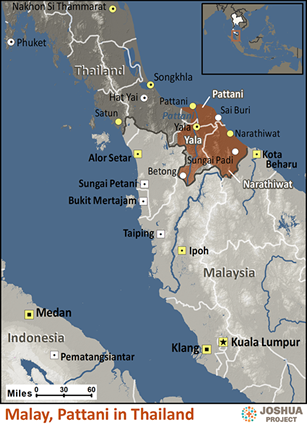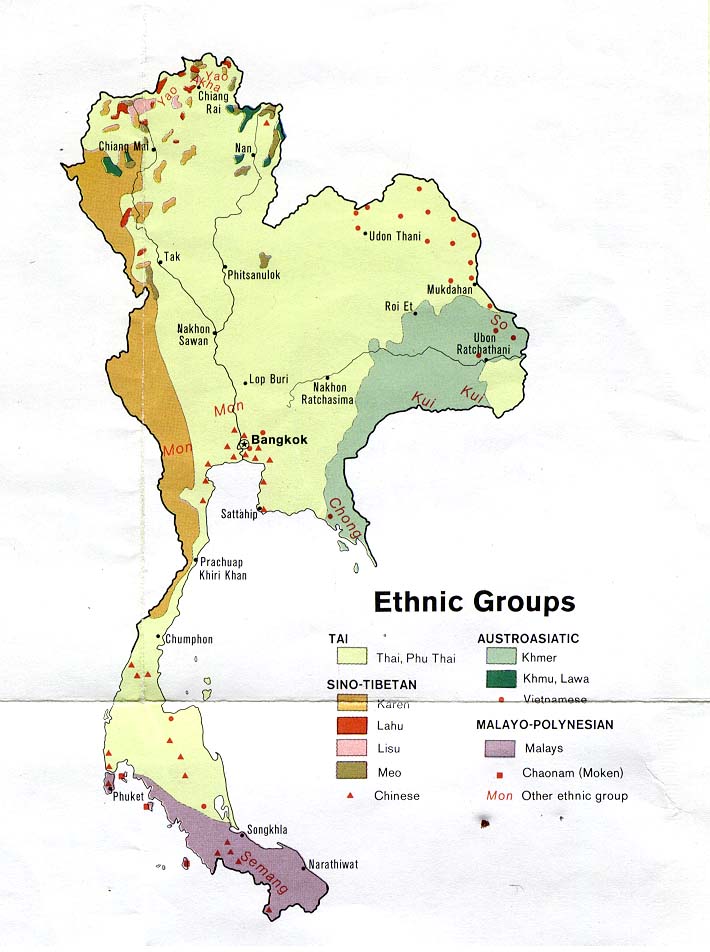

As descendants of Malaysian Muslims, the Pattani Malay have a distinct identity within predominantly Buddhist Thailand. They live primarily in the southern provinces, especially in Pattani, Yala, and Narathiwat, where their culture, language, and religion connect them closely with the Malay world to the south. Their Pattani Malay language reflects this heritage and serves as a key marker of identity in contrast to the Thai language used nationally.
Their history is shaped by their position at a cultural crossroads between Malay Muslim and Thai Buddhist societies. This distinction has contributed to long-standing tensions with the central Thai government and has, at times, led to separatist movements and conflict in the region. Despite these challenges, the Pattani Malay have maintained a strong sense of community, identity, and loyalty to their traditions.
Most Pattani Malays in Thailand are self-employed, with many working as farmers or fishermen. These occupations are closely tied to the natural environment of southern Thailand, where fertile land and coastal waters support rice farming, rubber cultivation, and fishing. Small-scale trade and local markets are also an important part of daily economic life.
Family and community relationships are central to Pattani Malay life. Households are often closely connected to extended family networks, and villages typically function as tight-knit communities where cooperation and mutual support are expected. Social life frequently revolves around the local mosque, which serves not only as a place of worship but also as a center for education and community gatherings.
Daily routines are shaped by religious practices, work responsibilities, and family obligations. Meals commonly include rice, fish, and locally available vegetables, reflecting both Malay culinary traditions and coastal influences. Men are often engaged in outdoor labor such as farming and fishing, while women play vital roles in managing the home, raising children, and sometimes contributing to family income through small businesses or agricultural work.
Leisure time is generally spent with family and neighbors. Community events, religious celebrations, and shared meals are important expressions of social life. Festivals connected to the Islamic calendar, such as Eid, are especially significant, bringing extended families together and reinforcing cultural identity.
The Pattani Malay are entirely Muslim, and Islam strongly shapes their worldview, values, and daily practices. They follow Islamic teachings that emphasize submission to God, obedience, and participation in religious duties such as prayer, fasting, and charity.
Islamic instruction influences both personal conduct and community expectations. From a young age, children are often taught religious principles, and many attend Islamic schools or receive instruction at local mosques.
Because of their religious background, many Pattani Malays have limited exposure to the message of Jesus Christ and may have misunderstandings about Christian beliefs. Islam's emphasis on works and obedience shapes their understanding of salvation, leaving little room in their thinking for the concept of grace through a Savior.
The Pattani Malay face both spiritual and practical needs. Ongoing social and political tensions in southern Thailand can create instability, insecurity, and limited opportunities for development. Access to quality education, healthcare, and economic advancement can be uneven, particularly in rural areas.
Spiritually, they have very little access to the gospel and few known followers of Christ within their community. Language and cultural barriers, along with religious resistance, make outreach difficult. However, the availability of Scripture portions and gospel media in the Pattani Malay language provides a foundation for future engagement.
There is a need for compassionate, culturally sensitive outreach that addresses both physical and spiritual concerns. Long-term relationships, community development, and respectful dialogue will be essential in sharing the hope of Jesus Christ in a meaningful way.
Pray that the Pattani Malay would be adopted through the People Group Adoption program, leading to sustained intercession and faithful gospel witness among them.
Pray that Christians would be equipped and sent to build relationships with the Pattani Malay, sharing the message of Jesus with wisdom, love, and perseverance.
Pray that a deep spiritual hunger would grow among the Pattani Malay, leading many to seek truth and encounter Jesus Christ, no matter the cost.
Pray for peace in southern Thailand and for improved access to education, healthcare, and economic stability for Pattani Malay communities.
Scripture Prayers for the Malay, Pattani in Thailand.
https://en.wikipedia.org/wiki/Pattani_Malay
https://www.ethnologue.com/language/mfa/
| Profile Source: Joshua Project |