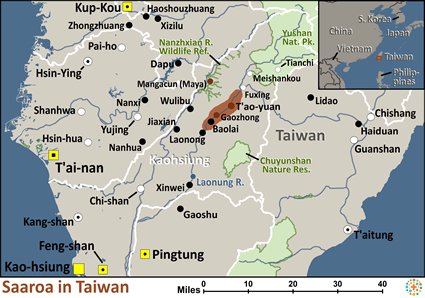

The Saaroa, also known as the Hla'alua people, are one of the indigenous Austronesian peoples of Taiwan. They live primarily in the mountainous regions of Kaohsiung in southern Taiwan, especially in the Taoyuan and Namasia districts along the Laonung River. The Saaroa language belongs to the Tsouic branch of the Austronesian language family and is closely related to the Kanakanabu and Tsou languages. Historically, the Saaroa were once grouped with the Tsou people but later received official recognition as a distinct indigenous people in Taiwan.
The Saaroa have experienced major cultural and linguistic pressures over the past century. Migration by the Bunun people into Saaroa territory during the twentieth century, combined with Mandarin-language education and movement into urban areas, caused severe language decline. Today the Saaroa language is critically endangered, with only a handful of fluent speakers remaining and almost no children speaking the language fluently.
Traditionally, the Saaroa lived in mountain communities where hunting, farming, and close clan relationships shaped daily life. Their oral traditions connect them to the ancient indigenous peoples of Taiwan's central mountains, and their culture preserves many elements of Taiwan's early Austronesian heritage.
Many Saaroa today live in small mountain villages or nearby urban areas in southern Taiwan. Traditional village life centered around agriculture, hunting, gathering forest resources, and community cooperation. Although modernization has changed much of daily life, family and clan relationships remain important within Saaroa society.
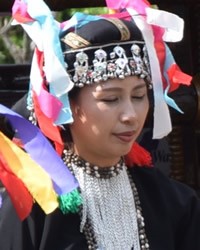
Traditional Saaroa culture includes weaving, leatherwork, hunting customs, oral storytelling, music, and ceremonial festivals. Men historically wore clothing made from deer or goat leather, while women created embroidered garments and feathered head coverings. Community festivals continue to play an important role in preserving ethnic identity and passing traditions to younger generations.
Food commonly includes rice, millet, vegetables, wild plants, pork, and foods typical of indigenous Taiwanese mountain communities. Seasonal cycles, festivals, and family gatherings continue to shape community life even as many younger Saaroa increasingly participate in mainstream Taiwanese culture.
One of the greatest challenges facing the Saaroa today is cultural and linguistic survival. Younger generations often speak Mandarin, Taiwanese Hokkien, or Bunun rather than the traditional Saaroa language. Many community leaders and educators are working to preserve remaining cultural knowledge through language classes, storytelling, and educational programs.
Traditionally, the Saaroa practiced animistic religion centered on ancestral spirits, nature spirits, sacred rituals, and ceremonies tied to agriculture, hunting, and community life. Like many indigenous Taiwanese peoples, their worldview included strong awareness of supernatural powers connected to mountains, rivers, ancestors, and the spirit world.
Over time, outside influences introduced elements of Chinese folk religion, Buddhism, and Christianity into Saaroa communities. Today some Saaroa identify as Christians, while others continue to practice a mixture of traditional beliefs and Taiwanese folk religion.
Among those who identify as Christian, there can still be a need for strong biblical discipleship and clear understanding of the gospel. Traditional spiritual fears, ancestral customs, and syncretistic practices may continue alongside Christian identity. Faithful teaching grounded in Scripture remains important for lasting spiritual growth.
The Saaroa need continued access to biblical discipleship, Scripture teaching, and spiritually mature believers who can help strengthen existing Christian influence within the community. Because the Saaroa are small in number and experiencing rapid cultural assimilation, there is urgency in preserving opportunities for gospel ministry among them.
Practical needs include language preservation, cultural support, educational opportunities, healthcare access, and encouragement for younger generations struggling with cultural identity loss. As traditional language use declines, there is also a need for Christian resources that communicate clearly in the languages younger Saaroa understand best.
There is a continuing need for believers who can serve humbly among the Saaroa while respecting their indigenous heritage and helping establish biblically grounded faith free from syncretism with traditional spiritual practices.
Pray that the Saaroa people will grow in a clear biblical understanding of the gospel and place their faith fully in Jesus Christ.
Pray that God will strengthen existing believers among the Saaroa so they can faithfully disciple younger generations and share the gospel with neighboring indigenous peoples.
Pray that the Saaroa people will be adopted through the People Group Adoption program so that ongoing prayer and future gospel engagement will continue among them.
Pray that God will preserve opportunities for Scripture teaching, language preservation, and faithful Christian ministry among the Saaroa as their traditional culture faces increasing pressure from modernization.
Scripture Prayers for the Saaroa in Taiwan.
https://en.wikipedia.org/wiki/Saaroa_people
https://en.wikipedia.org/wiki/Saaroa_language
https://www.researchgate.net/publication/276128727_Language_shift_of_Taiwan%27s_indigenous_peoples_a_case_study_of_Kanakanavu_and_Saaroa
https://thelanguagecloset.com/2021/12/04/languages-of-taiwan-saaroa-lhaalua/
https://languagelog.ldc.upenn.edu/nll/?p=53361
| Profile Source: Joshua Project |