




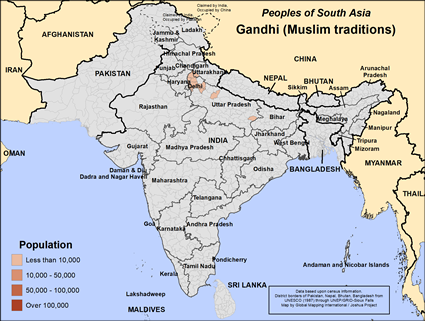
The Gandhi who follow Muslim traditions are a small community found in parts of India, particularly in western and northern regions where Muslim artisan and trading groups have historically lived. Their primary languages vary by location but commonly include Gujarati, Hindi, Urdu, and regional dialects. The community has traditionally been associated with small-scale trade, craft work, and labor connected to local village and town economies.
Over generations, the Muslim Gandhi developed a distinct identity shaped by both occupational heritage and Islamic faith. Like many smaller Muslim communities in India, their history reflects adaptation to changing economic conditions, migration into towns and cities, and interaction with surrounding Hindu and Muslim populations. Family heritage and community relationships remain important in preserving their identity and traditions.
Though information about the Muslim Gandhi community is limited, they are part of the broader social fabric of Indian Muslim society and continue to maintain customs connected to family honor, religious observance, and regional culture.
Many Muslim Gandhi families live in villages, market towns, or urban neighborhoods where they work in trade, transportation, small businesses, construction, craft work, or wage labor. Some families continue occupations connected to traditional artisan skills, while younger generations increasingly pursue education and employment in larger cities. Economic conditions vary, but many households face financial uncertainty and limited opportunities for advancement.
Family life is generally centered on close relationships among parents, children, grandparents, and extended relatives. Marriages are often arranged within the community, and social life commonly revolves around religious festivals, weddings, family gatherings, and local customs. Meals typically include rice, flatbreads, lentils, vegetables, meat dishes where affordable, and regional foods common to their area.
Religious and cultural traditions strongly influence daily life. Respect for elders, community reputation, and maintaining family ties remain important values. In both rural and urban settings, many Muslim Gandhi families work hard to balance traditional identity with the pressures of modern Indian society.
The Muslim Gandhi are primarily Sunni Muslims. They believe in Allah as the one true God and follow Islamic teachings based on the Quran and the traditions associated with Muhammad. Religious life commonly includes daily prayers, fasting during Ramadan, mosque attendance, charitable giving, and participation in Islamic celebrations such as Eid al-Fitr and Eid al-Adha.
In some communities, local customs and cultural traditions also influence religious practice. Folk beliefs regarding blessings, protection, spiritual healing, or family rituals may exist alongside formal Islamic observance. Religious identity is often closely connected to family heritage and community belonging.
Very few Muslim Gandhi have had meaningful exposure to the biblical gospel. Many know of Jesus only through Islamic teaching, where He is regarded as a prophet but not as the crucified and risen Son of God. Christian witness among them remains very limited in many areas.
The Muslim Gandhi people face both spiritual and practical needs. Economic instability, limited educational opportunities, healthcare challenges, and unemployment affect many families, especially in poorer rural and urban communities. Younger generations often face pressure from social change, migration, and competition for work in crowded economic settings.
Spiritually, many Muslim Gandhi have little access to clear biblical teaching or sustained Christian witness in their own cultural and linguistic setting. There is a need for mature believers who are willing to serve patiently, build genuine friendships, and communicate the gospel with wisdom, humility, and compassion.
Practical ministry through literacy programs, vocational support, education assistance, healthcare outreach, and family care can help demonstrate Christ's love while opening doors for long-term discipleship and gospel ministry. Churches in nearby regions also need encouragement and boldness to reach Muslim communities faithfully and biblically.
Pray that the Muslim Gandhi people would hear the gospel clearly and come to understand who Jesus Christ truly is according to Scripture.
Pray for Christian workers to serve among the Muslim Gandhi with humility, perseverance, wisdom, and genuine compassion.
Pray that the Muslim Gandhi people would be adopted through the People Group Adoption program so that ongoing prayer, outreach, discipleship, and future gospel engagement would continue among them.
Pray that believers in India would faithfully share the truth of Christ with Muslim communities and demonstrate His love through both word and action.
Scripture Prayers for the Gandhi (Muslim traditions) in India.
https://www.peoplegroups.org/explore/GroupDetails.aspx?peid=46324
https://www.britannica.com/topic/Islam
https://censusindia.gov.in
https://en.wikipedia.org/wiki/Islam_in_India
| Profile Source: Joshua Project |



