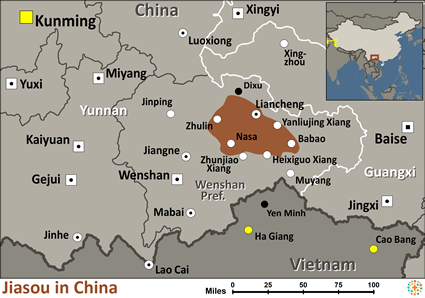

The Jiasou say they originated along the shores of Lake Dian in Kunming in ancient times. Many centuries ago, they migrated southward to the southeastern corner of Yunnan Province, where they experienced numerous clashes and battles with other ethnic groups. It seems probable that the Jiasou were once part of the same group as the Mengwu, but after centuries of separation, the group has evolved into two distinct ethnicities. Only in Guangnan County do members of both the Jiasou and Mengwu ethnic groups still live together.
Despite the fact that they speak their own language and possess a unique ethnic name and set of customs, the Jiasou were officially included under the Yi nationality by the Chinese authorities in the 1950s. Sir Reginald F. Johnston explained that it was futile to call all Yi people by one cover term: "I venture to express a doubt whether we should gain much by classing under one such designation a number of peoples who, whatever their origin, have been so long separated from one another that they refuse to acknowledge any mutual connection, and to some extent have different customs and speak different languages."
The Jiasou people of China live primarily in rural and mountainous regions, where daily life is closely tied to agriculture and the rhythms of the natural environment. Most families depend on small-scale farming, cultivating staple crops and raising livestock, and their routines are shaped by seasonal cycles of planting and harvest. Villages tend to be close-knit, with strong kinship ties and a high level of mutual dependence among households.
Recreation for the Jiasou is generally community-oriented and simple in form, reflecting both limited economic resources and strong social cohesion. In their free time, people often gather with neighbors and relatives to share meals, stories, and conversation. Traditional singing and dancing, especially during festivals or special occasions, provide an important outlet for enjoyment and cultural expression. Oral traditions, including storytelling and the passing down of local history, also play a role in leisure, particularly among older generations. Younger people may engage in more modern forms of entertainment when available, but community-based activities remain central to social life.
Marriage among the Jiasou is typically viewed as an important union not only between individuals but also between families. Marriages are often arranged or strongly influenced by parents, with attention given to family background, reputation, and compatibility. Courtship practices may be modest and guided by community expectations. Weddings are significant social events that involve the participation of the extended family and village community, often including shared meals, traditional customs, and celebratory gatherings.
After marriage, couples usually live near or with the husband's family, reinforcing extended family structures and obligations. Family loyalty and cooperation remain highly valued, and marriages are expected to contribute to the stability and continuity of both the household and the wider community.
In addition to ancestor worship, the Jiasou appease several protective spirits. Early on, they recognized their inability to withstand the Chinese who were continually encroaching on their land. The Jiasou sought the blessing of warring spirits who would attack their enemies. Some Jiasou say they once worshiped an all-powerful God of Heaven who was above all spirits, but they lost contact with him and have been harassed by demons ever since.
When a Jiasou person dies, a ceremony is held to send the soul back to the Jiasou's ancestral home. "The path of a Jiasou soul is thought to go first to Guangnan, then to Kaiyuan, and then to the Kunming lake-shores. This suggests the ancient path of migration taken by the Jiasou."
Few Christians reside in the Guangnan area, even among the Han Chinese majority. Catholic work in adjoining parts of Guangxi impacted the region in a general way prior to 1949, but little fruit from those endeavors remains today. Few outsiders have ever heard of the Jiasou.
Without the guidance of Christ, these people will be lost in this life and the life to come. They need someone to share the truth with them, so that the Jiasou in return become Christ-bearers themselves for others.
Pray for an unstoppable movement of Christ to transform the spiritual atmosphere so that the Jiasou can accept Jesus freely.
Pray for the spiritual blindness and bondage to the evil one to be removed so they can understand and respond to Christ.
Pray for the Lord to provide for their physical and spiritual needs as a testimony of his power and love.
Pray that the Jiasou people will have a spiritual hunger that will open their hearts to the King of kings.
Scripture Prayers for the Jiasou in China.
Operation China, Asia Harvest, Copyrighted © Used with permission.
| Profile Source: Joshua Project |