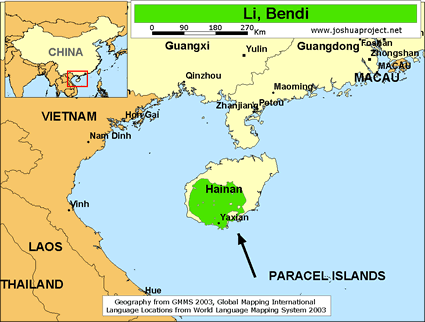

The Bendi Li are one of the distinct branches of the larger Li ethnic minority living on Hainan Island in southern China. The Li people are believed to have migrated to Hainan from mainland southern China thousands of years ago and are considered among the island's earliest inhabitants. The Bendi Li primarily live in the central region of Hainan, especially in and around Baisha County and the Yinggeling mountain area. Their language belongs to the Hlai branch of the Kra-Dai language family and differs noticeably from the speech of other Li groups.
Historically, the Li peoples developed separately from the Han Chinese majority because of Hainan's rugged mountains and forests. Different Li subgroups preserved their own dialects, customs, clothing styles, and local traditions. The Bendi Li traditionally lived in forested and mountainous environments where hunting, fishing, and small-scale agriculture shaped daily life. Over time, modernization, government integration policies, and economic development on Hainan Island have increasingly influenced their communities, though many traditional customs and cultural identities remain important.
Traditionally, the Bendi Li relied heavily on hunting, fishing, and subsistence farming for survival. In more recent generations, many families have also become involved in rice cultivation, tropical agriculture, rubber production, wage labor, and local trade. Hainan's tropical climate allows for the growing of crops such as rice, cassava, bananas, coconuts, sugarcane, and other tropical products.
Family and village relationships remain central to community life. Extended families often stay closely connected, and cooperation within villages is important for farming, celebrations, and daily survival. Traditional Li culture includes colorful woven textiles, music, dancing, oral storytelling, and ceremonial festivals tied to agricultural seasons and local customs. Some Li groups historically practiced tattooing traditions, especially among women, though these customs have become less common among younger generations.
Food commonly includes rice, root crops, vegetables, tropical fruits, fish, and locally raised livestock. In rural mountain areas, economic opportunities may still be limited, and some communities face challenges related to education, healthcare access, and stable employment. Younger generations increasingly migrate to towns and cities for work, which can weaken traditional language use and cultural continuity.
The Bendi Li traditionally practice animistic and polytheistic religion. They believe in numerous gods, spirits, and supernatural forces connected to nature, ancestors, and village life. Historically, many Li villages had shamans who acted as intermediaries between the community and the spirit world through rituals, sacrifices, and ceremonies intended to seek protection, healing, blessing, or guidance.
Fear of spirits and unseen powers continues to influence religious thinking among many Bendi Li. Traditional beliefs are often tied closely to agriculture, illness, family life, and local customs. Ancestor reverence and rituals connected to the natural world remain significant in many communities.
Although some Li people identify as Christian, many have had little exposure to clear biblical teaching. In some cases, Christianity may be mixed with older animistic beliefs rather than grounded in biblical discipleship. Faithful gospel teaching and mature discipleship remain greatly needed among the Bendi Li.
The Bendi Li need faithful access to the gospel through Scripture, discipleship, personal relationships, and long-term Christian witness presented in culturally understandable ways. Many communities still have little understanding of biblical Christianity and need to hear the gospel clearly explained in their own language and cultural setting.
Practical needs include healthcare access, educational opportunities, economic stability, and support for rural mountain communities facing modernization and social change. Language preservation is also an important issue as younger generations increasingly shift toward Mandarin Chinese and mainstream Chinese culture.
There is also a strong need for spiritually mature believers who can disciple local Christians, establish biblically grounded churches, and help prevent syncretism between Christianity and traditional animistic beliefs. Audio Scripture, oral teaching resources, and culturally appropriate discipleship materials would greatly strengthen future gospel ministry among the Bendi Li.
Pray that the Bendi Li people will hear a clear and understandable presentation of the gospel in their own language.
Pray that God will raise up compassionate Christian workers who are willing to serve faithfully among the Bendi Li communities of Hainan Island.
Pray that the Bendi Li people will be adopted through the People Group Adoption program so that ongoing prayer and future gospel engagement will continue among them.
Pray that believers among the Li peoples will grow strong in biblical faith and reject syncretism so they can faithfully share the truth of Jesus Christ with neighboring communities.
Scripture Prayers for the Li, Bendi in China.
https://factsanddetails.com/china/cat5/sub30/entry-4366.html
https://en.wikipedia.org/wiki/Hlai_people
https://english.scio.gov.cn/m/chinafacts/2017-06/07/content_40982901.htm
https://en.wikipedia.org/wiki/Baisha_Li_Autonomous_County
https://www.tribaltextiles.info/forum/Li_references.htm
| Profile Source: Joshua Project |