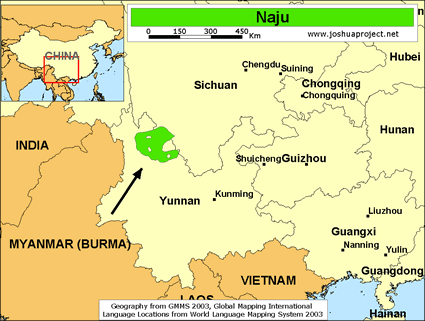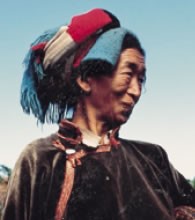

The Naju claim to have originated on the Tibetan Plateau. Between 800 and 1,000 years ago they migrated down from the plateau. Some stayed behind at Lugu Lake on today's Sichuan-Yunnan border where they gradually developed into the group now known as Mosuo. The majority continued farther south to Lijiang and became today's Naxi people. Sometime later, a group of the Mosuo left their homeland at Lugu Lake and they developed into the present-day Naju group. For several hundred years the Naxi and Mosuo had their own kings who dominated other ethnic groups and controlled commerce throughout the region.
Although they have been officially included under the Naxi nationality, the Naju have a different name, language, and history from the Naxi in Yunnan, and the Naheng and Mosuo in Sichuan. The Naju prefer to call themselves Naru, but their alternative name is used in Operation China to avoid confusion with the unrelated Naru of northern Yunnan.
The whole western and southwestern part of Sichuan Province was formerly known as Xikang. It was a lawless and violent province where few outsiders dared to enter. Much of the murder and strife was the result of opium trade which flourished until communist forces destroyed the poppy harvests in the early 1950s.
Today most Naju live in poverty, growing vegetables and herding livestock. They depend heavily on having the right amount of rain for their crops and for grazing land.
Men and boys may spend free time engaging in informal sports or physical games, which can include activities such as soccer or other locally popular pastimes. These games often take place in open fields or village spaces and provide an opportunity for social bonding as well as physical exercise. Older men may gather in small groups to talk, share stories, or play traditional board or card games, strengthening community ties.
Women and girls may devote portions of their leisure time to social visits with relatives and neighbors. These gatherings often involve conversation, food preparation, and the sharing of daily experiences. Handicrafts, sewing, or other domestic arts can also serve as both productive and recreational activities, especially among older generations.
Children typically create their own forms of entertainment, playing outdoors in small groups. Their activities may include running games, improvised toys, and participation in seasonal festivities that bring the whole community together.
Festivals and special occasions provide some of the most meaningful recreational experiences for the Naju. During these times, traditional music, dancing, and communal meals may take place, allowing the people to celebrate their heritage and strengthen their cultural identity.
Tibetan Buddhism is the predominant religious adherence among the Naju. They were originally polytheists but were converted to Buddhism by the Tibetans at least several centuries ago. Mixed in with their beliefs is a strong fear of powerful spiritual deities that they believe dwell inside mountains. As a result of these beliefs the Naju spend much of their time, energy and money on appeasing and placating the spirit world.
There is no record of missionary activity in Muli or Yanyuan counties prior to 1949. The geographic, linguistic and cultural isolation of the Naju creates barriers to Christian outreach among them in the future. Perhaps a few believers live among the Lisu in southern Sichuan, but there is no record of any Christian activity among the needy Naju.
The Naju people have few if any opportunities to experience the abundant life that comes from fellowship with the King of kings. Who will go to them?
Pray that the Naju people will be adopted through the People Group Adoption program so that they will have regular prayer and ultimately workers among them.
Pray that God will end their isolation; and that believers will attempt to reach them with the gospel.
Pray for bold workers who are driven by the love of the Holy Spirit to go to them.
Pray for an unstoppable movement to Christ among the Naju people.
Scripture Prayers for the Naju in China.
Operation China, Asia Harvest, Copyrighted © Used with permission.
| Profile Source: Joshua Project |