


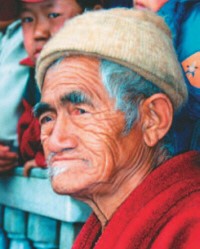

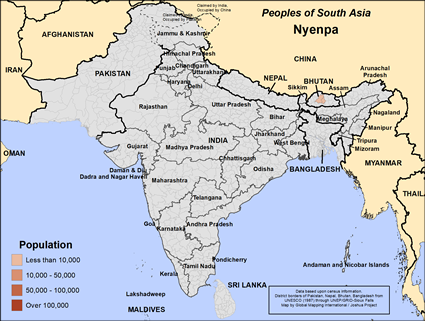
Nyenpa people live in central Bhutan. They inhabit the western half of the Trongsa District, as well as areas of south-east Wangdue Phodrang District. Linguist George van Driem has given a detailed description of where the Nyenpa language, called Nyenkha, is spoken: 'Nyenkha is spoken primarily on the eastern slopes of the Black Mountains overlooking the Mangdechu River. On the west bank of the Mangdechu, the language is spoken as far north as the village of Simphu and as far south as the village of Kala across the river from Zhamgang. Nyenkha is also spoken in several villages to the east of the Mangdechu between Trongsa and Zhamgang, including Taktse, Usa and Trashidingkha. Nyenkha is also spoken on the western slopes of the Black Mountains in the villages of Phobjikha, Rid 'ang and D 'angchu and in surrounding hamlets of Wangdue Phodrang District. '
The ethnic name of this group, Nyenpa, or 'people of Nyen ', is probably derived from the term Ngenlung, or 'ancient region '. This is the name the Tibetan sage Kunkhen Longchen Ramjam used to refer to west central Bhutan in the 14th century. The name of their language, Nyenkha, literally means 'ancient language '.
Most likely they herd livestock and grow grain like the other peoples around them.
The Nyenpa of Bhutan engage in recreational activities that are closely tied to their rural lifestyle, strong community relationships, and Tibetan Buddhist cultural traditions. Leisure time is often limited due to the demands of agriculture and pastoral work, but moments of rest are typically shared with others and centered on simple, meaningful pursuits.
Men may spend free time socializing with one another in village settings. They often gather to talk, exchange news, and strengthen social bonds. Informal games or light physical activities may take place in open spaces, particularly among younger men and boys, providing both enjoyment and a sense of fellowship.
Women commonly use their leisure time to visit neighbors or relatives. These visits are important for maintaining close-knit community ties and often include conversation, shared food, and mutual encouragement. Handicrafts such as weaving, sewing, or mending clothing may also serve as both practical work and a relaxing activity, especially during quieter periods of the day.
Children of the Nyenpa typically create their own forms of recreation. They play outdoors in small groups, using natural surroundings for games and exploration. Their activities often reflect imagination and cooperation, helping to build relationships from a young age.
Festivals and religious observances provide some of the most significant opportunities for recreation. During these events, the Nyenpa participate in traditional music, dancing, and communal gatherings. These occasions not only offer enjoyment but also reinforce cultural identity and spiritual devotion, as many celebrations are connected to the Buddhist calendar.
Tibetan Buddhism has had a spiritual stronghold on the area for more than 1,000 years. All the Nyenpa people are Tibetan Buddhists. This form of Buddhism is blended with the shamanistic bon religion.
The Nyenpa people have no chance to hear that only Jesus Christ saves us from sin.
Pray for a spiritual hunger that will lead the Nyenpa people to seek, find and embrace the King of kings.
Pray for loving and dedicated workers to go to them.
Pray for the Lord to open the door for gospel witness.
Pray for a movement to Christ among the Nyenpa people.
Pray that the Nyenpa people will be adopted through the People Group Adoption program so that they will have regular prayer and ultimately workers among them.
References
Scripture Prayers for the Nyenpa in Bhutan.
| Profile Source: Joshua Project |


