Garo (A-chik Mande) in India
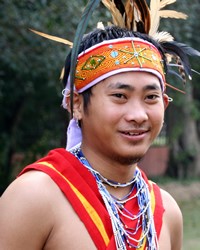
Photo Source:
Ramesh Lalwani - Flickr
Creative Commons
|
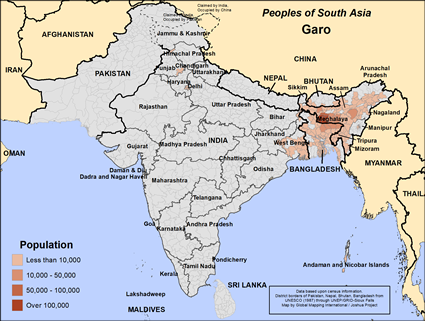
Map Source:
People Group data: Omid. Map geography: UNESCO / GMI. Map Design: Joshua Project.
|
| People Name: | Garo (A-chik Mande) |
| Country: | India |
| 10/40 Window: | Yes |
| Population: | 1,166,000 |
| World Population: | 1,265,000 |
| Primary Language: | Garo |
| Primary Religion: | Christianity |
| Christian Adherents: | 95.32 % |
| Evangelicals: | 0.00 % |
| Scripture: | Complete Bible |
| Ministry Resources: | Yes |
| Jesus Film: | Yes |
| Audio Recordings: | Yes |
| People Cluster: | South Asia Tribal - other |
| Affinity Bloc: | South Asian Peoples |
| Progress Level: |

|
Introduction / History
The Garo, also known as A-chik Mande, are a Tibeto-Burman ethnic group primarily residing in the northeastern Indian state of Meghalaya, with smaller populations in Assam, Tripura, Nagaland, and West Bengal. Their origins trace back to ancient migrations from Tibet, and they are recognized as one of the major indigenous tribes of Northeast India. The Garo have a rich oral tradition and a history marked by resilience, having maintained their distinct identity despite external influences and colonial encounters. Traditionally, they lived in hill settlements and practiced shifting cultivation, with their society organized around matrilineal clans. Over time, the Garo have adapted to modernity while preserving many of their unique customs and social structures.
What Are Their Lives Like?
The Garo people live mostly in rural villages, with community life centered around agriculture. They practice both shifting (jhum) and wet rice cultivation, growing rice, millet, and vegetables. Women play a central role in both family and economic life, as property and clan lineage are inherited through the female line. Villages are organized into exogamous clans, and social life is vibrant, featuring communal work, festivals, and traditional music and dance. The Garo diet is simple, based on rice, pork, beef, and local vegetables. Their homes are typically built on stilts, reflecting adaptation to the hilly terrain. While many Garos have moved to urban areas for education and employment, village life remains closely knit, with strong community participation and adherence to tribal codes.
What Are Their Beliefs?
Historically, the Garo practiced Songsarek, an indigenous animistic religion centered on the worship of spirits, nature deities, and ancestors. Rituals and sacrifices were performed to ensure harmony with nature and the well-being of the community. Since the late 19th century, Christianity has become the predominant faith among the Garo, largely due to missionary activity. Today, most Garos identify as Christians, and churches play a central role in community life. However, elements of traditional beliefs and rituals persist, especially in rural areas, and festivals such as Wangala (the harvest festival) continue to reflect their spiritual heritage.
What Are Their Needs?
The Garo community needs improved access to quality education, especially in rural areas, to empower the next generation and provide better employment opportunities. There is a need for sustainable development initiatives that support traditional agriculture while introducing modern techniques to increase productivity and income. Healthcare services are limited in many Garo villages, making access to medical care and health education a priority. The preservation of the Garo language, music, and cultural traditions is important as modernization and urban migration pose challenges to their cultural identity. Legal support and advocacy are needed to protect land rights and ensure that development projects respect the community's interests and environment. Efforts to address poverty, infrastructure, and social welfare are also essential for the holistic well-being of the Garo people.
Prayer Points
Pray for spiritual growth and unity among the Garo, that their faith in Christ would deepen and transform their communities.
Ask God to raise up strong leaders and educators who can guide the next generation with wisdom and integrity.
Pray for the preservation of the Garo language, even as they adapt to modern challenges.
Intercede for improved healthcare, education, and economic opportunities in Garo villages.
Pray for justice and protection regarding land rights and for peace in areas facing social or environmental pressures.